Climate change and the global threat to food security
 Climate change and the global threat to food security
Food security is one of the greatest pillars of global stability. It sustains human health, economic growth, social peace, and national security. Yet across the world, climate change is placing unprecedented pressure on the global food system, threatening the ability of millions of people to access safe, sufficient, and nutritious food.
Climate change is no longer a distant environmental issue discussed only in scientific forums. Its impacts are now visible in farms, rivers, oceans, forests, and markets across every continent. Rising temperatures, prolonged droughts, destructive floods, severe storms, melting glaciers, and rising sea levels are disrupting the delicate balance upon which global food production depends.
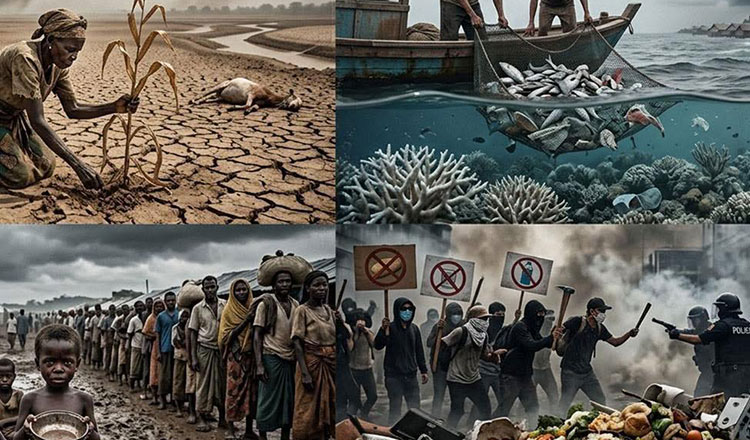
Agriculture has always relied on stable climate conditions. Farmers depend on predictable rainfall, fertile soil, and seasonal patterns developed over generations. Today, those patterns are rapidly changing. In Africa, droughts are devastating crop production and livestock systems. In Asia, stronger storms and floods damage rice fields and food infrastructure. In Europe and North America, heatwaves and water shortages increasingly reduce harvests. Across Latin America, changing weather patterns are affecting coffee, maize, and soybean production.
The result is a growing vulnerability in the global food supply chain.
Staple crops such as wheat, rice, maize, and soybeans are highly sensitive to climate stress. Excessive heat reduces crop yields and weakens plant development. Water shortages affect irrigation systems, while floods destroy farmland and erode fertile soil. Scientists warn that if global temperatures continue to rise, agricultural productivity in many regions could decline significantly within the coming decades.
The crisis extends beyond crops. Climate change is also threatening fisheries and marine food systems that billions of people rely upon. Rising ocean temperatures, coral bleaching, ocean acidification, and pollution are damaging marine ecosystems and reducing fish populations. Coastal communities, especially in developing countries and small island nations, face increasing risks to food supply and livelihoods.
Livestock production is similarly under pressure. Heat stress reduces animal productivity, increases disease outbreaks, and intensifies water scarcity. These impacts weaken food systems while increasing the cost of food production globally.
Food insecurity caused by climate change does not remain isolated within national borders. It affects global trade, migration, public health, and geopolitical stability. When harvests fail in major producing countries, food prices rise internationally. Poor and vulnerable populations suffer the most, particularly in regions already struggling with poverty, conflict, or limited access to resources.
The United Nations has repeatedly warned that climate change could reverse decades of progress in reducing hunger and malnutrition. Children are among the most vulnerable victims. Malnutrition, stunted growth, and food shortages threaten the physical and intellectual development of future generations.
Climate change also reveals the dangerous consequences of unsustainable development. Deforestation, pollution, overconsumption of fossil fuels, irresponsible industrialisation, and environmental degradation have intensified greenhouse gas emissions and weakened the ecosystems that support food production. Forests regulate rainfall.
Wetlands store water. Oceans regulate climate. Biodiversity supports pollination and soil fertility. When these systems are damaged, food security becomes increasingly fragile.
Yet the global challenge also presents an opportunity for collective action.
Countries around the world are beginning to invest in climate-smart agriculture, renewable energy, sustainable fisheries, water conservation, and ecosystem restoration. Technological innovation, scientific cooperation, and sustainable policies can strengthen resilience against climate impacts.
Reforestation, mangrove protection, clean energy transitions, and improved waste management all contribute to protecting food systems for future generations.
At the same time, solutions must remain equitable. Developing nations, which often contribute the least to global emissions, are frequently among the most vulnerable to climate-related food insecurity. International cooperation, climate financing, technology transfer, and shared responsibility are therefore essential to achieving global food security.
Food security cannot be separated from environmental protection. Humanity cannot continue exhausting forests, polluting rivers, degrading soils, and warming the planet while expecting food systems to remain stable. Nature is not merely a resource to exploit; it is the foundation upon which human survival depends.
The global fight against climate change is therefore also a fight for food, health, dignity, and peace. Protecting the climate means protecting farmers, protecting fisheries, protecting children from hunger, and protecting future generations from instability and suffering.
In the end, climate change is forcing humanity to confront a fundamental truth: the future of food security will depend not only on how much the world can produce, but on how responsibly the world chooses to live with nature.