Cambodia pivots to UNCLOS as Thailand jettisons 2001 MoU
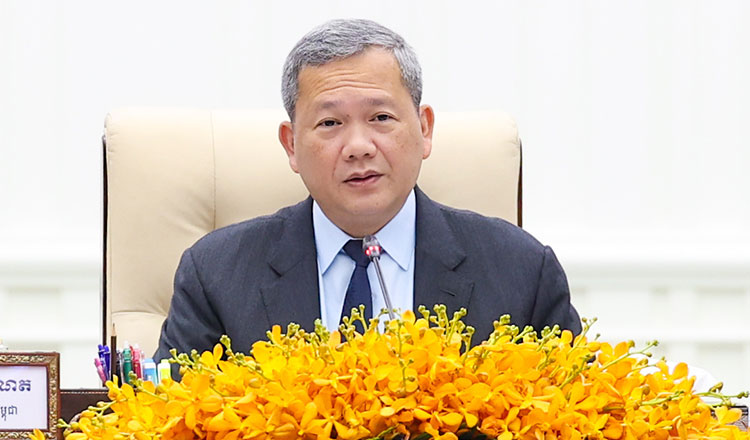 Prime Minister Hun Manet says it is ‘regrettable’ that Thailand has decided to unilaterally withdraw from the 2001 MoU. KT/Khem Sovannara
#National
Synopsis: Thailand’s exit from maritime agreement sends talks back to square one, analysts warn, as Phnom Penh is prompted to pursue compulsory conciliation under the United Nations Convention on the Law of the Sea to address overlapping claims.
Cambodia will pursue compulsory conciliation under the United Nations Convention on the Law of the Sea (UNCLOS) after Thailand unilaterally broke a 2001 bilateral agreement to find a resolution to overlapping maritime claims in the Gulf of Thailand.
Prime Minister Hun Manet said this yesterday after the Thai Cabinet, under Prime Minister Anutin Charnvirakul, approved the cancellation of MoU 44—as the agreement is known in Thailand—claiming the move will not affect border stability.
“For more than 25 years, this MoU has played a crucial role as a mutually agreed bilateral framework for both sides to address overlapping maritime claims. The entry into force of this MoU reflects the spirit of cooperation and mutual goodwill,” he said.
“It is regrettable that Thailand has decided to unilaterally withdraw from this MoU. Cambodia has always given priority to bilateral mechanisms in line with this MoU for dealing with our overlapping maritime claims. Thailand’s unilateral withdrawal would reject the only bilateral agreement, which constitutes the only bilateral framework that both parties have relied upon for more than two decades.”
He said Thailand has left Cambodia with no choice but to turn to UNCLOS, particularly the mechanism of compulsory conciliation, to resolve the overlapping claims.
“The compulsory conciliation mechanism was established by UNCLOS to assist state parties in resolving disputes peacefully in accordance with international law. Therefore, Cambodia’s decision reflects our sincere hope that both countries can reach a just and lasting solution in line with international law, allowing our peoples to live together in peace, stability, and harmony,” he said.
Analysts warned that Thailand’s termination of the 2001 MoU effectively set bilateral maritime negotiations back 25 years.
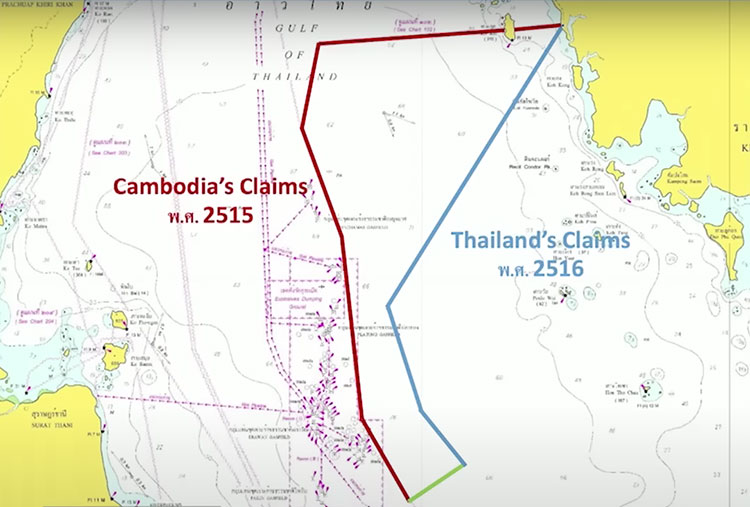
The 2001 MoU, known in Thailand as “MoU 44”, is a bilateral agreement between Cambodia and Thailand that served as a framework for negotiating maritime boundaries and the joint development of energy resources in the Gulf of Thailand. It was signed on 18 June 2001, to jointly manage and define a 26,000-square-kilometre overlapping claims area in the energy-rich gulf.
In a statement yesterday, Foreign Affairs and International Cooperation Minister Prak Sokhonn said Cambodia will pivot to compulsory conciliation under UNCLOS as a result of the Thai Cabinet’s decision. Sokhonn said the MoU had been “the only bilateral framework” for addressing overlapping maritime claims and advancing boundary delimitation through peaceful and legal means.
He described Thailand’s move as a departure from the spirit and political will that had enabled both countries to establish a cooperative mechanism to resolve the issue.
“Cambodia once again expresses its regret over this decision,” he said, adding that in response, “Cambodia has no option but to initiate the compulsory conciliation mechanism under the United Nations Convention on the Law of the Sea.”
Anutin yesterday defended his government’s decision to end the decades-old agreement, saying the move was not linked to any dispute with Cambodia but reflected a policy review of a framework that had existed for over 25 years without yielding results.
He told local media that both countries could now rely on international frameworks, including UNCLOS, to guide future discussions, noting that Thailand and Cambodia are both parties to the convention. He added that future talks would take place under a “new context”, with the 2001 MOU no longer serving as the basis.
Anutin said his government would formally notify Cambodia of the decision before it takes effect, adding that any future arrangement on sharing benefits from undersea resources would require fresh discussions and potentially a new agreement.
Regarding the ASEAN Summit tomorrow in the Philippines, he said he expects to meet Prime Minister Hun Manet on the sidelines for dialogue.
Cambodia ratified UNCLOS in January, more than four decades after it signed the treaty in 1983. The convention entered into force for the Kingdom on 8 March.
UNCLOS establishes a comprehensive legal framework governing maritime rights, boundaries, and dispute resolution. A key provision is compulsory conciliation, a mechanism designed to facilitate peaceful settlement when negotiations between states reach an impasse.
Under this process, an independent conciliation commission examines the dispute, hears submissions from both parties, and issues non-binding recommendations aimed at reaching a fair and equitable outcome in accordance with international law. While not legally binding, such recommendations carry diplomatic and legal weight and often influence subsequent negotiations or arbitration.
Yang Peou, Secretary-General of the Royal Academy of Cambodia, said the MoU had been increasingly drawn into Thailand’s domestic political dynamics, particularly since 2024, as a political tool to drive nationalist sentiment.
In late 2024, Thai nationalist and conservative groups began a campaign to revoke the MoU, alleging it compromised Thai sovereignty over Ko Kut Island and favoured Cambodian interests.
Peou said that in the absence of the MoU, international legal obligations would still compel both countries to engage in negotiations.
“For example, now that Thailand has cancelled the 2001 MoU, under UNCLOS, both parties are required to negotiate. Therefore, there is still a need for a bilateral negotiation mechanism, as already stated in the MoU,” he said.
Peou maintained that the current debate is largely political, as the fundamental requirement for bilateral engagement remains unchanged.
“I would say this is a political wave because it still requires the same bilateral mechanism, as required by UNCLOS. Each side has drawn its own continental shelf lines, and UNCLOS does not determine whether it belongs to Thailand or Cambodia,” he said.
Peou agreed that terminating the agreement would not eliminate the need for cooperation but would instead complicate and delay the process.
“Therefore, the 2001 MOU is absolutely necessary. If Thailand dares to terminate it, it means Thailand is trying to go back 25 years, meaning restarting this process. Cambodia cannot accept Thailand using its own continental shelf line unilaterally, and Thailand cannot do so either. Therefore, negotiations must take place under the UNCLOS framework,” he said.
Peou highlighted the MoU’s benefits, including no maritime disputes and a recognised dialogue platform over 25 years.
“First, since the 2001 MOU was signed 25 years ago, we have never had maritime disputes with each other. Second, it provides an opportunity for a bilateral negotiation table that we need, which is recognised by international law and UNCLOS. Third, it allows for joint studies on sharing mutual benefits, including gas and oil,” he said.
Beyond economic considerations, he said that the agreement plays a critical role in maintaining regional stability at a time of heightened maritime tensions elsewhere in Asia.
“The most important benefit is ensuring security and peace in the region, because we already know that issues in the South China Sea and the East China Sea are highly tense. If this issue is added, it would create further instability in the region,” he said.
The MOU established a framework to manage overlapping maritime claims by dividing the OCA into two tracks: Area I for delimitation (including Ko Kut) and Areas II–IV for joint development (JDA). It marked the first formal recognition of overlapping claims and a commitment to resolve them jointly.
However, the MOU had key weaknesses. Thailand insisted that both delimitation and joint development be treated as an “indivisible package”, which later became a major obstacle. The agreement also did not define revenue-sharing terms or a clear development model.
Following the MOU, negotiations intensified, with both sides proposing different joint development models. Cambodia supported a 50–50 revenue split, while Thailand favoured a model based on the relative strength of claims.
Analysts warned that ending the 2001 MOU could undermine trust, disrupt diplomatic progress, and heighten tensions, stressing that continued dialogue and adherence remain the responsible path forward.