Cambodia’s 27 Years in ASEAN: Celebration and Reflection
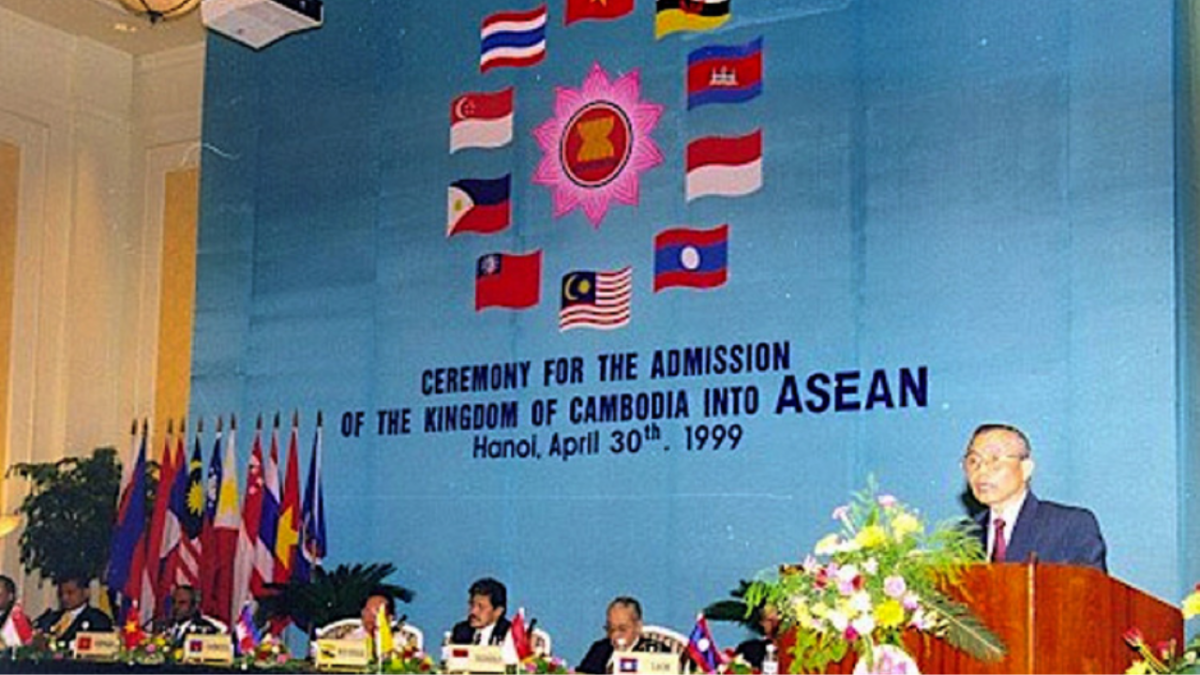 The April 30, 1999 ceremony which saw Cambodia became Asean’s 10th member. Supplied
#Opinion
As Cambodia approaches the 27th anniversary of its membership in the Association of Southeast Asian Nations (ASEAN) on April 30, the occasion invites both celebration and sober reflection. Joining on April 30, 1999, after years of post-conflict isolation, Cambodia stepped from the margins of regional affairs into the heart of Southeast Asia’s premier organisation.
What was once a fragile re-entry into the international community has become a cornerstone of the Kingdom’s stability, growth and global standing. Yet, as the region faces persistent crises, this milestone also prompts a candid conversation about ASEAN’s strengths, its shortcomings and the urgent need for a bolder, more self-reliant future.
The significance of Cambodia’s accession cannot be overstated. Emerging from decades of turmoil, genocide, civil war and international embargo, Cambodia saw ASEAN as a pathway to peace, dignity and development. Membership offered more than a seat at the table — it provided a framework for reconciliation with neighbours and integration into a rules-based regional order grounded in the principles of sovereignty, non-interference and mutual respect.
Economically, the dividends have been substantial. Access to the ASEAN Free Trade Area (AFTA), the ASEAN Economic Community (AEC), and later the Regional Comprehensive Economic Partnership (RCEP) helped transform Cambodia from one of the region’s poorest nations into one of its fastest-growing economies. Intra-ASEAN trade and investment surged, tourism from fellow member states multiplied, and Cambodian exports found larger markets. Infrastructure projects, connectivity initiatives and capacity-building programmes under ASEAN frameworks supported poverty reduction and human development.
Politically, ASEAN gave Cambodia a collective voice in global forums and helped anchor its foreign policy in the principle of regional centrality.
Cambodia has not been a passive member. It chaired ASEAN successfully in 2022, navigating complex global challenges including the aftermath of the Covid-19 pandemic and geopolitical tensions. The Kingdom has consistently advocated for unity, development gaps reduction (particularly for CLMV countries — Cambodia, Laos, Myanmar and Vietnam), and practical cooperation. Hosting business summits and contributing to regional initiatives, Cambodia has shown that even smaller members can play constructive roles.
Yet, after nearly three decades, it is clear that ASEAN’s journey remains incomplete. The organisation’s greatest strengths — consensus-based decision-making and the principle of non-interference — have also become notable weaknesses when decisive action is required.
The ongoing crisis in Myanmar stands as the most glaring example. Five years after the 2021 coup, the civil war continues with devastating humanitarian consequences. ASEAN’s Five-Point Consensus, once hailed as a breakthrough, has seen painfully slow implementation. The bloc’s reluctance to intervene more robustly has drawn criticism that it lacks the teeth to address threats to regional stability emanating from within.
Similarly, progress on the Code of Conduct in the South China Sea has dragged on for years despite repeated commitments. Overlapping claims involving several ASEAN members and a major external power continue to test the organisation’s ability to maintain unity and uphold international law. Occasional flare-ups in bilateral disputes, such as historical border tensions, further highlight how the “ASEAN Way” sometimes prioritises harmony over resolution.
Economic disparities persist. While Singapore and other original members operate at high-income levels, newer members like Cambodia still grapple with infrastructure gaps, skills shortages and vulnerability to external shocks. Decision-making can feel slow in an era of rapid geopolitical and technological change. Great-power rivalry between the US and China increasingly pulls at ASEAN’s fabric, challenging its much-cherished centrality. In some cases, member states have looked outside the region for support on issues that ASEAN might have been expected to handle internally.
These weaknesses matter because they erode confidence in ASEAN’s relevance. Citizens and businesses across the region increasingly ask whether the organisation can deliver not just dialogue, but tangible solutions to the problems that affect their daily lives and long-term security.
This is where hope must meet realism. The newly adopted ASEAN Community Vision 2045 — “Resilient, Innovative, Dynamic, and People-Centred ASEAN” — offers a promising roadmap. It recognises the need to address megatrends such as digital transformation, climate change, supply-chain resilience and demographic shifts while elevating connectivity as a fourth pillar alongside the political-security, economic and socio-cultural communities.
For ASEAN to fulfil this vision, it must become stronger and more capable of solving its own problems. This does not mean abandoning core principles of sovereignty and consensus, but rather evolving them.
Practical steps could include more effective implementation mechanisms, faster dispute-resolution processes, greater flexibility in addressing urgent crises and deeper institutional capacity. Reducing development gaps through targeted investment in CLMV countries would make integration more inclusive and sustainable. Strengthening intra-ASEAN trade and investment would build resilience against external protectionism and geopolitical risks.
Economically, the goal should be a truly single market and production base where prosperity is shared, not concentrated. Innovation, green growth, digital economy and skills development must become priorities so that young people across the region see ASEAN as a platform for opportunity rather than bureaucracy.
On peace and security, ASEAN should aim to be the primary venue for resolving regional differences. A stronger, more cohesive bloc would be better positioned to maintain centrality in the Indo-Pacific, engage major powers on equal footing and prevent external actors from exploiting divisions.
Cambodia, with its unique perspective as both a beneficiary of ASEAN solidarity and a witness to its limitations, has a valuable role to play. As a nation that has rebuilt itself through regional partnership, Cambodia can continue to champion practical cooperation, advocate for the interests of developing members and push quietly for mechanisms that make ASEAN more effective without undermining its foundational values.
Twenty-seven years is both a significant milestone and a relatively short chapter in the long story of Southeast Asian cooperation. The region has come far — from confrontation to dialogue, from isolation to integration. Yet the coming decades will test whether ASEAN can evolve from a respected diplomatic forum into a truly resilient community capable of delivering prosperity and peace on its own terms.
The hopes are clear: an ASEAN that is not only united in words but decisive in action; not only economically integrated but equitably prosperous; not only peaceful on paper but capable of resolving its challenges internally. Cambodia’s journey from the darkness of the late 20th century to a hopeful participant in a shared regional future stands as living proof that transformation is possible.
As we mark this anniversary, Cambodians and our ASEAN brothers and sisters should renew our commitment to building a stronger, more self-reliant ASEAN — one that truly serves the aspirations of its 700 million people for dignity, opportunity and lasting peace.
Dr. Seun Sam is a policy analyst at the Royal Academy of Cambodia. The views and opinions expressed are his own.
-Phnom Penh Post-