Hungary vote delivers blow to Trump-style politics but not its demise
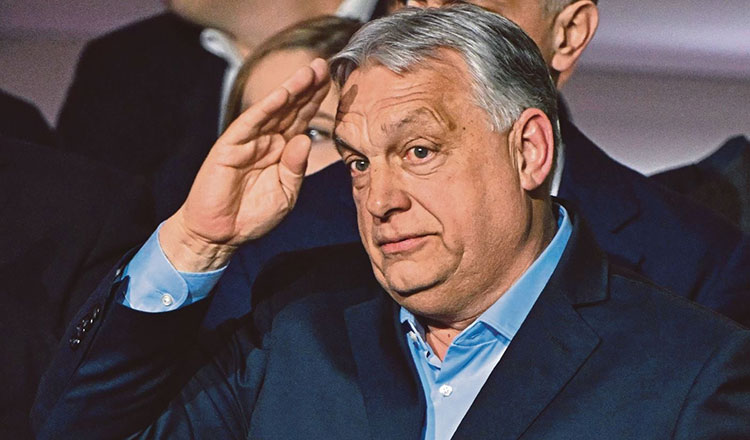 Viktor Orban, who served as Hungary’s prime minister for 16 years, has long been seen as a disruptive force within the European Union for blocking support for Ukraine. AFP
#opinion
Prime Minister Viktor Orban’s defeat in Hungary is a blow to global nationalists and signals the waning allure of the Trumpism movement in Europe, but the vote result should not be seen as a turning tide for right-wing populism.
For years, populist leaders had drawn inspiration from the self-styled “illiberal” politician who on Sunday lost to political newcomer Peter Magyar in a bitterly fought legislative election.
A thorn in the side of the European Union establishment, Orban ruled Hungary for 16 years and cultivated ties with United States President Donald Trump, Russian President Vladimir Putin and Marine Le Pen, leader of France’s far-right National Rally (RN) party.
US Vice-President JD Vance travelled to Budapest last week to campaign alongside Orban, but even his support was not enough to secure a victory for Washington’s Hungarian ally.
“The political space for MAGA to play on the continent is shrinking—and I suspect the RN in France and other far-right parties will now start actively distancing themselves from the Trump administration,” said Mujtaba Rahman, Europe director at risk analysis firm Eurasia Group.
Sebastien Maillard, of the Jacques Delors Institute in Paris, said the result raised new questions about whether closeness to Trump had become a political liability, after the US leader threatened to seize Greenland and impose tariffs against European allies who opposed the plan.
“Trump, from the start of his new term and with this tariff war, Greenland and other issues, has crossed every red line and is deeply unpopular across Europe,” said Maillard.
Many politicians and analysts said Orban’s defeat shows that no populist system, however entrenched, is permanent.
“This shows that the victory of nationalist populist right-wing parties is neither eternal nor inevitable,” said Nonna Mayer, a political scientist at France’s Sciences Po university.
Stijn van Kessel, professor of comparative politics at Queen Mary University in London, added: “The result does show that authoritarian governments can be defeated in elections, even if they tilt the playing field.”
Much of the French political establishment viewed Orban’s loss as an encouraging sign ahead of next year’s high-stakes presidential election, for which the far-right RN is polling strongly.
Le Pen—who has sought to align herself closely with Orban — berated “the European Commission’s sense of satisfaction” after EU chief Ursula von der Leyen celebrated Hungary having “chosen Europe”.
In Germany, Chancellor Friedrich Merz said Magyar’s victory was a “heavy defeat” for “right-wing populism”, while Polish Prime Minister Donald Tusk said the Hungarian prime minister’s defeat showed the world is “no longer condemned to authoritarian and corrupt governments”.
Analysts say Orban’s exit—long seen as a disruptive force within the EU for blocking support to Ukraine and opposing rule-of-law sanctions—gives Hungary an opportunity to demonstrate a renewed commitment to its EU and North Atlantic Treaty Organisation obligations.
But political observers caution against interpreting the result as a universal formula for defeating the populist radical right.
“To understand why Orban is voted out, we primarily need to consider domestic factors, not least the economy,” said van Kessel. “This election does not necessarily offer a blueprint for how to defeat the populist radical right elsewhere.”
Populist parties are no longer political outsiders in Europe and now govern or co-govern in countries including Italy and the Netherlands.
Far-right forces in France and Germany—where inflation and anxiety over migration rank among voters’ top concerns—are also gaining ground.
“One defeat for a populist radical right party or government does not denote a general turning point,” said Van Kessel.
While some analysts said Magyar’s victory could mark an end to Russian influence in Hungary, others argued that the EU country would still need Russian energy and would seek to maintain functional ties with the Kremlin.
“This outcome deprives Russia of what had been its most pragmatic ally within the European Union and one of the few European leaders consistently opposed to robust support for Ukraine,” analyst Tatyana Stanovaya wrote in a report for R.Politik, her political consultancy.
“At the diplomatic level, Moscow appears to be signalling to Magyar that pragmatic relations could be maintained, provided Hungary does not adopt overtly anti-Russian rhetoric or policies.”
-Khmer Times-