Peace Requires Principle: Cambodia Stands Ready—Will Thailand Honor Its Word?
 Peace Requires Principle: Cambodia Stands Ready—Will Thailand Honor Its Word?
#opinion
Since the ceasefire of December 2025, Cambodia has demonstrated consistency, restraint, and a clear commitment to peace. Under the leadership of Prime Minister Hun Manet, Cambodia has not only respected the cessation of hostilities but has also faithfully upheld the spirit and substance of the Joint Statement of the 3rd Special General Border Committee (GBC) signed on 27 December 2025. This is not merely diplomatic rhetoric—it is a matter of principle.
At the heart of that Joint Statement lies a critical commitment: that all arrangements agreed upon must not prejudice the internationally recognized boundary between Cambodia and Thailand, and that both sides must urgently resume survey and demarcation work through the Joint Boundary Commission (JBC). This is clearly articulated in Point 3—arguably the most consequential provision for ensuring long-term stability.
Cambodia has taken this commitment seriously. It has prepared, coordinated, and signaled readiness to move forward with technical demarcation work immediately. The objective is simple yet profound: to establish a clearly defined, mutually recognized border that eliminates ambiguity, reduces tensions, and secures lasting peace for communities on both sides.
But peace cannot be built on one side’s commitment alone. The real test now lies with Thailand.
Will Thailand match Cambodia’s sincerity? Or will it continue to delay, deflect, and reinterpret commitments in ways that undermine the very agreement it signed?
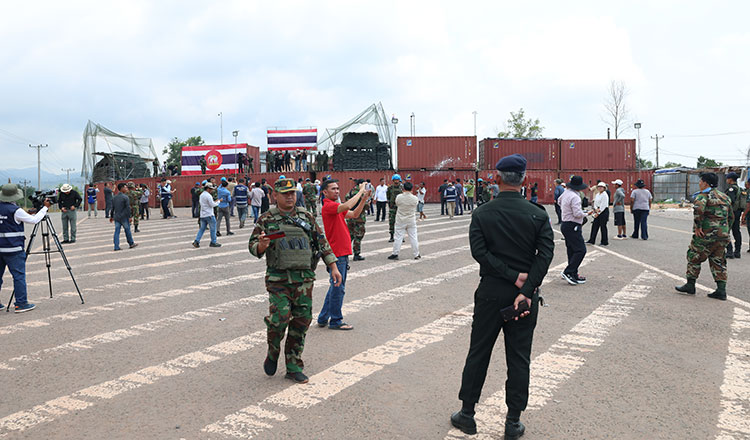
The urgency is undeniable. Border communities—ordinary civilians—remain the most vulnerable. For them, unclear boundaries are not abstract diplomatic issues; they are daily realities marked by insecurity, uncertainty, and risk. That is precisely why the Joint Statement prioritizes demarcation in affected areas where civilians reside. Delaying this process is not a neutral act—it prolongs instability and exposes innocent lives to unnecessary danger.
Moreover, adherence to Point 3 is not optional. It is a binding political commitment that reflects broader obligations under international law: respect for sovereignty, territorial integrity, and peaceful dispute resolution. Any attempt to bypass or dilute this commitment would raise serious questions about Thailand’s credibility and intentions.
Cambodia, by contrast, has nothing to hide and nothing to delay. Its position is transparent, consistent, and firmly rooted in law and bilateral agreements. It seeks no escalation—only clarity. No confrontation—only cooperation. No unilateral advantage—only mutual respect.
The pathway forward is already agreed upon. The mechanism exists. The technical framework is in place. What remains is political will.
Prime Minister Hun Manet’s message is therefore both measured and firm: Cambodia is ready—fully, immediately, and sincerely—to proceed with border demarcation in accordance with the Joint Statement. The responsibility now lies with Thailand to demonstrate that its commitments are not merely words on paper, but obligations to be honored in action.
Peace along the Cambodia–Thailand border is not beyond reach. But it requires one essential condition: that agreements are respected, not reinterpreted; implemented, not delayed.
Cambodia has upheld its part. It is now time for Thailand to do the same.
Roth Santepheap is a geopolitical analyst based in Phnom Penh. The views expressed are his own.
-Khmer Times-