Anti-online scam law a ‘tight legal net’ to punish and protect
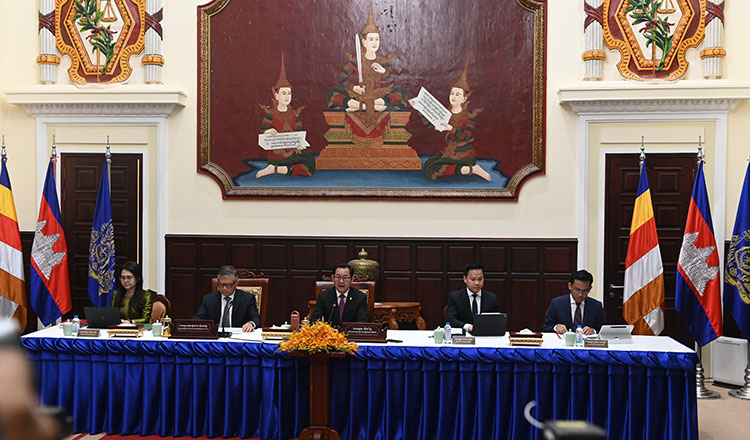 (L-R) Undersecretary of State at Ministry of Justice Song Chorvoin; Senior Minister Chhay Sinarith, Head of Secretariat of Commission for Combatting Online Scams; Justice Minister Koeut Rith; Secretary of State at Ministry of Justice Keng Somarith; and Undersecretary of State at Ministry of Justice Nann Chanroeurn, at a press conference in Phnom Penh on Friday. KT/Pann Rachana
#National
Synopsis: Justice Minister Minister Koeut Rith says newly approved draft legislation with fair and targeted enforcement will impose tough penalties on cyber fraud networks while safeguarding citizens and property owners.
The draft law to combat online scams will serve as a comprehensive and robust legal instrument to tackle the rapidly growing form of transnational crime while protecting citizens and property owners, Justice Minister Koeut Rith said on Friday.
The Senate approved the draft the same day. Speaking at a press conference after the session, Rith unveiled the draft law for the first time, calling it a critical step in strengthening Cambodia’s legal framework against technology-based fraud, which has increasingly threatened national security, public order, and the country’s global reputation.
The Law on Combatting Online Scams consists of five chapters and 24 articles. Under the proposed legislation, individuals convicted of online fraud offences face a prison sentence ranging from two to five years and a fine of 200 million riel ($50,000) to 500 million riel.
The law imposes significantly harsher penalties in aggravated circumstances. Crimes committed by organised groups or those involving multiple victims carry a prison term of five to 10 years and a fine of up to one billion riel.
The draft law also introduces detailed provisions targeting so-called “online scam centres”, which have been a major concern in Cambodia and across the region. Individuals found guilty of organising or managing such facilities, whether in a single location or as part of a network, will face imprisonment of five to 10 years and a substantial fine.
If these operations are interconnected across multiple locations and coordinated as part of a broader criminal system, the penalties increase to between 10 and 20 years in prison, along with a fine ranging from one billion to two billion riel.
In the most serious cases, where scam-related operations lead to the death of one or more victims, offenders face a prison sentence of 15 years to life.

Beyond targeting operators, the draft law also addresses the recruitment and training of individuals for online scam activities. Those found guilty of such a crime will face two to five years in prison and a fine of 200 million to 500 million riel. The penalties escalate to five to 10 years’ jail if the recruitment involves violence, torture, unlawful detention, or results in death—reflecting concerns about the coercive nature of some scam operations in the region.
A key concern addressed during the press conference was the impact of the law on property owners whose buildings or premises may be used by criminal groups without their knowledge.
Rith said existing laws and the draft do not contain a provision for automatic confiscation of property because it was rented out to scam operators. He said asset seizure would only occur if there were clear evidence that the property owner was complicit in the illegal activities.
This distinction, he said, is intended to protect “honest third parties” who unknowingly lease their properties to criminal actors, while ensuring that those who intentionally support such operations are held accountable.
“This law will not impact innocent people,” the minister reiterated, adding that the legal framework has been designed to balance strict enforcement with fairness and justice.
The Justice Minister said online scams have become a major global concern, citing data from Interpol and the Global Anti-Scam Alliance, which estimate that financial losses from cyber fraud worldwide reached about $442 billion in 2025 alone.
He noted that while traditional transnational crimes such as drug trafficking and human trafficking remain major concerns, online scams are rapidly emerging as one of the most significant and fast-growing threats globally.
Cambodia, he said, is among several countries in the region that have been exploited by criminal networks as bases for such operations, leading to serious consequences for national security, public safety, tourism, investment, and economic growth.
Rith pointed to real-world consequences of these crimes, including the recent murder of a South Korean in Kampot province. The case linked to online scam activities sparked fear among potential visitors and reportedly led to widespread cancellations of flights and hotel bookings by South Korean tourists.
Such cases, he said, underscore the urgency of strengthening legal and enforcement mechanisms to restore confidence among international visitors and investors.
“Online scam crimes have caused severe damage to Cambodia’s reputation, dignity, and image on the international stage,” Rith said.
He said Cambodia’s efforts to combat online scams are not new, noting that the government has been implementing measures since the sixth mandate of the National Assembly and continues to prioritise the issue in the current mandate.
He added that the introduction of the new law represents an evolution of these efforts, providing a more comprehensive and enforceable legal basis to dismantle scam networks and prevent their re-emergence.
Describing the draft law as a “tight legal net”, Rith said it will leave little room for offenders to operate while ensuring transparency and accountability in enforcement.
In addition to legal measures, the minister called on the public to play an active role in combatting online scams by reporting suspicious activities to authorities.
He said collective vigilance is essential to protecting not only individual victims but also the nation’s honour and standing in the global community.
“The fight against online scams is a top priority,” he said. “It must be carried out with the highest level of effectiveness and with the participation of all citizens.”
-Khmer Times-