Thailand’s Next Trick
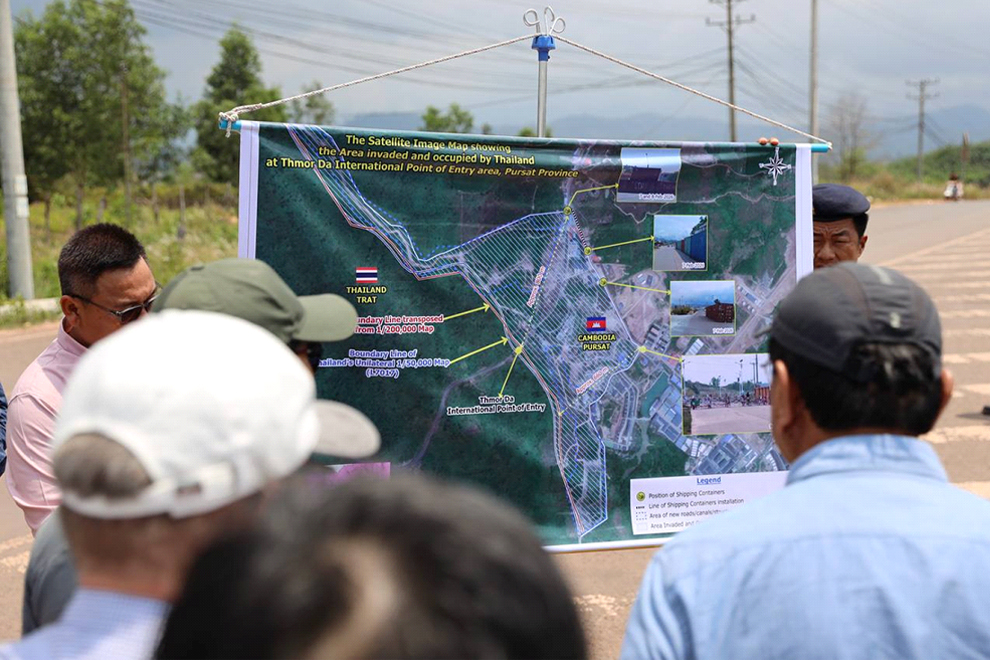 The foreign ministry staged a tour to some of the disputed border areas for a delegation of international diplomatic staff on March 27. Foreign ministry
#Opinion
Following the successful formation of its new government, Thailand appears increasingly unlikely to return the Cambodian territories it has illegally occupied in violation of international law and bilateral agreements. Rather than complying with calls for withdrawal and peaceful demarcation, Thailand may instead resort to manufacturing excuses or directing fresh accusations at Cambodia.
This tactic would serve as a convenient pretext for launching what could become a third wave of aggression, allowing Bangkok to pursue several strategic objectives simultaneously.
The potential motives behind such a calculated approach can be outlined as follows:
1. Establishing Long-term Occupation and Creating Irreversible ‘Facts on the Ground’
Thailand may choose to consolidate its control over the recently seized Cambodian territories by maintaining a sustained military presence and accelerating development activities. This could involve constructing roads, military outposts, barriers or other infrastructure projects deep within Cambodia’s sovereign land. By embedding physical structures and administrative measures, Thailand aims to transform the temporary occupation into a de facto reality — a classic strategy known as creating “facts on the ground”.
Such actions would complicate future negotiations or legal resolutions, making it far more difficult for Cambodia to reclaim the areas through diplomacy or international arbitration. Over time, this could shift the territorial status quo in Thailand’s favour, effectively altering the border through unilateral actions rather than mutual agreement.
2. Safeguarding Domestic Political Stability and Consolidating Power
Thailand’s newly elected government owes much of its electoral success to heightened nationalist sentiments, particularly those centred on the long-standing border dispute with Cambodia. The issue has been effectively leveraged to rally public support and portray the ruling coalition as strong defenders of Thai sovereignty.
If the new administration were to promptly return the occupied territories or adopt a conciliatory stance, it would risk triggering intense domestic backlash. This could manifest in large-scale protests, street demonstrations or even threats to governmental stability, including the possibility of a military coup or a dramatic drop in the ruling party’s popularity. By maintaining a firm, uncompromising position on the border issue, Thailand’s leadership can project strength, appease nationalist factions and preserve internal cohesion and public backing during a sensitive period of political transition.
3. Capitalising on a Distracted and Overburdened International Community
Thailand may perceive the current global landscape as highly favourable for bolder moves. With multiple major crises dominating headlines — ranging from conflicts in other regions to economic uncertainties and geopolitical rivalries — the international community’s attention and resources are stretched thin. In such an environment, any new escalation along the Cambodia-Thailand border might elicit only muted responses, delayed diplomatic interventions or superficial calls for restraint. Thailand could calculate that the world’s limited bandwidth would allow it greater freedom of action with minimal immediate consequences, reducing the deterrent effect of international law or pressure from major powers and regional organisations.
4. Aggressive Diplomacy and Coordinated Media Propaganda
Thailand has already demonstrated a proactive approach in the diplomatic arena and through its media ecosystem. By actively engaging international partners, shaping narratives in global outlets and portraying Cambodia as the aggressor or an unreliable neighbour, Thailand seeks to sway international opinion in its favour.
This propaganda effort aims to depict Thai actions as defensive or justified, while casting Cambodian responses in a negative light. With a more sympathetic or at least neutral international audience, Thailand believes it can more easily pursue policies that stretch or violate established international norms, facing reduced criticism, fewer sanctions or even tacit understanding from certain quarters.
Thailand may be preparing to implement a sophisticated dual strategy often described as “attacking while accusing” — deploying military force to strike or hold Cambodian positions while simultaneously amplifying accusations against Phnom Penh. This approach bears a striking resemblance to the classic ploy of “a child who eats the cake and then cries to others about it” where the perpetrator positions itself as the victim.
Historically, various nations have employed similar tactics to advance territorial ambitions. By combining military pressure with information warfare and victimhood narratives, they manage to achieve strategic gains while preserving a respectable image on the global stage — appearing as defenders rather than aggressors. This pattern underscores the complexity of the current border tensions and highlights the challenges Cambodia faces in seeking a fair and peaceful resolution.
Cambodia remains firmly committed to resolving any differences through peaceful dialogue, diplomatic negotiations, and mechanisms provided under international law and ASEAN’s own frameworks. Cambodia rejects the use of force or unilateral actions that undermine the sovereignty and territorial integrity of any nation.
Furthermore, as a regional community, ASEAN member states should strive to become stronger, more united, and mutually respectful.
True strength does not lie in aggression or the violation of borders, but in our collective ability to uphold the rule of law, foster good neighborliness and resolve disputes amicably in the spirit of ASEAN solidarity and the “ASEAN Way”. When all member countries demonstrate genuine respect for one another’s sovereignty and territorial integrity, the region as a whole will grow more stable, prosperous, and resilient.
In an increasingly complex world, it is essential that all nations — especially within ASEAN — reaffirm their commitment to the fundamental principles of international law and regional cooperation. Only through strict adherence to these shared values can we build lasting peace, prevent conflict and create a brighter future for all our peoples.
Cambodia stands ready to work constructively with all parties to uphold these principles and contribute positively to regional peace and stability.
Dr. Seun Sam is a policy analyst at the Royal Academy of Cambodia. The views and opinion expressed are his own.
-Phnom Penh Post-
———————