Wake Up the World: Greed and Mistrust Lead Only to War
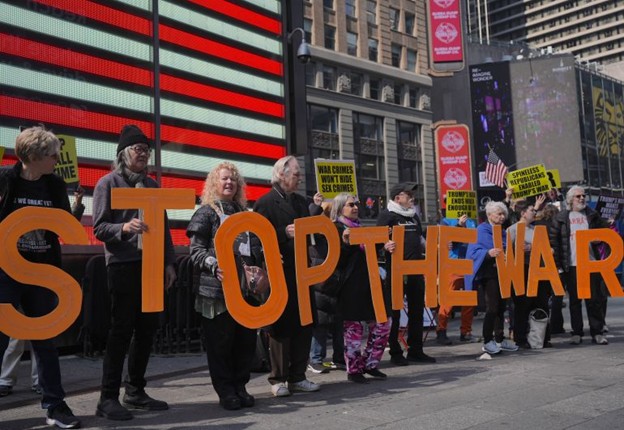 American citizens protest against the war on Iran in Times Square, New York, US [Selcuk Acar/Anadolu] Al Jazeera
#opinion
History repeatedly warns humanity about the consequences of greed, mistrust and unchecked ambition. Wars do not appear suddenly; they grow slowly from suspicion, fear and the desire for power or control. When trust disappears between nations, dialogue weakens and hostility begins to take its place. Countries divide themselves into opposing blocs, each convinced that the other is a threat. Eventually, if wisdom does not prevail, these tensions escalate into conflict and war.
Today the world stands at a dangerous crossroads. Several ongoing crises demonstrate how mistrust and geopolitical rivalry can destabilise entire regions. The war between Russia and Ukraine has already caused enormous human suffering and destruction. Beyond the battlefield, it has disrupted global food supplies, energy markets and international stability. The longer this conflict continues, the greater the risk that divisions between global powers will deepen.
In the Middle East, decades of tension, political rivalry and historical grievances continue to produce cycles of violence. Despite numerous peace initiatives, mistrust between different parties often undermines lasting solutions. The suffering of civilians in this region serves as a painful reminder that unresolved disputes and hardened attitudes can perpetuate instability for generations.
At the same time, tensions in the South China Sea illustrate another dangerous flashpoint. Competing territorial claims and strategic interests among several countries have increased military activity and diplomatic friction. This vital maritime region is not only important for regional security but also for global trade. If miscalculation or confrontation occurs, the consequences could extend far beyond the region itself.
These situations should serve as a wake-up call to the international community. The world cannot afford to repeat the tragedies of the past century. Modern warfare has become far more destructive than ever before, and another major conflict could bring catastrophic consequences for humanity.
Yet the path toward peace is not impossible. Humanity has long been guided by moral and spiritual teachings that encourage compassion, restraint and mutual respect. The teachings of Gautama Buddha remind us that greed, hatred and ignorance are the root causes of suffering. When these forces dominate the hearts of individuals or the policies of nations, conflict becomes almost inevitable.
Many other traditions across cultures and civilizations promote similar values — respect for human dignity, tolerance and peaceful coexistence. These principles are not merely spiritual ideals; they are practical foundations for a stable and cooperative international order.
The global community, including institutions such as the UN, must strengthen dialogue, diplomacy and international law to prevent disputes from escalating into violence. Leaders must place the welfare of humanity above narrow political interests. Military strength alone cannot guarantee security; true security comes from trust, cooperation and responsible leadership.
This is a moment for reflection and responsibility. The lessons of history are clear: greed divides nations, mistrust fuels conflict and war destroys lives and civilizations. The world must awaken to these dangers before it is too late.
Humanity shares one planet and one future. If nations choose wisdom over rivalry, compassion over hatred, and cooperation over greed, the world can still avoid the road to war. The choice before us is simple but profound: continue down the path of division and destruction, or unite in the pursuit of peace for the sake of future generations.
Tesh Chanthorn is a Cambodian citizen who longs for peace. The views and opinions expressed are his own.
-Phnom Penh Post-
———————