The Peace Premium: Cambodia’s Diplomatic Masterclass at the Thai Border
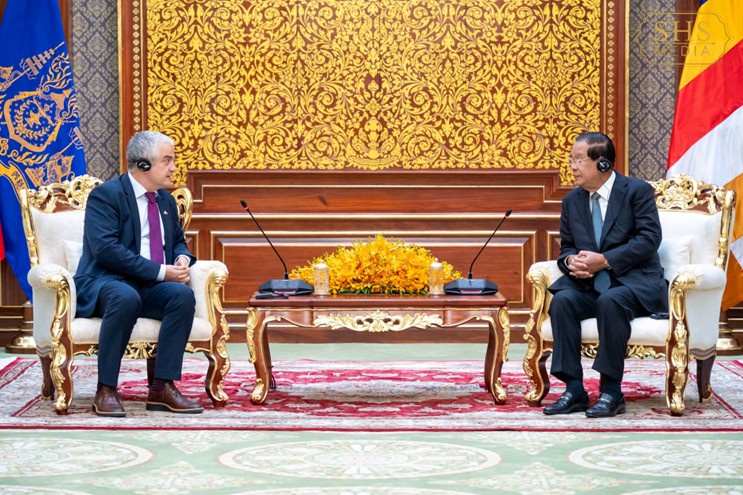 Danish ambassador Danny Annan (left) sat down with acting head of state Hun Sen on March 16. SHS
#opinion
In the theatre of international relations, profound shifts in regional power are rarely announced with artillery fire; they are often quietly signalled in the polished corridors of diplomatic meetings. When Danish ambassador Danny Annan sat down with acting head of state Hun Sen on March 16 to offer a ringing endorsement of Cambodia’s border diplomacy, the loudest echoes weren’t heard in Phnom Penh, but in Bangkok.
On its face, the meeting was a straightforward diplomatic win: Europe explicitly praised Phnom Penh’s adherence to the December 2025 ceasefire with Thailand. However, viewing this exchange purely as a standard bureaucratic pleasantry misses a much sharper reality. Cambodia is effectively weaponising the rhetoric of peace. In doing so, it has transformed a localised border dispute into a deeply uncomfortable domestic wedge issue for the Thai government, while simultaneously courting Western capital.
Asymmetric Diplomacy and the Weaponisation of Restraint
There is a distinct, critical difference between passive peace and aggressive diplomacy. Let us be clear: for Phnom Penh, this is not an exercise in altruistic peacebuilding. It is a cold, calculated necessity. Securing Western capital and driving domestic economic growth require the projection of a frictionless border.
By loudly positioning itself as the uncompromising defender of the December 27 ceasefire, Cambodia has successfully cornered the international narrative. This is a masterclass in asymmetric diplomacy. Cambodia has realized that the most efficient way to neutralise a larger neighbour’s hard power is to smother it in soft power.
Ambassador Annan’s praise — and his subsequent promises to expand economic cooperation and investment ahead of the 2027 bilateral anniversary — validates this strategy.
Bangkok isn’t losing a border war; it’s losing the narrative. In the court of global diplomacy, Cambodia has figured out that whoever dictates the peace, dictates the terms.
What does this mean for Thailand? It paints Bangkok into a geopolitical corner. By officially being recognised by Western democracies as the “rational actor” seeking peaceful dialogue, Cambodia ensures that any military or political friction at the border inherently casts Thailand as the aggressor. Phnom Penh is actively securing a stability premium from European investors, leaving a paralysed Bangkok to manage the fallout.
Diplomacy as a Weapon, Not a Concession
For both domestic and international observers, a vital distinction must be drawn: choosing diplomacy is a strategic weapon, not a surrender of sovereignty. In geopolitics, a ceasefire can easily be misread by critics as passively accepting the status quo or conceding contested ground.
Let observers in both Phnom Penh and Bangkok be absolutely clear: Cambodia has not given up a single inch of land, and not a single inch will ever be conceded to Thailand.
By adhering strictly to the December 2025 agreement, Phnom Penh has brilliantly decoupled the defence of its borders from the trap of military escalation. Hardline nationalist factions in Thailand might mistakenly hope that a prolonged ceasefire silently solidifies a disputed status quo in their favour. They are miscalculating. Cambodia is playing a much longer, more sophisticated game of diplomatic entrenchment.
By securing European backing and international legitimacy, Cambodia is building the exact geopolitical and economic leverage necessary to fortify its territorial integrity indefinitely. Sovereignty is non-negotiable; diplomacy is merely the shield guarding the sword of Cambodia’s territorial rights. It is holding the line and securing the high ground without firing a single shot.
Europe’s Pivot and the Thai Nationalist Trap
Why does Denmark — acting as a proxy for broader European Union interests — care about a border skirmish in the Mekong region? Global capital is notoriously cowardly; it flees from conflict. As European supply chains fracture under the weight of global instability, Western nations are desperately seeking stable, emerging markets for trade diversification. Denmark’s explicit shift in the conversation from the ceasefire to “economic cooperation, trade and investment” reveals the transactional nature of this endorsement. Europe is rewarding Cambodia for maintaining the regional stability that Western capital requires.
This dynamic short-circuits the traditional Thai political playbook. For Thailand, the Cambodian border has never been merely a line on a map; it is a perennial flashpoint for domestic nationalist fervour. Historically, competing Thai political factions have routinely utilised border tensions to rally domestic support, distract from internal economic woes or undermine rival coalitions.
Cambodia’s pre-emptive Western backing makes it incredibly costly for any Thai political faction to agitate at the border. If the ruling government in Bangkok pushes back against Cambodia, they risk international censure and the alienation of the very European trade partners they also desperately need. Conversely, if the Thai government remains quiet, domestic opposition groups and hardliners will inevitably accuse the leadership of weakness, arguing that the government is allowing Phnom Penh to dictate the terms of sovereignty.
Cambodia has effectively outsourced the defence of its border to the court of international public opinion, turning a bilateral dispute into a litmus test for Thai political stability.
A Fragile Peace Built on Leverage
Ultimately, international observers must remain clear-eyed about the long-term viability of this dynamic. The ceasefire is holding not because the underlying territorial and political grievances have evaporated, but because Cambodia has ensured that the geopolitical cost for Thailand to break it is currently too high.
Denmark’s eagerness to tap into Cambodia’s “significant untapped potential” proves that this strategy is yielding tangible economic dividends. Phnom Penh has played a brilliant tactical hand, using European praise to checkmate Bangkok while maintaining an iron grip on its land claims.
However, Phnom Penh must not confuse a temporary tactical victory with a permanent resolution. Relying on the applause of distant European capitals to manage a deeply entrenched border dispute is a high-wire act. Cambodia has undeniably won the narrative this week, but it must guard against the hubris of overplaying its diplomatic hand. A Thai political establishment buckling under its own domestic pressures remains an inherently unpredictable and dangerous neighbour.
Panhavuth Long is founder and attorney-at-law at Pan & Associates Law Firm. The views and opinions expressed are his own.
-Phnom Penh Post-
———————