Cambodia is Grateful to France for Sovereignty Protection
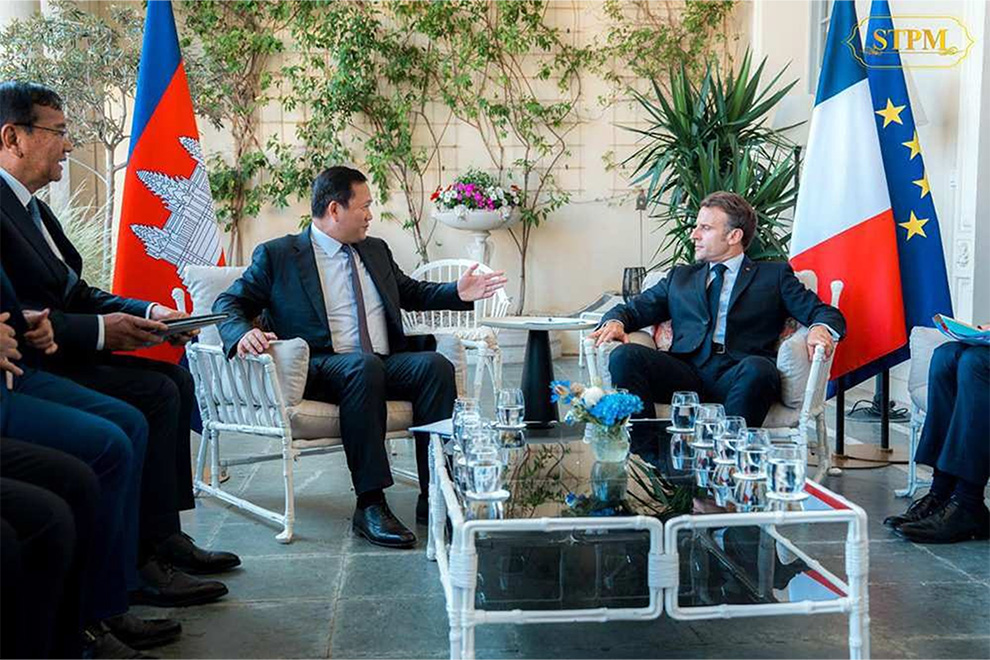 Prime Minister Hun Manet meets with French President Emmanuel Macron in Nice, France, in June 2025. STPM
#opinion
The enduring Franco-Cambodian partnership, rooted in the 19th-century protectorate era, represents a pivotal chapter in Cambodia’s preservation of sovereignty and territorial integrity.
In 1863, facing mounting existential pressures from neighbouring powers — particularly Siam (present-day Thailand) to the west and Vietnam (Annam) to the east — King Norodom formally requested French protection. This appeal was not a sign of submission but a calculated diplomatic strategy to safeguard the kingdom’s independence and cultural heritage amid regional rivalries. The Treaty of Protectorate, signed on August 11, 1863, established French oversight while preserving the Cambodian monarchy and internal administration. Unlike colonial conquests elsewhere, this arrangement emphasised guardianship, allowing Cambodia to maintain its distinct identity under French diplomatic and military support.
France’s role extended beyond mere protection to the systematic demarcation and defense of Cambodia’s borders. Through a series of bilateral agreements with Siam, France helped delineate frontiers that balanced historical claims, geographical features, and equitable exchanges. The Franco-Siamese Treaty of February 13, 1904, set key principles, including the use of watershed lines along the Dangrek Mountains for segments of the border. This treaty aimed to resolve interpretive disputes from earlier accords, such as the 1893 convention, by establishing mixed commissions for precise surveying.
The subsequent Franco-Siamese Treaty of March 23, 1907, signed in Bangkok by French Minister Victor Collin de Plancy and Siamese Foreign Minister Prince Devawongse Varoprakar, represented the culmination of these efforts. Its preamble expressed the mutual desire “to assure the final regulation of all questions relating to the common frontiers of Indo-China and Siam”.
The agreement also phased out French extraterritoriality over Asian subjects in Siam, extended certain rights to French nationals and mandated mixed delimitation commissions to conduct final surveys. These commissions produced high-quality cartographic records, including 1:200,000-scale maps, which became foundational references in international law.
The 1907 treaty’s significance lies in its reunification of culturally vital Khmer lands with Cambodia under French oversight, preserving sites like Angkor Wat — a UNESCO World Heritage treasure today. It addressed lingering ambiguities from prior treaties and reflected the geopolitical context of the Entente Cordiale between France and Britain, which stabilised colonial boundaries in Southeast Asia.
A landmark affirmation of this legacy came in the International Court of Justice (ICJ) proceedings on the Temple of Preah Vihear (Cambodia v. Thailand). In its 1962 judgment, the ICJ awarded sovereignty over the temple to Cambodia, relying heavily on the 1907 maps and Franco-Siamese agreements.
The Court highlighted Thailand’s long-term acquiescence to these delimitations, noting decades of non-contestation. The 2013 interpretation further clarified the ruling, emphasising Cambodia’s consistent adherence to international legal processes. These decisions underscore how colonial-era demarcations, grounded in mutual agreement and objective surveying, provide enduring legal clarity.
Cambodia has steadfastly upheld these principles, pursuing resolutions through multilateral institutions like the UN, bilateral dialogue and adherence to the UN Charter and customary international law. In contrast, elements of Thailand’s border policy have involved challenges to established precedents, including periodic rejections of ICJ determinations and unilateral assertions diverging from treaty-based boundaries. Such approaches risk eroding the stability that the 1904 and 1907 agreements sought to establish, particularly in contested areas like Preah Vihear and adjacent zones.
Cambodia respects and follows international laws and international treaties as well as agreements. Thailand should be courageous enough to use laws and diplomacy to solve the remaining problems with Cambodia and other neighbouring countries.
Recent developments highlight the ongoing relevance of France’s historical contributions. The Cambodia-Thailand border dispute escalated dramatically in 2025, beginning with a fatal skirmish in late May that killed a Cambodian soldier.
Tensions mounted through military buildups, landmine incidents and clashes, culminating in armed confrontations on July 24, 2025, followed by a brief ceasefire on July 28 mediated in Putrajaya, Malaysia, with involvement from ASEAN, the US and China.
Hostilities resumed in December 2025, including Thai airstrikes on December 8 targeting Cambodian facilities, leading to further casualties, the displacement of over 500,000 people, and economic disruptions from closed border crossings affecting billions in trade and remittances. A second ceasefire on December 27, 2025, aimed at de-escalation, but the situation remains fragile into 2026.
Amid this volatility, Cambodian Prime Minister Hun Manet formally requested assistance from French President Emmanuel Macron in early February 2026.
In a February 4 letter, Manet sought technical expertise, advisory support and access to protectorate-era historical maps, treaties and demarcation documents. This appeal followed France’s prior indications of readiness to assist, reflecting a shared commitment to law-based solutions. France’s archival holdings — rooted in its expertise in colonial cartography and international boundary law — could enable precise frontier verification, potentially clarifying ambiguities and de-escalating tensions.
Granting this assistance would honour the original protective mandate of 1863, when France responded to King Norodom’s plea to preserve Cambodian sovereignty. It would advance contemporary peace efforts by reinforcing a rules-based order in Southeast Asia, promoting regional cooperation and preventing force from overriding legal precedents.
The Franco-Cambodian relationship exemplifies how historical alliances can inform modern diplomacy. By facilitating access to these invaluable documents, France can reaffirm its legacy as a guardian of sovereignty and contribute to lasting stability. Cambodia remains profoundly appreciative of this enduring partnership — one that ensured its survival in the 19th century and offers tools for resolution today — and looks forward to collaborative steps toward mutual security, prosperity and peaceful coexistence.
Dr. Seun Sam is a policy analyst at the Royal Academy of Cambodia. The views and opinions expressed are his own.
-Phnom Penh Post-
———————