Thai assaults leave border regions littered with explosives
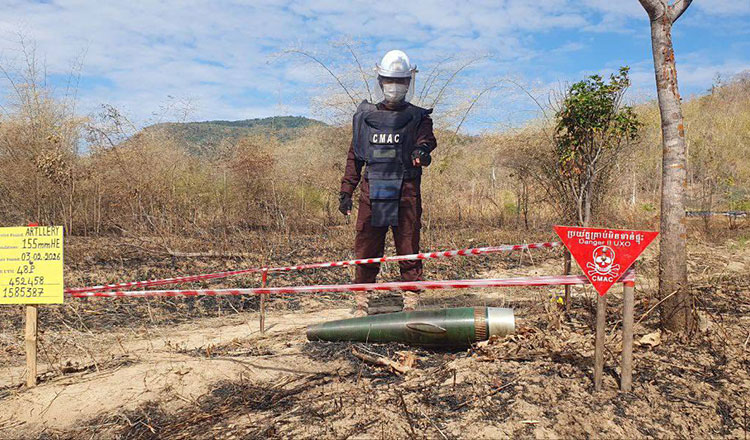 CMAC experts clear unexploded ordnance at a school near the Cambodia-Thailand border, on February 5. CMAC
Synopsis: Cambodia Mine Action Centre warns that roughly 441,000 hectares of land are contaminated with unexploded ordnance following armed clashes.
Recent border clashes between Cambodia and Thailand have left about 400,000 hectares of Cambodian territory contaminated with deadly unexploded ordnance (UXO), the Cambodia Mine Action Centre (CMAC) has warned.
In an interview with Khmer Times, CMAC Director-General Heng Ratana detailed the devastating impact of the conflict, noting that about 340 villages and 91,400 families have been affected by landmines, aerial-dropped munitions, cluster submunitions, and chemical devices.
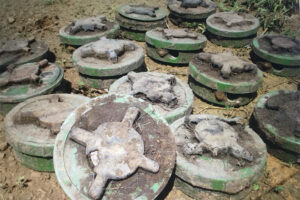
“We are currently surveying the affected areas, and preliminary estimates suggest that 441,000 hectares are at risk,” Ratana said. He added that the majority of the discovered explosives are cluster munitions fired by Thai forces, along with 105mm and 155mm artillery shells and several drone-dropped ordnances.
CMAC’s clearance operations are divided into two main phases. The first focuses on high-risk areas, including villages, schools, and hospitals, where the safety of residents—especially children—is the highest priority. The second phase focuses on farmland, roads, bridges, and other vital infrastructure.
“Ensuring the safety of children in schools affected by these explosives is a source of pride for our deminers,” Ratana said. “It is also a right of children, as stated in international conventions.”
In Banteay Meanchey province, Brigadier General Neth Ratha, Commander of Mine Action Unit 1, said the scale of the threat, noting that about 35,000 hectares across multiple operational zones have been affected. This includes residential areas and public spaces.
From late December to early January, CMAC teams uncovered 2,500 hazardous sites, including 133 cluster submunitions on the surface and 139 buried explosives, some nearly two metres deep.
While some munitions can be safely removed, others must be destroyed on site under controlled conditions, Ratha said.
Despite round-the-clock clearance efforts, the danger remains high. In January, three people were injured when a cluster munition exploded in Banteay Ampil district, Oddar Meanchey province. In the month following the December ceasefire, CMAC cleared over 150 hectares of high-risk land and neutralised approximately 800 devices.
Ratana said that the UXO threat is a long-term crisis, warning that the Cambodian population will face challenges from these remnants for many years. He said that the technical complexity of the work requires a large deployment of personnel, placing a strain on national resources.
According to the Ministry of Interior, more than a month after the ceasefire, 87,204 displaced persons, including 45,756 women and 28,256 children, still cannot return to their homes due to the lingering threat of explosives.
-Khmer Times-
—————-