US emerges as major guarantor of Cambodia-Thailand ceasefire
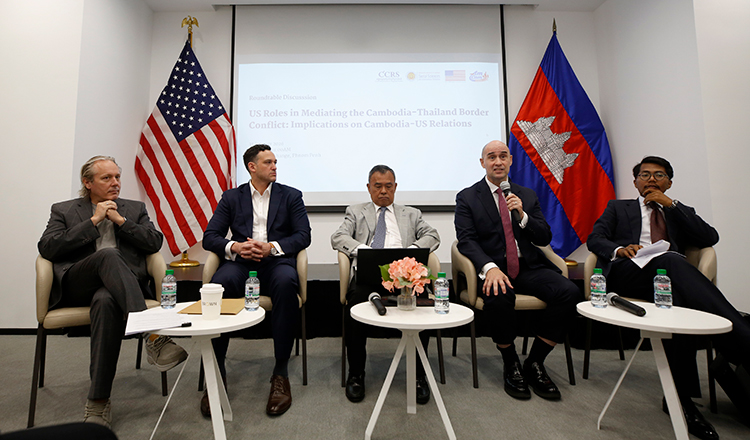 (From left) Dean of Social Sciences and International Relations at the Pannasastra University of Cambodia Kevin Nauen; Political and Economic Counsellor of the US Embassy in Phnom Penh Andrew Leyva; Distinguished Senior Adviser to the Cambodian Centre for Regional Studies Ambassador Pou Sothirak; AmCham Cambodia President Casey Barnett; and CCRS deputy director Him Rotha at the roundtable yesterday. KT/Chor Sokunthea
#National
Synopsis: Through diplomacy, political pressure and post-conflict aid, the United States has positioned itself as the key external guarantor of the fragile peace accord.
The United States has taken on a central role in guaranteeing the ceasefire between Cambodia and Thailand following months of border tensions, with senior American officials leading behind-the-scenes diplomacy, facilitating peace negotiations, and committing millions of dollars to post-conflict stabilisation.
Experts, meanwhile, point out that the new context presents a golden opportunity for enhancing US-Cambodia bilateral ties.
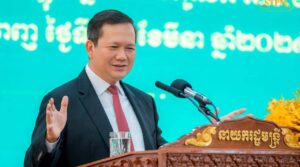
The diplomatic push culminated on October 26, when Cambodia’s Prime Minister Hun Manet and his Thai counterpart Anutin Charnvirakul signed a joint declaration, witnessed by US President Donald Trump and Malaysian Prime Minister Datuk Seri Anwar Ibrahim on the sidelines of a regional summit in Malaysia
The new challenges emerged soon after, with fighting resuming in December. Despite this setback, US officials remained actively engaged behind the scenes to restore calm.
The renewed ceasefire was eventually secured following an ASEAN foreign ministers’ meeting convened by Malaysia on December 22 and subsequent engagement through the Cambodia–Thailand General Border Committee. Peace was re-established on December 27.
US President Donald Trump has engaged Cambodian and Thai leaders at least six times in recent months to ensure the ceasefire holds, signalling Washington’s sustained political involvement in the process.
The US is also giving financial commitments, $45 million to be specific, to reinforce stability along the border and address humanitarian consequences of the conflict.
Observers say the combination of direct diplomatic mediation, high-level political pressure, and post-conflict assistance effectively positions the US as the principal external guarantor of the fragile ceasefire.
Speaking at a roundtable yesterday, Dean of the Faculty of Social Sciences and International Relations at Paññāsāstra University of Cambodia, Kevin Nauen, said it was given the assurance that the US would continue to serve as the primary guarantor of the ceasefire.
He said this explains that the US played a key role in reducing tensions and strengthening relations in the region by helping negotiate the release of 18 Cambodian soldiers, an act that led to a rise in trust between Cambodia and Thailand. This move was also politically important for Mr Hun Manet, as it reinforced his legitimacy and addressed nationalist sentiments at home.
“The US very astutely emphasised the role of ASEAN so that the US would not be perceived as being too overly pushy, overly meddlesome, and imposing its will on smaller states. There was an important strategic element to keeping ASEAN’s centrality maintained. But ASEAN’s centrality was certainly not enough. By itself, it would not have resulted in a ceasefire and a peace accord,” he said.
-Khmer Times-