Thai incursion violates international law, threatens ties
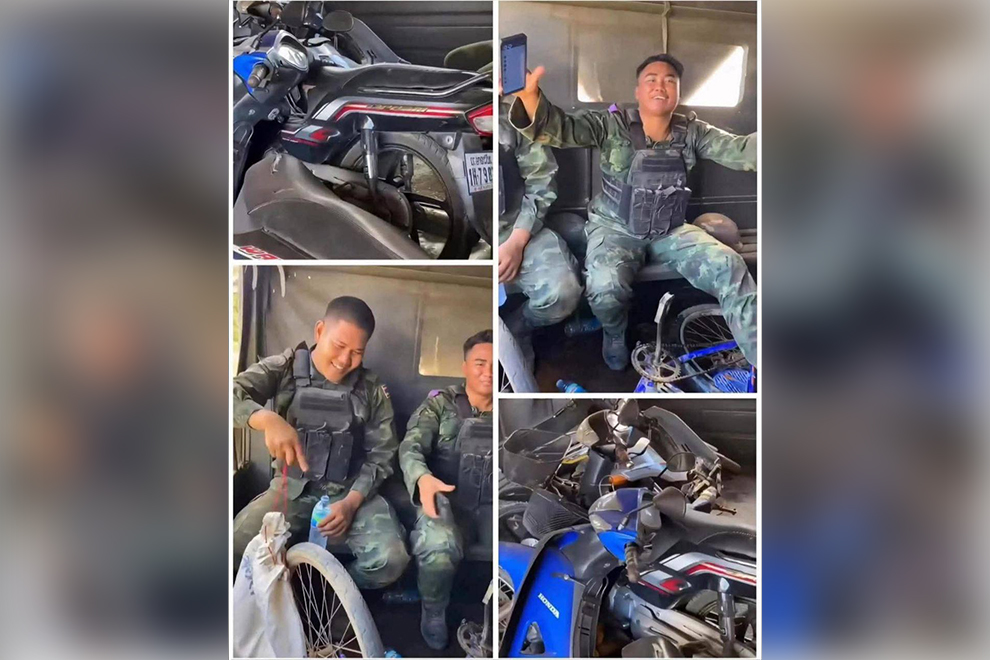 In Pursat Province, Thai armed forces cut locks and forcibly entered civilian homes in Sangkum Thmei Village, subsequently confiscating valuable property from 8 houses, including 4 motorcycles and 2 village garbage carts. Ministry of Interior
#National
Synopsis: Thai troopers forcibly occupy homes inside Cambodian territory in Pursat and Oddar Meanchey provinces.
Experts have condemned the forced entry of Thai armed forces into Cambodian homes in Pursat and Oddar Meanchey provinces, calling it a violation of international law, warning that such incursions threaten bilateral relations and regional stability.
According to the Ministry of Interior, on Thursday, Cambodians visiting their homes in Oddar Meanchey province discovered Thai soldiers occupying houses well beyond the recognised boundary.
“Cambodian women respectfully raised their hands and requested permission to collect essential belongings. The Thai military denied the use of vehicles to transport items and ordered the Cambodian men to leave, before allowing the Cambodian women who owned the houses to enter briefly to collect a small number of remaining items, while homeowners reported that most valuable property and household goods had been stolen,” the Ministry said.
In a separate incident in Pursat province, Thai forces forced their way into eight homes in Sangkum Thmei Village, breaking locks and confiscating things, including four motorcycles and two village garbage carts, the Ministry added.
International Relations Institute of Cambodia Director-General Kin Phea described the incursion as “a flagrant violation of territorial integrity and international norms.” He noted that such actions directly contravene the UN Charter, which prohibits military forces from operating on foreign soil without explicit consent.
“This situation is highly serious, as it directly erodes the mutual trust that underpins peaceful coexistence between Cambodia and Thailand,” he said. “Aggressive actions on the ground risk escalating localised tensions into a broader diplomatic crisis, undermining the spirit and credibility of the 2000 MoU and regional security, with wider implications for stability in the border areas and ASEAN unity.”
He pointed to systemic failures in border management, noting that Thai forces continue to act unilaterally, bypassing established mechanisms such as the GBC, JBC, and the 2000 MoU.
“By prioritising military actions over diplomatic channels and established hotlines, these incursions expose a deeper problem—weak implementation of joint mechanisms and persistent threats to Cambodia’s territorial integrity amid unresolved border demarcation and declining bilateral trust,” Phea said.
According to the UN Charter (Article 2), any unauthorised entry of foreign armed forces into another state’s territory, whether by ground patrols, use of force, or emplacement of military equipment, prima facie raises concerns of a sovereignty violation.
“Thai military’s actions are clearly an act of violating Cambodia sovereignty, despite this is particularly sensitive in disputed or undemarcated border areas, where international practice emphasises restraint, consultation, and reliance on joint boundary mechanisms,” said Geopolitical analyst Thong Mengdavid, a lecturer at the Royal University of Phnom Penh.
“In international practice, even if sovereignty claims are contested, the use of force or unilateral military action is discouraged, and states are expected to manage such incidents through diplomatic and technical channels rather than military means.”
He added that the deeper problem is due to the structural weakness in Cambodia-Thai border management, since large portions of the border (land and maritime) remain undemarcated or ambiguously defined, leaving room for differing interpretations, patrol overlap, and competing narratives of territorial control.
“Without strengthening joint mechanisms, demilitarising routine border management, and accelerating technical demarcation, similar incidents and conflicts are likely to recur,” he said.
-Khmer Times-