Ceasefire is not a licence to occupy
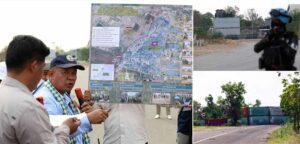
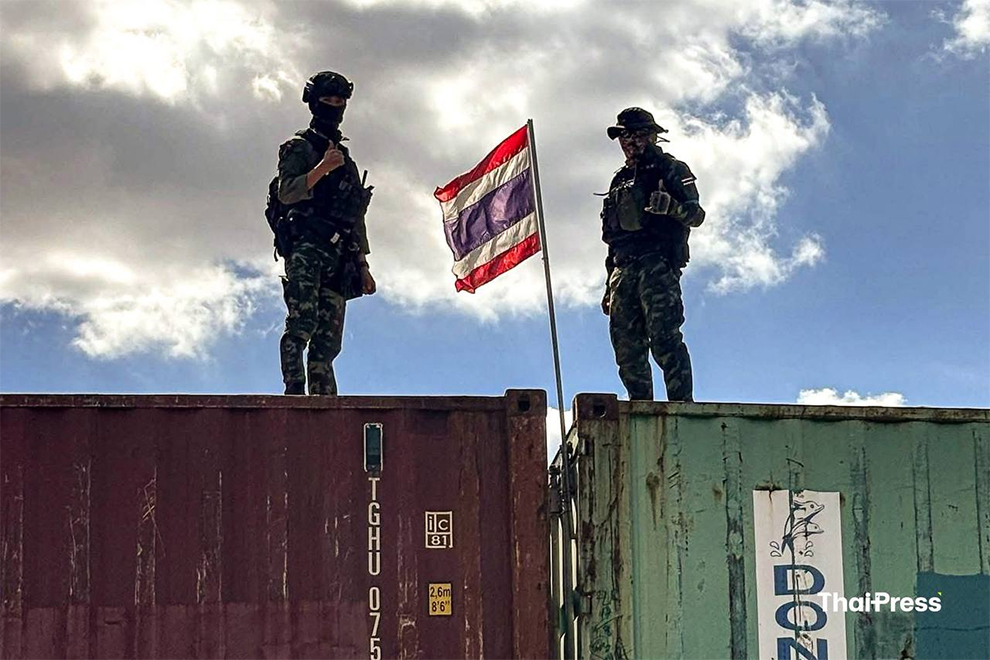 Thai soldiers have reportedly placed shipping containers to illegally occupy Cambodian territory in O Beichoan commune, Banteay Meanchey province. Thai Press
#opinion
The joint ceasefire statement agreed by Cambodia and Thailand on 27 December 2025 is unambiguous. Both sides committed to maintaining current troop deployments without further movement. There shall be no patrols towards the other side’s positions. All arrangements under the statement are explicitly without prejudice to border demarcation and the international boundary between the two countries.
In plain terms, the ceasefire was designed to freeze the situation on the ground – not to legitimise unilateral actions, alter facts or advance territorial claims by stealth.
Yet Thailand’s conduct since then tells a different story.
The planting of flags, the destruction of civilian homes, the erection of barbed-wire fences and the deployment of armed troops inside contested areas are not acts of self-defence. They constitute a patterned and deliberate military encroachment into Cambodian sovereign territory. These actions are unilateral, coercive and fundamentally incompatible with both the letter and the spirit of the joint ceasefire statement.
Self-defence, under international law, cannot be invoked to justify gradual occupation, civilian displacement or the physical alteration of disputed land. Nor can it excuse actions that undermine agreed bilateral mechanisms. What Thailand has pursued instead resembles a classic fait accompli strategy – creating new “realities” on the ground in the hope that they will later be accepted as irreversible.
Cambodia categorically rejects this approach.
Crucially, the joint statement affirms that all border-related matters must be referred to the Joint Boundary Commission (JBC), with the explicit goal of resuming survey and demarcation work at the earliest opportunity. Both sides agreed to use existing JBC mechanisms to guarantee the safety of joint survey teams, including protection from landmines, and to prioritise demarcation in affected border areas where civilians previously resided. This is not procedural language. It is the cornerstone of peaceful conflict resolution.
Cambodia has consistently upheld this framework. The Cambodian side of the JBC remains ready to resume land surveying and boundary demarcation with Thailand, not to score political points, but to achieve lasting peace, stability and clarity along the border. This is the only lawful and sustainable path forward.
Thailand’s unilateral actions, by contrast, undermine the JBC process itself. They send a troubling signal: that negotiated mechanisms can be bypassed when inconvenient, and that force can be a substitute for law. Such behaviour does not merely strain bilateral relations – it contradicts ASEAN norms of restraint, dialogue and non-use of force among neighbours.
Equally important is what Cambodia does not accept.
Cambodia does not recognise one-sided claims, temporary occupations or physical markers imposed through intimidation or military presence. Flags planted under armed protection do not determine sovereignty. Fences erected without agreement do not redraw international boundaries. Homes destroyed do not erase the rights of civilians to return to their land.
International law is clear: borders are determined by treaties, maps and agreed demarcation processes – not by coercion.
Cambodia remains firmly committed to peace, respect for international law and constructive dialogue. Cambodia will not be drawn into narratives that attempt to reframe encroachment as “defence”, or unilateral actions as “security measures”. Such narratives do not withstand legal scrutiny, nor do they contribute to regional stability.
A ceasefire is a responsibility, not an opportunity.
If Thailand is serious about peace, it must honour not only the words of the joint statement, but its intent: no troop movement, no unilateral actions and full recommitment to the Joint Boundary Commission as the sole legitimate mechanism for resolving border issues.
Cambodia stands ready – for dialogue, for law and for peace. What it will not accept is the normalisation of force as a tool of boundary-making.
Roth Santepheap is a geopolitical analyst based in Phnom Penh. The views and opinions expressed are his own.
-The Phnom Penh Post-