Why Cambodia’s next growth chapter hinges on structural reform
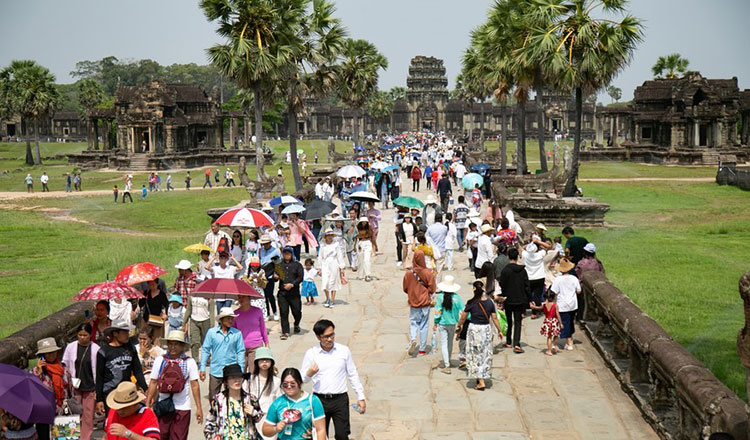 Tourism is among the engines of growth that have carried the Cambodian economy. Khmer Times
#opinion
Cambodia’s economic and political journey cannot be understood without acknowledging the deep scars left by decades of conflict and instability. While the country struggled to rebuild its institutions and social fabric after the devastation of the Khmer Rouge era, its neighbour Thailand was steadily laying the foundations of long-term development. Over time, this divergence shaped two very different national trajectories. Thailand’s relative political continuity allowed it to invest in education, infrastructure, and industrial capacity, gradually building economic resilience and regional influence. Cambodia, by contrast, spent much of its recent history simply trying to recover what had been lost.
The contrast between the two is not merely one of wealth, but of continuity. Where Thailand was able to plan, adapt, and compound progress, Cambodia was forced to restart—often more than once. These interruptions slowed the formation of strong institutions and delayed the emergence of a diversified, self-sustaining economy. As a result, growth in Cambodia has frequently been fragile, vulnerable to external shocks, and unevenly distributed.
Yet within this contrast lies an important lesson. Thailand’s experience demonstrates that lasting development does not come from rapid expansion alone, but from stability, sound governance, and long-term investment in people and systems. For Cambodia, the path forward is not about comparison or competition, but about learning—recognising that sustainable growth depends on strong institutions, social cohesion, and deliberate economic diversification.
If Cambodia can draw wisdom from its own history and from the experiences of its neighbours, it can transform past hardship into strategic clarity. The challenge now is not simply to grow, but to grow wisely—building a future that is resilient, inclusive, and firmly grounded in lessons learnt rather than mistakes repeated.
For much of its modern history, Cambodia’s story has been told through the lens of tragedy—war, destruction, loss, and recovery. But if we look more carefully, the deeper story is not simply about what the country endured. It is about why the same vulnerabilities kept reappearing, and what lessons were never fully absorbed.
Cambodia’s repeated setbacks were not the result of a single catastrophe or a single generation’s failure. They were the outcome of structural weaknesses that accumulated over time—weaknesses that left the nation exposed whenever crisis struck. Time and again, moments of promise were followed by collapse, not because Cambodians lacked resilience or intelligence, but because the foundations needed to sustain progress were never fully secured.
One of the most profound challenges has been the absence of enduring institutions. Across different eras, systems of governance were built, dismantled, and rebuilt again, often without continuity.
Laws, administrative capacity, and professional norms rarely had time to mature before being disrupted. As a result, the state often depended more on individuals than on institutions—on personalities rather than processes. When those individuals disappeared, so too did the stability they temporarily created.
This fragility was compounded by repeated disruptions to education and knowledge transmission. Cambodia did not merely lose schools or teachers; it lost entire generations of institutional memory. Skills that normally accumulate over decades had to be relearnt from scratch. As the world moved forward technologically and economically, Cambodia was forced to start over, again and again, with limited human capital and limited time.
Economic development followed a similar pattern. Growth occurred, sometimes rapidly, but it often rested on narrow foundations. Agriculture, garment, construction, and later tourism carried the economy, yet these sectors were rarely supported by deep domestic supply chains or innovation ecosystems. Value was created, but much of it leaked outward. Without strong local industries, research capacity, or financial depth, the economy remained vulnerable to external shocks and global cycles.
At the same time, reform efforts—though often sincere—tended to focus on immediate results rather than structural transformation. Policies were introduced, incentives were offered, and institutions were created, but too often without the continuity or enforcement required to change behaviour over the long term. Reform became episodic rather than systemic.
Perhaps the most profound challenge, however, was the absence of a unifying long-term national vision that could survive political transitions. Development strategies shifted with leadership changes, and national priorities were frequently recalibrated before previous efforts had time to mature. Without a stable compass, progress became uneven and fragmented.
Yet to focus only on failure would be to miss the deeper truth. Cambodia’s survival itself is remarkable. Few nations have endured such profound disruption and still managed to rebuild social order, economic function, and international standing within a single generation. The country’s ability to recover at all speaks to an underlying resilience that is often underestimated.
Today, Cambodia stands at a crossroads. The question is no longer whether it can grow—it has already demonstrated that. The real question is whether it can convert growth into durability.
Whether it can move from recovery to resilience, from speed to stability, from adaptation to intentional design.
The lesson of the past is clear: development without strong institutions remains fragile. Growth without human capital is shallow. And progress without long-term vision is easily reversed.
If Cambodia can internalise these lessons—investing in people, strengthening institutions, and committing to a coherent national trajectory—then its future need not be a repetition of its past.
Instead, it can become a case study not of perpetual recovery, but of conscious transformation.
History has tested Cambodia many times. The next chapter will be defined not by what the country endured, but by what it chooses to build—deliberately, patiently, and with purpose.
The author is a leading voice in Cambodia on economic transformation, public-private partnerships, strategic policy reform, impact investments and blended finance as well as TVET capacity building. He has more than four decades of experience advising government institutions, multinationals, and development institutions on building resilient, future-ready economies. The views expressed here are his own.
-Khmer Times-