Khmer Buddhist monks providing psychosocial and spiritual counselling to displaced people along border
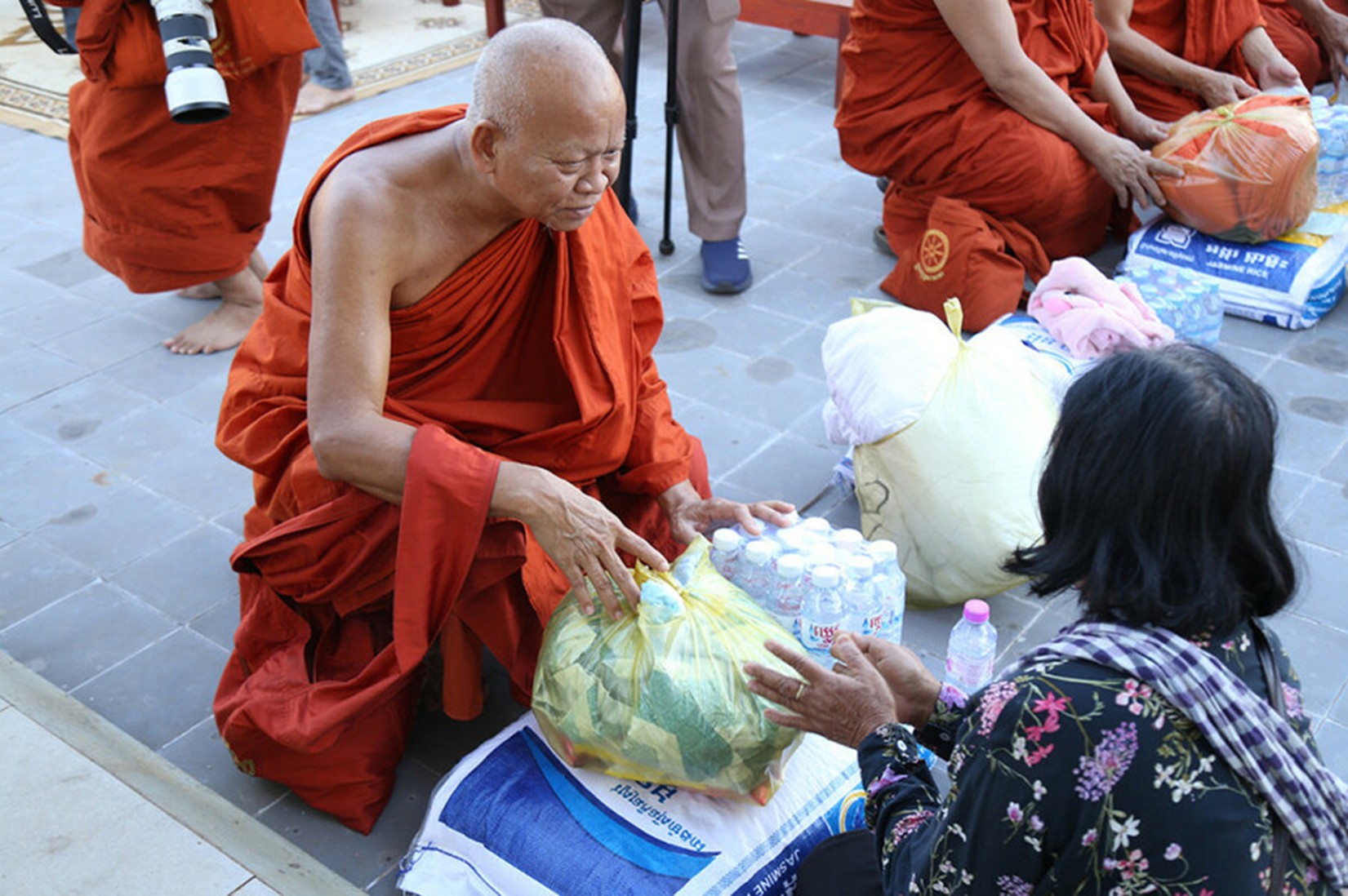 Buddhist monks provided aid to displaced people in Siem Reap province last week. Ministry of Information
#opinion
In times of national crisis, whether due to war or any force majeure issues involving religious leadership, Khmer Buddhist monks continue to play a vital role.
They are often sent from their monasteries to visit villages and refugee camps across the country, providing spiritual guidance through education and meditation training, and the promotion of compassion and kindness to help alleviate mental and emotional distress.
Recently, based on my observations, Khmer Buddhist monks have made remarkable contributions, including distributing aid to refugees and providing spiritual counselling to displaced populations. These valuable activities exemplify the important role of Khmer Buddhist monks in supporting society during crises, particularly in response to the recent war along the Cambodia-Thailand border.
Armed conflict and border tensions along the Cambodia-Thailand frontier have repeatedly forced civilians to flee their homes, disrupting livelihoods, fragmenting families and leaving deep psychological and emotional wounds.
While humanitarian responses often focus on food, shelter and medical assistance, the less visible but equally critical dimensions of trauma – fear, grief, anxiety and loss of meaning – are frequently overlooked.
In this context, Khmer Buddhist monks have emerged as vital, though often under-recognised, providers of psychosocial and spiritual counselling for displaced populations.
Overlooked dimensions of displacement: psychological and spiritual suffering
Displacement is not only a physical experience, it is also a profound psychological and existential rupture. Refugees and internally displaced persons along the Cambodia-Thailand border often experience chronic stress, uncertainty about the future and unresolved trauma linked to violence and separation. These conditions can manifest as insomnia, depression, irritability and social withdrawal.
Formal mental health services in border and rural areas remain limited, and cultural barriers may discourage affected individuals from seeking clinical psychological support. As a result, many displaced people turn instead to familiar, trusted and culturally resonant sources of care – most notably, Buddhist monks and temples.
Buddhist monks as trusted community counsellors
In Khmer society, Buddhist monks have long played roles that extend beyond ritual and religious instruction. Traditionally, monks serve as moral guides, educators, mediators and counsellors within their communities. During times of crisis, temples often become safe havens where people seek not only material assistance but also emotional reassurance and moral clarity.
Along the Cambodia-Thailand border, monks have provided informal counselling through Dharma talks, individual conversations, chanting and guided meditation sessions. These practices help displaced persons calm their minds, process suffering and regain a sense of inner stability. Unlike formal therapy settings, these interactions are embedded in familiar cultural and religious frameworks, making them more accessible and less stigmatising.
Applied Buddhist philosophy in healing trauma
The psychosocial support offered by Khmer Buddhist monks is deeply rooted in core Buddhist teachings such as dukkha (suffering), anicca (impermanence) and mettā (loving-kindness). By framing suffering as a universal human condition rather than a personal failure, monks help displaced individuals normalise their pain and reduce feelings of isolation or shame.
Mindfulness practices encourage individuals to observe fear and grief without being overwhelmed by them, while compassion-based teachings foster resilience, patience and mutual support within displaced communities. In this sense, Buddhist counselling does not aim to eliminate suffering entirely but to transform how individuals relate to it – an approach that aligns closely with contemporary psychosocial resilience frameworks.
Monasteries as spaces of collective healing.
Beyond individual counselling, temples function as communal spaces for collective healing. Group prayers, meditation sessions and religious ceremonies create shared experiences that rebuild social bonds weakened by displacement. These collective practices restore a sense of belonging and moral order, which is essential for psychological recovery.
Significantly, monks often act as intermediaries between displaced populations and humanitarian actors, helping to communicate needs, distribute aid and maintain social cohesion. Their moral authority and perceived neutrality enhance trust, particularly in politically sensitive border areas.
Challenges and the need for recognition
Despite their contributions, Khmer Buddhist monks remain largely absent from formal humanitarian and mental health strategies. Their work is often informal, undocumented and unsupported by institutional resources. Without appropriate recognition or collaboration, there is a risk of overburdening monks or overlooking opportunities to integrate culturally grounded counselling into broader psychosocial programmes.
While monks are not replacements for trained mental health professionals, they can play a complementary role. Partnerships between Buddhist institutions, civil society organisations and public health agencies could strengthen psychosocial responses by combining professional expertise with culturally embedded practices.
A culturally rooted path to healing
As displacement continues to devastate communities along the Cambodia-Thailand border, our understanding of humanitarian care must expand beyond conventional aid. Khmer Buddhist monks play a critical role – not only offering spiritual solace but delivering culturally grounded psychosocial support that confronts trauma, restores dignity and strengthens resilience.
Acknowledging and empowering monks as providers of psychosocial and spiritual counselling is more than an act of cultural respect – it is a moral and practical necessity. In times of conflict and uncertainty, healing the mind and spirit is as urgent as rebuilding physical infrastructure. The engagement of Buddhist monastics offers a uniquely local, ethical and effective path toward recovery, reconciliation and lasting peace.
Finally, with the strong hope that Khmer Buddhist monks continue to play an important role as great sons of the Buddha, faithfully following His teachings to strengthen the spirit of refugees and provide effective spiritual healing along the Cambodia-Thailand border.
May the Buddha’s teachings always prevail! May peace and prosperity endure, beginning with national unity, a shared national spirit and a unified voice.
Dr Prak Samphose is a lecturer at the Graduate School of Preah Sihanouk Raja Buddhist University. The views and opinions expressed are his own.
-The Phnom Penh Post-