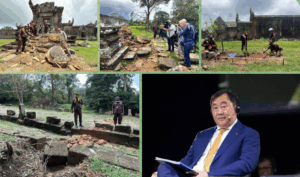
AmCham president notes increased airstrikes, suggests Thai domestic politics may be behind aggression
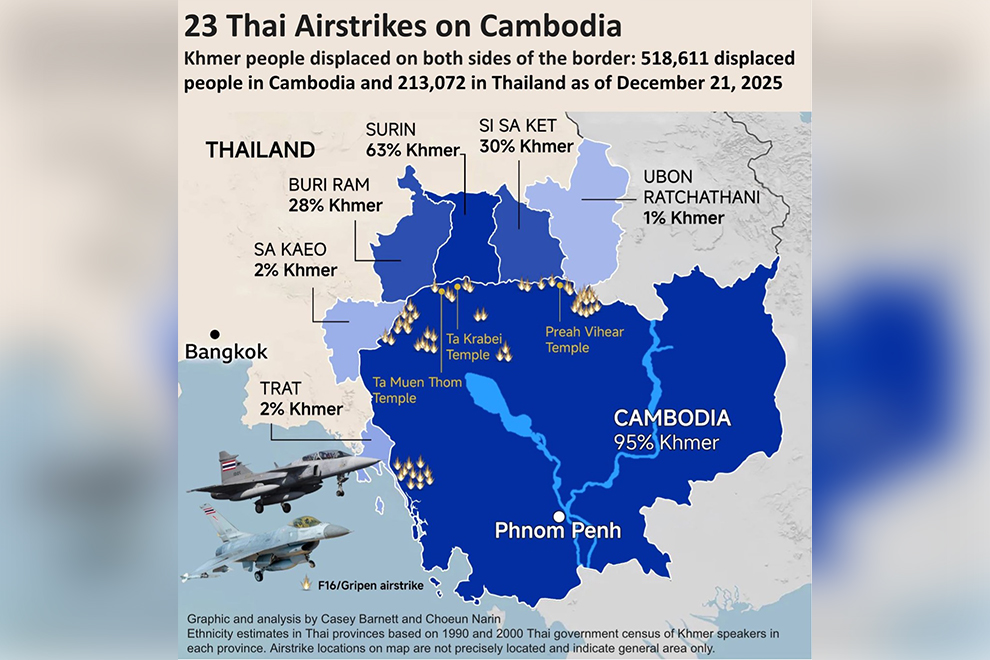 A map illustrates the extent of Thai airstrikes since December 8 and also highlights the Khmer ethnicity of the populations of many Thai border provinces. Supplied
#National
As of December 22, 2025, Thailand had conducted approximately 23 airstrikes on Cambodia, destroying military targets as well as civilian infrastructure, including primary schools, pagodas and bridges, according to research personally conducted by Casey Barnett, president of American Chamber of Commerce in Cambodia (AmCham).
While bombing by F-16 fighter jets have been reported almost daily since December 8, the second day of the renewed fighting, Barnett said the intensity of the airstrikes has increased, with five airstrikes on December 18 and another four on December 19. The strikes targeted rural towns and districts, as well as the densely populated town of Poipet.
“The Thai airstrikes are unanswered by Cambodia. Cambodia does not have its own fighter aircraft or any surface-to-air defences. Cambodia has no choice but to absorb the bombings, which have resulted in internal displacement of 518,611 Cambodian families, children and elderly who are now surviving in make-shift tents in camps,” he said.
According to Barnett, the fighting affects ethnic Khmer people on both sides of the border. 95% of the people in Cambodia are Khmer and the Thai provinces along the border are also widely populated by ethnic Khmer, such as Surin province, which is at least 63% Khmer, despite widespread language assimilation.
Thailand agreed to an unconditional ceasefire on July 28, 2025. It was brokered by US President Donald Trump, who granted each country a relatively favourable reciprocal trade tariff rate of 19%.
Barnet described the 19% reciprocal trade tariff rate as a “win” for Thailand, as it had not made any concessions to the US, contrary to Cambodia, which offered tariff free access to most US goods.
“The result is that Thailand was rewarded for bad behaviour; Thailand’s invasion of Cambodian territory was brought to a temporary halt by being awarded a favourable US tariff,” he said, adding that the July 28 ceasefire agreement and the Kuala Lumpur Peace Deal were declared suspended and void by Thai Prime Minister Anutin Charnvirakul, with his claim of newly planted landmines.
“Given that the Thai unilateral cancellation of the peace accord has resulted in numerous civilian and military deaths, widespread destruction and nearly 700,000 displaced people, Anutin’s cancellation of the peace accord due to the injury of four soldiers appears to be an unreasonable overreaction,” he said.
Like many other analysts, Barnett suggested that Anutin’s calls for war may have been influenced by political calculus to stay in power by deceiving the People’s Power Party, a coalition in the Thai parliament before it was dissolved on December 12, and as a distraction to what was perceived as poor management of flooding in the southern parts of the country.
A Thai domestic election is scheduled for February.
-The Phnom Penh Post-