From Confession to Consequence: Why the Thai Army Commander’s War Policy Triggers Responsibility
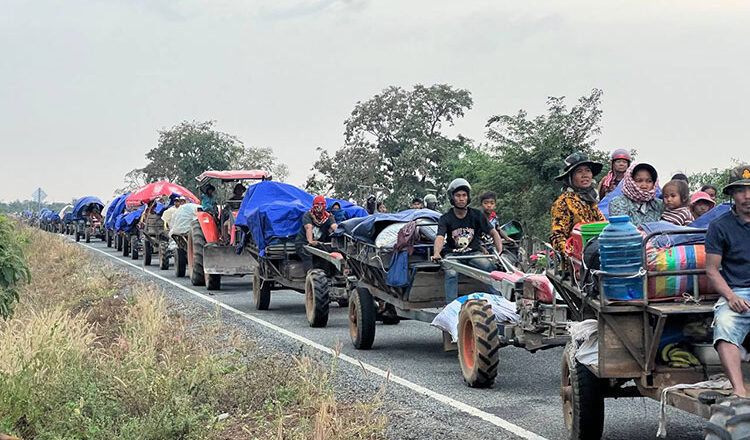 People fleeing the front lines where intense fighting has displaced close to 500,000 people since the war started 12 days ago. Supplied
[Opinion]
There are moments when international responsibility no longer needs to be inferred, reconstructed or debated. It announces itself—clearly, publicly and with a confidence that betrays a belief that power itself constitutes a legal defence.
Such a moment arrived when Thailand’s top military commander, Gen Chaiyapruek Duangprapat, openly declared that the objective of ongoing operations is to “disable Cambodia’s military capabilities” so that Cambodia will not pose a threat “for a long time.” This was not an off-hand remark or a tactical aside. It was a war policy, articulated at the highest level of command. And in international law, a publicly declared war policy is not rhetoric; it is attribution.
Honoré de Balzac once warned that: laws, like spider webs, catch the small flies and let the large ones go free. Modern international law was constructed precisely to rebut that pessimism. Since Nuremberg, its organising principle has been uncompromising: authority magnifies responsibility. Rank does not dilute liability; it concentrates it.
International law has little patience for euphemism. Article 2(4) of the United Nations Charter prohibits not only the use of force, but also the threat of force against the territorial integrity or political independence of another State. A war policy openly aimed at long-term military incapacitation is a threat in its purest form. It is coercive by design, punitive in ambition and unlawful in character.
The attempt to shelter such a policy under the familiar banner of “self-defence” collapses on contact with the law. Self-defence is not a strategic worldview. It is a narrow legal exception, triggered only by an armed attack and constrained by necessity and proportionality. A war policy designed to degrade another State’s military capacity “for a long time” satisfies none of these criteria. It is not defensive; it is dominative.
As Hersch Lauterpacht made clear, State sovereignty is not unlimited but subject to the overriding requirements of international law. Military command does not suspend those requirements; it puts them to the test. As De Visscher warned, sovereignty confers no licence for arbitrariness. Authority exercised beyond law is not power defended—it is power abused.
Words, unfortunately for those who speak them, produce consequences.
At the time of writing, more than 400,000 Cambodian civilians have been displaced from their homes. Over 883 schools across border provinces have been closed, depriving at least 200,000 children of access to education. These figures do not describe incidental inconvenience. They describe a humanitarian rupture—classrooms emptied, families uprooted, futures deferred—not by accident but by the foreseeable effects of a declared war policy.
Air operations have penetrated deep into Cambodian territory, with predictable results: civilian casualties, mass displacement and the systematic destruction of civilian infrastructure. Homes, hospitals, pagodas, bridges and administrative buildings have been damaged or destroyed. These outcomes reflect not accident or miscalculation, but the operational implementation of a strategy that treats long-term degradation as a legitimate military objective.
Yet the most damning evidence of unlawfulness lies not only in the numbers recorded, but in what those numbers cannot capture—the deliberate exposure of history, memory and civilisation itself to destruction.
Military operations have extended beyond the realm of immediate military necessity into the realm of the irreplaceable, reaching ancient temples and protected cultural sites, including the Temple of Preah Vihear and Ta Krabey—structures that embody centuries of civilisation and belong not to one nation alone, but to humanity itself. Under law, cultural heritage enjoys heightened protection. Its destruction is neither incidental nor collateral. It is a serious breach that wounds not only a people, but the shared cultural inheritance of humankind.
What makes this case exceptional is not merely the scale of harm, but the clarity of authorship. International responsibility does not require secret orders or clandestine chains of command. Public declarations suffice. They establish intent (mens rea). They clarify intent. They tether outcomes to individuals.
In this sense, the Thai army’s top commander has not merely overseen operations; he has defined the war policy that governs them. He has articulated its purpose, its duration and its logic. And international law listens closely when power speaks plainly.
Cambodia, by contrast, has not announced war policies of incapacitation, nor invoked nostalgic ambitions of territorial “reclamation”—a concept international law buried decades ago, for reasons written in blood. It has called for ceasefires, monitoring mechanisms, investigations and the use of established diplomatic frameworks. These are not gestures of provocation. They are the habits of a State insisting on restraint, de-escalation and peace.
The conclusion, therefore, is neither speculative nor rhetorical. It is legal.
When a senior military commander publicly declares a war policy of long-term military incapacitation, and that policy is followed by mass civilian displacement, closed schools, devastated communities and strikes on protected cultural heritage, responsibility does not dissipate into institutional fog. It crystallises.
The policy was declared at the highest level. The intent was explicit. The operations followed. The harm was foreseeable—and foreseen. Civilians were uprooted. Education was paralysed. Temples that belong to humanity were struck. These were not accidents of war; they were the predictable consequences of a publicly proclaimed strategy.
International law was built for precisely such moments—when intent is confessed, authorship is clear and harm is visible. Where accountability is evaded in these circumstances, the failure is not doctrinal or evidentiary. It is moral and institutional: a choice not to apply the law when power speaks most plainly.
History is unsparing in such cases. Commanders may shape narratives in the present, but law shapes the record. And the record remembers who spoke, who decided and who acted.
That is the burden of command. It cannot be shed by rhetoric, rank or time.
The author is the Ambassador Extraordinary and Plenipotentiary, Permanent Representative of the Kingdom of Cambodia to the United Nations Office and other International Organisations in Geneva. (The views and opinions expressed are his own.)
-Khmer Times-