Cambodia’s Anti-Scam Fight Lifts Global Image
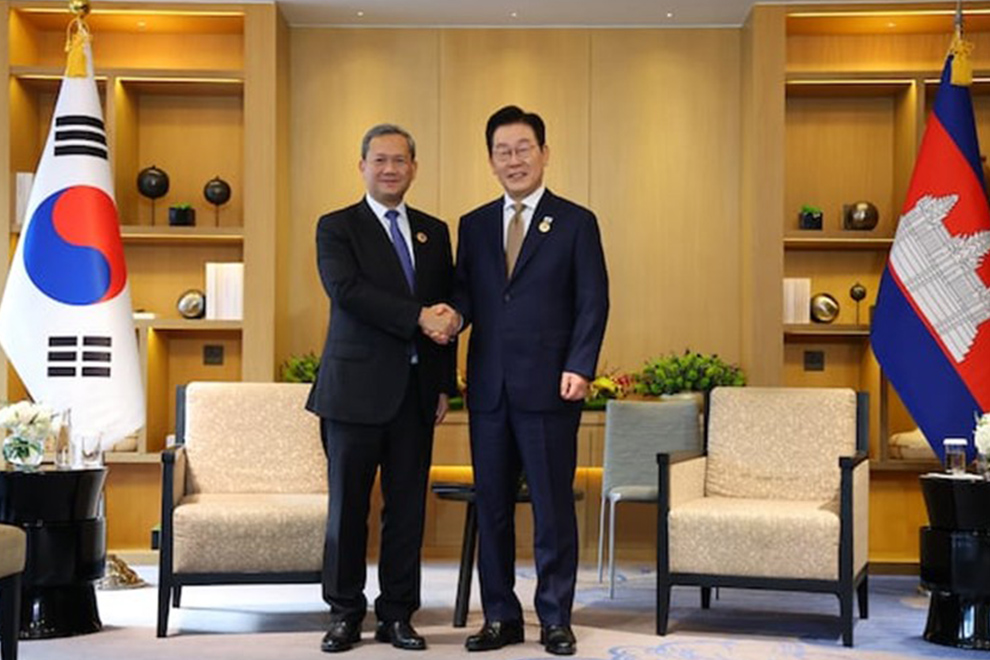 South Korean President Lee Jae-myung and Cambodian Prime Minister Hun Manet pose for a commemorative photograph before a summit meeting on October 27, in Kuala Lumpur, Malaysia. Supplied
-Opinion-
The recent, intensified joint crackdown on online scam syndicates by the governments of Cambodia and South Korea marks a pivotal moment, signalling a deepening of their bilateral relationship and simultaneously enhancing Cambodia’s standing on the international stage.
This decisive action, spearheaded by a shared commitment to eradicating sophisticated transnational crime, is doing far more than just disrupting criminal networks; it is forging a stronger bond between the two nations and painting a new, positive image of Cambodia as a serious and effective partner in global security.
Under the efforts of former Prime Minister Hun Sen, Cambodia and South Korea established diplomatic ties in 1997, when Hun Sen served as second prime minister of Cambodia.
Cambodia treats South Korea as an important development partner since there are many Cambodians working there nowadays, as well as many students studying. There are also many Korean citizens working in Cambodia in different fields right now.
Strong South Korean warning met with swift Cambodian action
Following a string of scam-related crimes involving Korean victims, South Korean President Lee Jae Myung issued one of his strongest warnings yet, declaring that authorities must “show that anyone who touches Koreans will be ruined”.
He ordered an all-out response, calling the situation as an opportunity to “eradicate scam crime organizations at their roots”. He reiterated that South Korea would “mobilise its full capacity to make clear that harming a Korean national will cost perpetrators far more than they imagine”.
The issue of scam operations is not exclusive to Cambodia but is an international and regional issue. According to a UN report, it involves dozens of countries such as Thailand, Myanmar, Laos and Cambodia.
Cambodia is, in fact, one of the countries that has suffered the most damage due to scam crimes. Furthermore, the strong statement by the South Korean President was not directed at any specific country.
Instead, it expressed a firm stance against online scam crimes themselves. It is regrettable that his original words were misinterpreted by some media outlets that are biased towards countries that are unfriendly to Cambodia. Both Cambodia and South Korea should have a special channel to meet and discuss when they face problems and they should not let media to play the role before the verbal meeting of the authorities of the two countries.
Aspirations for cooperation from South Korea were met with significant action from Phnom Penh.
Prime Minister Hun Manet launched the Commission for Combating Online Scams (CCOS) in February, and the commission has arrested more than 3,400 suspects during 5 months, signalling Cambodia’s commitment to intensifying its efforts against online scam activities. With both leaders aligned on eliminating scam compounds, the bilateral cooperation was strengthened further.
Solidified cooperation and tangible results
The concrete steps taken in recent months highlight the unprecedented depth of this partnership. During an October 27 bilateral meeting, held on the sidelines of the ASEAN Summit, Lee and Manet agreed to establish a dedicated system to coordinate responses to scam crimes targeting Koreans.
This led directly to the launch of the permanent cooperation channel, the Cambodia-Korea Joint Task Force for Koreans (Korea Task Force), on November 10. This high level of collaboration is a powerful engine for developing the Korea-Cambodia relationship.
Elevating the Kingdom’s international image and diplomatic recognition
Reportedly, some scammers, alarmed by the strengthened joint crackdown, are leaving Cambodia and moving their bases to third countries like Thailand. This trend is a good example which demonstrates Cambodia’s strong will to eradicate online scams.
By actively engaging and taking a leading role in the charge against transnational scamming, Cambodia is making a profound statement to the international community.
The Kingdom is showing its commitment to being a proactive member of the global effort to combat organised crime, establishing itself as a reliable and essential security partner, particularly with a key player like South Korea.
The recent downward adjustment of the travel advisory for the Phnom Penh and Siem Reap areas by the South Korean government should be interpreted as diplomatic recognition of Cambodia’s efforts to improve security and the success of the bilateral cooperation.
The Cambodian government should consider providing visa free entry for Korean tourists who may want to visit Cambodia because South Korean tourists have enjoyed visa-free access to Vietnam under an extended policy that started March 15, allowing stays of up to 45 days. This exemption is set to last until March 14, 2028, as part of a broader measure to boost tourism.
Thailand has offered visa-free entry for South Korean tourists for a long time, but recently expanded it to a 60-day exemption starting July 15, 2024. Laos granted South Korean citizens visa-free entry for short tourist stays, initially in September 2008 (15 days), with further confirmation and potential extensions through 2009 and even temporary unilateral visa-free access in September 2018, allowing visa-free entry for 15 days or longer, but always confirm with official sources as policies can change.
Cambodia should also consider expanding visa exemptions to other key markets such as the US, Japan and Australia. China was the first country outside ASEAN to be offered free tourist visas on arrival by the Cambodian government. Even if the country loses revenue from visa fees, tourism growth would increase, bringing more money into the economy and creating jobs nationwide. When tourists come, money comes and the economy will be further upgraded gradually.
By standing shoulder-to-shoulder with South Korea and other friendly countries, Cambodia is not only securing its immediate national interest but also strategically investing in its global image and the long-term prosperity of its relationship with vital partners. This enhanced reputation will undoubtedly attract further legitimate investment, tourism and diplomatic respects and tourists from around the world.
Dr. Seun Sam is a policy analyst at the Royal Academy of Cambodia. The views and opinions expressed are his own.
-The Phnom Penh Post-