Thailand’s Unilateral Maps and Political Instability: The Real Causes of the Border Tension
 Thai razor wire barricades cut these Cambodian families off from the homes where they have lived for decades. Supplied
-Opinion-
For more than a century, the border between Cambodia and Thailand has been legally settled. The Franco-Siamese Conventions of 1904 and 1907 clearly defined the boundary between the two countries and were mutually agreed upon. Those conventions, signed between France and Siam, remain binding under international law. The map attached to those treaties — recognised by the International Court of Justice (ICJ) in 1962 — leaves no doubt about where the border lies.
Under international law, this issue was settled long ago. What Thailand is doing today is not border negotiation — it is border distortion.
Thailand continues to provoke tension and confusion by reviving a border issue that no longer exists. This is not a historical dispute — it is a modern political fabrication born in Bangkok. Cambodia has not changed any border; it is Thailand that keeps trying to redraw it.
There are two root causes behind Thailand’s repeated attempts to challenge the border. The first is Thailand’s use of a unilateral map — the 1:50,000 map drawn by the Thai military without Cambodia’s consent. The second is Thailand’s chronic internal political instability, which drives its leaders to use nationalism and anti-Cambodian sentiment as political weapons.
Thailand’s Fake Map and Illegal Claims
The so-called “disputed areas” along the Cambodia–Thailand border exist only on Thailand’s own self-made map. This 1:50,000-scale military map, drawn unilaterally by the Royal Thai Survey Department, has never been accepted by Cambodia or recognised internationally. It directly contradicts the official 1:200,000-scale map that was jointly produced by the Franco-Siamese Commissions following the 1904 and 1907 treaties. That official map, attached to the treaties and accepted by both sides, was later confirmed by the ICJ in 1962 as the only valid reference for determining the frontier between Cambodia and Thailand.
By using its unilateral 1:50,000 map instead of the legally recognised 1:200,000 treaty map, Thailand is in clear violation of international law. No country has the right to unilaterally redraw borders. Doing so is an act of aggression, not diplomacy.
When Thailand continues to reject this legal reality, it undermines the rule of law and disrespects the sovereignty of its neighbour. It also puts the lives of ordinary Cambodian villagers at risk. In Cambodia’s Chouk Chey and Prey Chan villages, innocent families have lost farmland, face military intimidation and live in fear — all because Thai soldiers try to enforce Thai law on Cambodian land. These actions are not just illegal — they are inhumane.

Bangkok’s Internal Chaos Is Driving Border Conflict
The second reason behind these provocations lies inside Thailand itself. Its political instability has turned Cambodia into a convenient scapegoat. Whenever Bangkok faces domestic crises — whether from corruption, protests or military power struggles — politicians and generals shift public attention by stirring up border nationalism.
This manipulation of history and geography may serve short-term political goals, but it destroys regional trust and damages Thailand’s international reputation. The world can see clearly that these tensions are not about borders — they are about Thai politicians trying to save themselves by creating an external enemy.
Cambodia Chooses Law, While Thailand Chooses Provocation
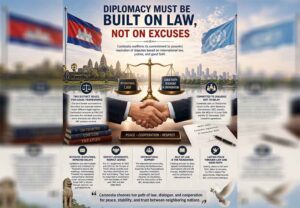
Cambodia has always chosen the path of law, peace and dialogue. Cambodia respects international treaties, the ICJ decisions, the UN Charter and the ASEAN Charter. Cambodia has never used force or falsified maps. Cambodia only demands that Thailand behave like a civilised nation — respect the treaties it signed and stop violating Cambodian sovereignty.
Reopening the 1904 and 1907 border settlements is not only legally baseless — it is politically dangerous. It encourages extremism, fuels hatred and risks dragging the region backward into conflict.
If Thailand truly values peace, stability and friendship, it must stop using false maps and propaganda against Cambodia.
The border issue between Cambodia and Thailand was finished long ago. What remains today is Thailand’s refusal to accept the truth. The problem lies not on the frontier, but in Bangkok — inside the military, the bureaucracy and the political class that benefit from creating false enemies.
Cambodia stands by the truth, by history and by international law. It is time for Thailand to do the same. Peace will come not from new maps, but from respect for old agreements.
Roth Santepheap is a geopolitical analyst based in Phnom Penh. The views and opinions expressed are his own.
-The Phnom Penh Post-
#CambodiaWantsPeace
#JusticeForCambodia
#Cambodianeedpeace
#TruthFromCambodia
#ThaiLawOnCambodianSovereignty
#ទាហានថៃបានអនុវត្តច្បាប់ថៃនៅលើទឹកដីខ្មែរ