Military historian challenges Thailand’s border row narrative
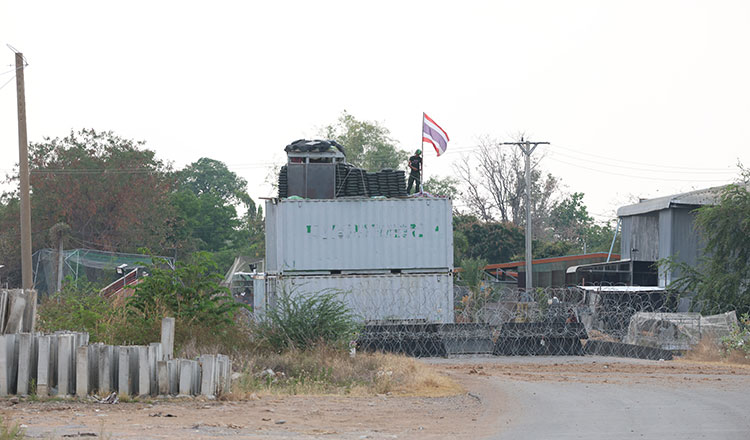 The Thai army blocks access to Cambodian villages with barbed wire and container barricades in Banteay Meanchey province. KT/Khem Sovannara
Synopsis: DC-Cam Director Youk Chhang argues that Bangkok’s presentation at the UN General Assembly overlooks historical records and downplays the impact on displaced Cambodian civilians.
Military historian and Documentation Center of Cambodia (DC-Cam) Director Youk Chhang has challenged Thailand’s account of its border conflict with Cambodia, saying Bangkok’s presentation to the United Nations General Assembly (UNGA) omitted key elements of the historical record and relied on disputed claims about territory and recent fighting.
His remarks followed a diplomatic exchange at the 81st UNGA session, where the two countries presented sharply different accounts of the border dispute and the displacement of Cambodian civilians.
“It is mystifying how comfortable the Thai government appears when presenting wildly false and misleading information about its border conflict with Cambodia in the public forum of the UN’s General Assembly,” Youk said in an interview.
He said the international community could assess the dispute by referring to “the facts on the ground and the historical record.”
The 2018 Ramon Magsaysay Award winner acknowledged that some elements of Thailand’s account reflected genuine developments, including its objection to Cambodia’s release of a recording of a private conversation between the two countries’ leaders, injuries suffered by Thai soldiers from unexploded ordnance and the harm inflicted on civilians on both sides.
“There’s no doubt that hundreds of thousands of Thai and Cambodian civilians have and are being harmed by this tragic conflict,” he said.
However, Youk disputed Thailand’s interpretation of the unexploded ordnance incidents, saying the border areas had been heavily contaminated by mines and unexploded ordnance as a result of decades of conflict.
He rejected Thailand’s assertion that Cambodian civilians displaced by the recent fighting had been occupying Thai territory since the 1970s or 1980s.
Thailand’s UN Ambassador Cherdchai Chaivaivid, in his right-of-reply statement, said Cambodian displaced persons – including more than 20,000 internally displaced people – were Cambodians living in areas Thailand had opened as temporary shelters in the 1970s.
“Their failure to return to Cambodia, despite our repeated protests, constitutes an encroachment on Thai territory,” Cherdchai said.
Phnom Penh has rejected that interpretation, arguing that unilateral assertions cannot establish international boundaries.
Youk noted that the current dispute should be understood against the broader history of bilateral relations.
He noted that in the 19th century and during the Second World War, Thailand controlled areas claimed by Cambodia, followed by later military tensions along the border.
He highlighted the Preah Vihear temple dispute, noting the International Court of Justice’s 1962 ruling that the site was under Cambodian sovereignty and its 2013 clarification of that judgement.”
Youk argued that disputes over territory should be addressed through historical documentation and international law rather than military action or competing narratives.
“Thailand’s recent attempt to seize these areas under the false narrative that these areas were always part of Thailand is not a new claim, nor is its creation of false narratives a novel strategy,” he said.
“Thailand’s representations to the UN General Assembly are a recycling of old ideas for a long-held desire of control over Cambodian territory.”
His comments follow Cambodia’s own presentation at the UNGA, where Foreign Affairs and International Cooperation Minister Prak Sokhonn called on Thailand to implement bilateral agreements, resume border demarcation and allow displaced civilians to return home.
Thailand reaffirmed its commitment to the ceasefire but accused Cambodia of portraying it negatively and of pursuing compulsory conciliation over the maritime boundary dispute instead of relying on bilateral dialogue.
Cambodian officials have maintained that a ceasefire must include not only an end to fighting but an end to troop advances, actions that create new situations on the ground and measures that could prejudice future border demarcation.
For Youk, the competing statements at the UN demonstrate the importance of placing current claims within their historical context.
“We can only hope that the international community recalls the long history here and recognises the recent developments as a repeat of the past,” he said.
-Khmer Times-