
China’s Constructive Role in ASEAN Peace
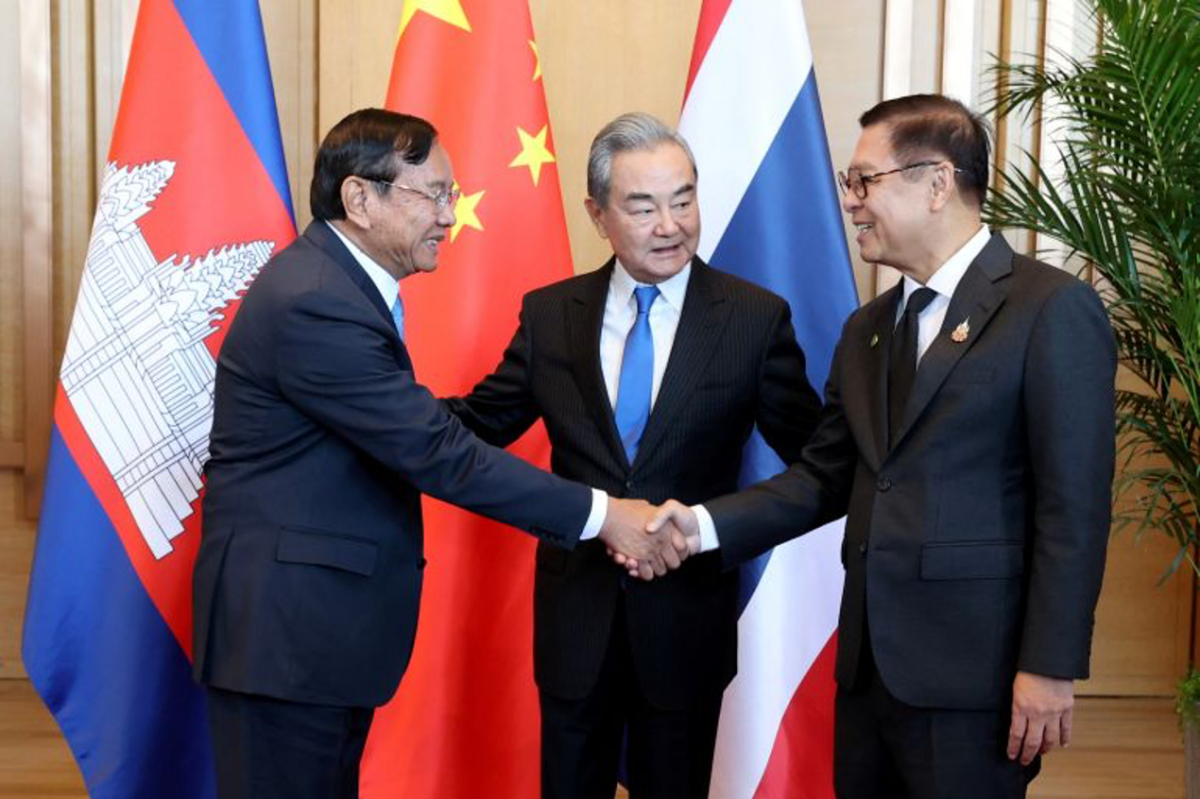 Cambodian foreign minister Prak Sokhonn (left) shakes hands with his Thai counterpart Sihasak Phuangketkeow as Chinese foreign minister Wang Yi looks on, after talks in China's Yunnan province. AKP
In the heart of Southeast Asia, where history has too often tested borders and tested friendships, a quiet but momentous step toward lasting stability occurred on December 27, 2025.
Cambodia and Thailand, both members of ASEAN, signed a joint statement at the 3rd Special General Border Committee (GBC) Meeting. They committed to an immediate ceasefire effective at noon local time, halting weeks of deadly clashes that had claimed lives, displaced communities and shaken regional confidence. An ASEAN Observer Team (AOT) was tasked with monitoring implementation of the ceasefire, while both sides pledged to resume dialogue, restore trust and address humanitarian needs along their shared frontier.
This was not the first attempt at peace. The Kuala Lumpur Peace Accord of October 2025, signed on the sidelines of the ASEAN Summit with facilitation from Malaysia (as ASEAN chair) and witnessed by US President Donald Trump, had offered hope. Yet tensions reignited in early December, reminding us that ceasefires require constant nurturing.
What made the December 27 agreement different — and why it deserves the trust of every Cambodian, Thai and ASEAN citizen — is the inclusive, multi-layered diplomacy that sustained it. At its core was a clear, constructive contribution from China that complemented, rather than competed with ASEAN-led efforts.
China’s role was never about imposing solutions or claiming credit. It was about practical support at a critical juncture. In the days leading up to the ceasefire, Beijing’s Special Envoy for Asian Affairs engaged both capitals through shuttle diplomacy, urging restraint and dialogue.
When the Joint Statement was signed, China immediately welcomed it. The following day, December 28–29, foreign ministers and senior military officials from Cambodia, Thailand and China convened at Fuxian Lake in China’s Yunnan province.
The resulting “Anning Outcome” was modest yet meaningful: commitments to consolidate the ceasefire, advance humanitarian de-mining, provide immediate aid to displaced border communities and support the work of the AOT. China offered technical assistance through the Joint Coordinating Task Force and stood ready to maintain military-to-military contacts — but only upon request by both sides. No unilateral pressure. No hidden agendas. Simply “Asian way” diplomacy, rooted in mutual respect and shared prosperity.
Cambodia’s long-standing friendship with China has delivered tangible infrastructure, investment and development that strengthen sovereignty and lift livelihoods. In this crisis, Beijing’s engagement reinforced that friendship without undermining Cambodia’s independent decision-making or ASEAN’s centrality.
For our Thai neighbours, the same approach signalled respect for Thailand’s security concerns and national dignity. For the wider ASEAN family — from Hanoi to Jakarta, Manila to Singapore — the message is even clearer: major external partners can play stabilising roles when they align with ASEAN’s own mechanisms rather than bypass them.
Skeptics may ask whether China’s involvement reflects self-interest. The honest answer is yes — but it is enlightened self-interest that coincides with ours. A stable Cambodia-Thailand border safeguards regional supply chains, protects Belt and Road projects that benefit multiple ASEAN states, and prevents external powers from exploiting divisions.
Peace here reduces the risk of spillover that could distract from South China Sea code-of-conduct negotiations or broader economic cooperation. China’s upgraded Free Trade Agreement with ASEAN, signed earlier in 2025, already shows Beijing understands that prosperity and security are inseparable. By helping de-mine fields, reopen border trade routes and support displaced families, China is investing in the very stability that allows trade and people-to-people ties to flourish across the region.
Importantly, this was not a zero-sum game. The US played a valuable part in the October Accord, and Washington’s continued calls for implementation are welcome. ASEAN itself led the observer mission and crisis diplomacy. China’s contribution filled a practical gap at the moment when momentum risked stalling again. Such complementarity — ASEAN at the driver’s seat, with responsible partners providing support — is exactly the model that builds trust across our diverse 11-member community.
The true significance of December 27 lies not in any single country’s role, but in what it proves possible. It demonstrates that longstanding neighbours can choose dialogue over confrontation, even after painful clashes. It shows that external powers can contribute positively when guided by respect for sovereignty and ASEAN-led processes. And it reminds every Cambodian and every ASEAN citizen that peace is not abstract rhetoric; it is concrete — ceasefires monitored, mines cleared, markets reopened, families reunited.
As we move into 2026, let us treat this agreement as a foundation, not a photo opportunity. Cambodia and Thailand must implement it in good faith. ASEAN must remain vigilant through its observer team. And China — having shown it can act as a partner for peace — should continue to be judged by deeds: supporting de-mining, aiding reconstruction and respecting the outcomes both sides negotiate.
The region is watching. So far, the signs are encouraging.
Peace in ASEAN is not a gift from any capital; it is a shared achievement. The December 27 ceasefire, backed by China’s steady and respectful engagement, reminds us that when neighbours and partners choose cooperation, the entire region wins. Cambodians, Thais and all ASEAN peoples have every reason to trust this process — because it was built on our own terms, with friends who understand that our stability is their stability too.
Dr. Seun Sam is a policy analyst of the Royal Academy of Cambodia. The views and opinions expressed are his own.