Preah Vihear and the Limits of International Law
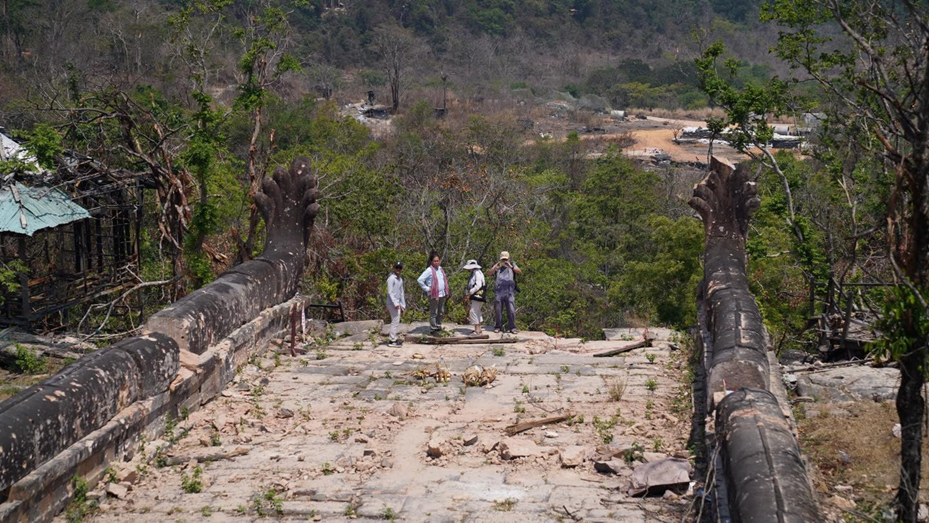 Officials pay a recent visit to Preah Vihear temple, against the backdrop of Thai military action. NAPV
#opinion
The deployment of cluster munitions in the vicinity of the 11th-century Preah Vihear temple marks a critical intersection of international law, cultural preservation and modern border security. Reports from the Cambodian Mine Action Centre (CMAC), detailing the dispersal of unexploded ordnance (UXO) across 2,300 square kilometres alongside 562 documented points of structural damage to this UNESCO World Heritage site, elevate what might otherwise be localised friction into a matter of international concern.
This situation demands analysis beyond nationalist rhetoric — grounded instead in legal frameworks, socioeconomic consequences and strategic foresight. For communities living near the site, the implications are not abstract: fields are left uncultivated, access routes become hazardous and livelihoods tied to tourism are suspended under the persistent threat of unexploded ordnance.
The Legal Realities of Asymmetric Border Friction
The use of cluster munitions in contested zones presents a complex challenge in international law. While neither Cambodia nor Thailand are signatories to the Convention on Cluster Munitions (CCM), this non-membership does not create a legal vacuum.
Customary International Humanitarian Law (IHL), codified in the Geneva Conventions and their Additional Protocols, universally mandates the principles of distinction and proportionality. Parties to a conflict must distinguish between military objectives and civilian infrastructure and must avoid attacks that cause excessive harm relative to anticipated military advantage. The deployment of wide-area effect weapons near civilian villages and a globally recognised cultural monument raises serious, legally grounded concerns regarding compliance with these principles.
Moreover, both states are bound by the overarching principles of the 1954 Hague Convention for the Protection of Cultural Property in the Event of Armed Conflict. This framework explicitly prohibits the targeting, misuse or endangerment of cultural heritage sites. Damage inflicted on Preah Vihear — whether direct or incidental — must therefore be assessed within this broader legal context.
When munitions affect an area as vast as 2,300 square kilometres — embedding parachute-retarded bomblets into forest canopies and civilian pathways — the consequences extend far beyond immediate military engagement. The result is functional “area denial”: A long-term condition of insecurity that disrupts economic activity, undermines human safety and imposes a decades-long burden of clearance. Tourism, a vital economic engine for the region, becomes one of its earliest casualties.
Navigating the Potential Collapse of MoU 43
Legal concerns alone do not define the strategic risk — the erosion of diplomatic mechanisms compounds it. The physical damage to Preah Vihear is occurring alongside a deteriorating bilateral environment. Much of the management of overlapping claims and border demarcation has historically depended on established agreements, notably the 2000 Memorandum of Understanding (commonly referred to as MoU 43 under the Thai Buddhist calendar).
Should the trust underpinning MoU 43 erode completely — or should the agreement be suspended or abandoned — Cambodia will face a fundamentally altered strategic landscape. Reliance on bilateral negotiation in a context of diminished trust becomes a liability rather than a solution.
Preparing for a post-MoU 43 reality requires a shift toward a more resilient and independent strategic posture built on three key pillars:
1. Transitioning to Multilateral Legal Arbitration
If bilateral mechanisms fail, Cambodia must be prepared to elevate the dispute fully to multilateral forums. This requires reframing the issue from a border disagreement into a matter of international legal accountability concerning sovereignty and cultural heritage protection.
Building on precedents set by the International Court of Justice (ICJ) rulings of 1962 and 2013, Cambodia should systematically document UXO deployment patterns, damage assessments and associated risks. Such evidence can support formal engagement with the ICJ and the UN Security Council. Legal leverage grounded in verifiable data offers a more durable form of deterrence than diplomatic protest alone.
2. Enhancing Border Transparency and Verification
In an environment where trust is limited, transparency becomes strategic currency.
Cambodia must invest in modern border monitoring capabilities, including counter-battery radar systems and persistent drone surveillance.
By establishing an incontrovertible, real-time record of cross-border activity, Cambodia reduces the space for plausible deniability. This enables international observers, ASEAN partners and legal bodies to assess developments based on empirical evidence rather than competing narratives. In contested environments, data is not merely informative — it is strategic.
3. Building Strategic Economic Resilience
Prolonged border instability inevitably disrupts supply chains, trade flows and regional development. To mitigate external leverage, Cambodia must accelerate efforts toward economic diversification and logistical independence.
Infrastructure projects such as the Funan Techo Canal and the expansion of autonomous port capacity are not merely economic initiatives — they are strategic safeguards. Reducing reliance on cross-border land routes enhances national resilience. At the same time, the tourism sector should pivot toward deeper international partnerships, securing global heritage funding for restoration and UXO clearance to sustain long-term recovery.
Conclusion: Securing Sovereignty Through Law and Strategy
The protracted crisis at Preah Vihear transcends the geography of a border dispute. It represents a broader stress test for the international rules-based order in Southeast Asia. The use of long-lasting ordnance in proximity to a World Heritage site is an unsustainable form of geopolitical pressure — one that demands a firm, legally grounded response.
If the bilateral framework embodied by MoU 43 collapses, Cambodia cannot afford to remain reactive. The path forward requires a proactive strategy anchored in international law, supported by technological transparency, and reinforced by economic independence.
Preah Vihear must stand not as a casualty of asymmetric attrition, but as proof that sovereignty can be secured through law, evidence and strategic foresight.
Panhavuth Long is founder and attorney-at-law at Pan & Associates Law Firm. The views and opinions expressed are his own.
-Phnom Penh Post-
———————