The Silent Siege: Why 1,300 Explosives at Preah Vihear Are a Wound to World History
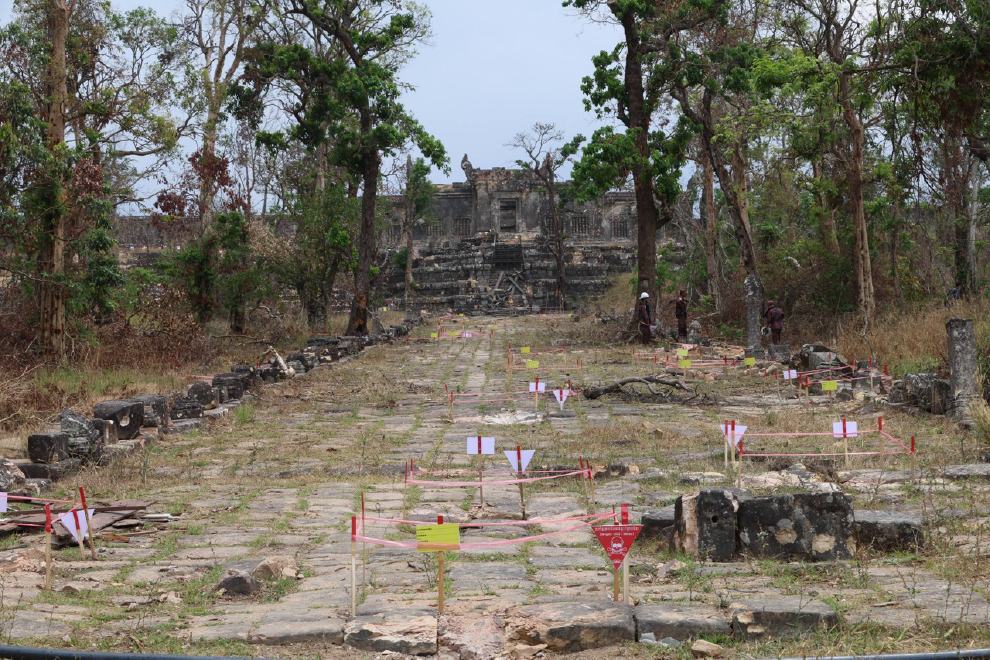 Warning markers placed at Preah Vihear Temple by CMAC deminers after the temple was heavily bombarded during the December fighting. AKP
#National
There are places on Earth that do not belong to a single flag, but to the collective soul of humanity. Preah Vihear, the “Temple in the Clouds”, is one of them. Perched on a 525-metre limestone cliff in the Dangrek Mountains, this 11th-century Khmer masterpiece is a triumph of perspective — a spiritual staircase carved into the heavens that has survived a millennium of shifting empires.
But today, the sanctuary is under a different kind of siege. As a man of the law, I see more than just broken stone; I see a lethal desecration that violates the very foundations of international humanitarian and cultural protection treaties.
The Mathematics of Desecration
The Cambodian Mine Action Centre (CMAC) recently confirmed a chilling reality: more than 1,330 pieces of unexploded ordnance (UXO) have been recovered from the temple grounds following the military clashes of late 2025.
Think about that number: 1,330. These are not merely the remnants of a skirmish; they are the forensic evidence of a war crime against history. CMAC teams have unearthed 105-mm and 155-mm artillery shells, cluster munitions and traces of white phosphorus nestled against stones hand-carved by artisans a thousand years ago. To turn a UNESCO World Heritage Site into a ballistic target is not a tactical necessity — it is a flagrant breach of the 1954 Hague Convention for the Protection of Cultural Property.
A Masterpiece Held Hostage
When heavy weapons are turned toward Preah Vihear, the victim is our shared human story. The damage reported by Cambodia’s Ministry of Culture and Fine Arts is a scar on our global identity:
Shattered Sovereignty of History: The gopuras (ornate gateways) and the historic northern stairways — the path pilgrims have climbed for ten centuries — now bear the jagged wounds of modern shrapnel. Under international law, these are protected civilian objects, immune from military targeting.
The Toxic Legacy: The deployment of white phosphorus near an ancient sanctuary is a visceral insult to the sanctity of the land and a direct threat to the safety of the conservationists tasked with its survival.
The Stalled Healing: Justice is delayed when recovery is impossible. How can an archaeologist restore a crumbling archway when the ground beneath them is seeded with death? The temple grounds have been transformed into a minefield, effectively holding a thousand years of history hostage.
A Call to the Global Conscience
To the global community of historians, jurists and heritage lovers: This is your heritage, too. When the Great Pyramid is threatened, the world gasps. When Notre Dame burns, the world weeps. Preah Vihear deserves that same global embrace.
It is a testament to a civilization that reached for the stars through stone. If we remain silent when a World Heritage site is used as a tactical waypoint, we signal to future generations that our history is expendable.
From a legal standpoint, silence is acquiescence. We must not acquiesce to the destruction of the irreplaceable.
The War After the War
The ceasefire may be in effect, but for Preah Vihear, the war continues. It remains a prisoner of the 1,300 explosives still haunting its shadows.
Cambodia stands as the guardian of this wounded giant, but the legal and moral burden of its protection belongs to the world. We must demand that these “stones of the gods” never again be used as shields or targets. We must stand with the deminers and the conservators who are painstakingly peeling back the layers of violence to reveal the beauty beneath.
Preah Vihear survived the fall of the Angkorian Empire. We cannot allow it to fall to the negligence and violence of the modern age.
Panhavuth Long is founder and attorney-at-law at Pan & Associates Law Firm. The views and opinions expressed are his own.
-Phnom Penh Post-
———————