
Rethinking China’s Role in the Cambodia-Thailand Border Conflict
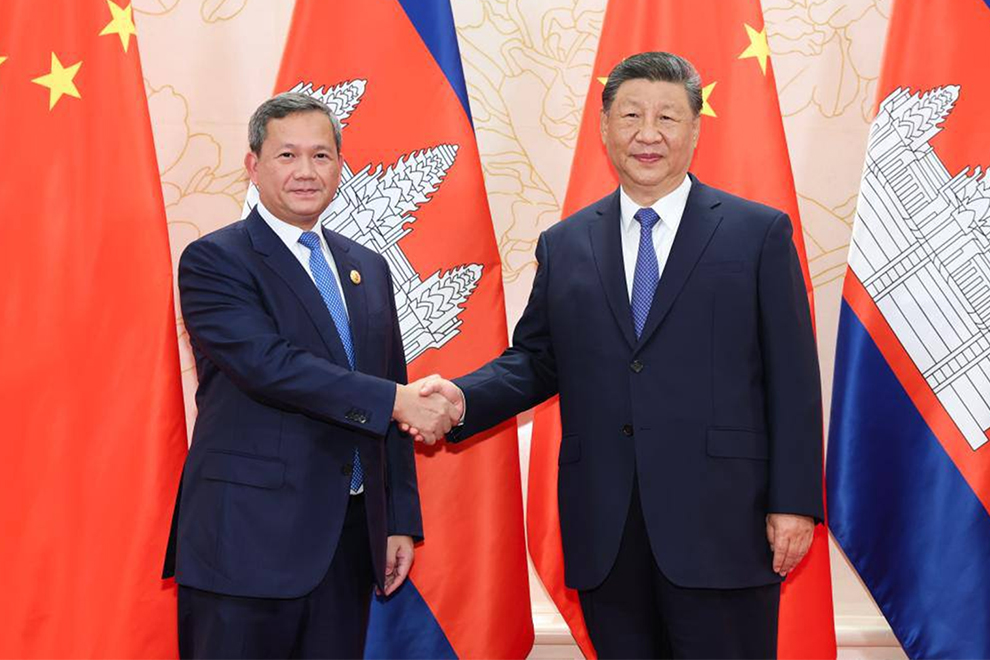 [Chinese President Xi Jinping (right) met with Cambodian Prime Minister Hun Manet in Tianjin, north China, on August 30, during the Shanghai Cooperation Organization (SCO) Summit 2025. Xinhua/Huang Jingwen]
-Opinion-
The latest Cambodia-Thailand border crisis is often framed as a quarrel over ambiguous lines on a colonial-era map. Yet the artillery smoke hanging over Banteay Meanchey and Sisaket also carries the outline of a third player, China. When Cambodian and Thai troops traded shells and airstrikes, Beijing was not a distant observer. It was Cambodia’s main arms supplier, its biggest creditor, its key political shield and, increasingly, a self-declared constructive actor urging both sides to exercise restraint.
To understand China’s real role in this conflict, it is not enough to read calming press statements from Beijing. The key questions are how Chinese support has shaped the balance of power between Phnom Penh and Bangkok, what China actually gains from stepping into a peacemaker role, and whether its presence makes escalation less likely or simply more complicated. At the same time, the picture is not purely negative. Despite the clear imbalance in its relations with the two countries, China still has the capacity to play a positive role in anchoring both sides to the agreements they have already signed and in working with ASEAN and the US to enforce regional mechanisms more strictly.
The starting point is the asymmetry. China is no neutral bystander. For more than a decade, Cambodia and China have deepened their relationship into something close to strategic dependence. Chinese funding has built highways and bridges, powered special economic zones, reshaped Sihanoukville and underwritten the modernisation of Ream Naval Base. Chinese training and equipment have become central to the Royal Cambodian Armed Forces, reinforced by regular joint drills that showcase new hardware and interoperability. A government that feels militarily equipped and politically shielded by a great power is less vulnerable to external pressure and more confident about taking a hard line on sovereignty.
From Bangkok’s perspective, this creates a strategic headache. Thailand’s military planners are not dealing with the Cambodia of the 1990s, and that shift cuts both ways. For decades, Thai officers have seen themselves as the bigger power in mainland Southeast Asia, with superior economic weight, more capable armed forces and wider geopolitical leverage. They have been accustomed to the idea that pressure from Bangkok can nudge smaller neighbours into compromises on border security. Today, however, they are confronting a neighbour whose forces are backed by Chinese weapons, exercises and infrastructure, including facilities that some in the region fear could one day host elements of the People’s Liberation Army Navy.
The border is no longer just a local flashpoint between an established heavyweight and a weaker state; it sits in a theatre increasingly shaped by Chinese logistics, intelligence and political influence. Cambodia is by no means a puppet, but its room for manoeuvre is undeniably enlarged by the knowledge that Beijing has its back, and by the belief in Phnom Penh that Chinese support helps it resist Thai pressure and avoid being forced into unequal bargains over territory and security.
Alongside this patronage, China has tried to present itself as a responsible stabiliser. Chinese officials have voiced concern, called for restraint and offered support for dialogue, often linking stability on the frontier to broader economic cooperation and connectivity projects that Beijing wants to advance across mainland Southeast Asia. The message is that peace is good for trade, and China is ready to help. Yet this mediation is constrained by Beijing’s own choices. Thailand knows China is much closer to Phnom Penh than to Bangkok. Cambodia knows its value to China rests partly on being a loyal voice inside ASEAN and a reliable partner in other sensitive theatres such as the South China Sea. When one side is heavily favoured, it is difficult for the other to see China as an honest broker, no matter how carefully worded the statements may be.
China’s preferred style of diplomacy tends to be highly controlled and elite driven. It is comfortable hosting meetings, issuing joint communiqués and bundling peace with investment deals. It is less enthusiastic about transparent multilateral monitoring mechanisms that would give border villagers confidence that the guns will stay silent. ASEAN frameworks and accords have done much of the visible heavy lifting at earlier moments of de-escalation, not Chinese envoys. Once implementation began to wobble, China’s concern sounded cautious rather than decisive, as if it preferred to avoid taking sides on enforcement.
Despite the imbalance in its relations with both countries, China can still help lock Cambodia and Thailand into the agreements they themselves have negotiated. Instead of offering generic calls for restraint, Beijing could put its name and resources behind strict implementation of those deals, including ceasefire provisions, demilitarised zones and hotlines between commanders.
It does not need to do this alone. Cooperation with ASEAN and the US on monitoring and verification would give any mechanism much greater legitimacy. An ASEAN-led observer mission supported by Chinese funding and American technical expertise, for example, would be harder for either side to ignore or manipulate. In that arrangement China would not be a neutral referee, but it would be part of a coalition that has a shared interest in preventing a local clash from turning into a wider crisis.
That shared interest is often overlooked in narratives that cast every move in Southeast Asia as a zero-sum contest between Beijing and Washington. On the Cambodia-Thailand border, genuine peace and stability would benefit both powers. ASEAN is widely seen as one of the world’s more peaceful regions and as a friendly environment for global production and investment. Factories, supply chains and infrastructure projects from both China and the US depend on predictable conditions, open borders and the absence of serious conflict. A border that is periodically closed by shelling, landmine accidents or nationalist posturing undermines the very economic environment that both external powers say they value.
If China works with ASEAN and the US to push for strict implementation of regional mechanisms, it will be acting in its own long-term interest as well as in the interests of Cambodia, Thailand and the broader region.
Joint support for de-mining, the monitored withdrawal of heavy weapons, reopening of crossings and genuine transparency at strategic facilities would begin to align Chinese behaviour with Chinese rhetoric. The US, for its part, would have to accept that in this space it is better to share credit for success than to compete for influence while villagers live under the shadow of artillery.
None of this would transform China into a neutral arbiter. Beijing will remain closer to Phnom Penh than to Bangkok, and its strategic interests will not suddenly merge with the everyday concerns of border communities. But if Cambodia and Thailand press for meaningful demilitarisation on the ground, for empowered ASEAN mechanisms, and for real cooperation between China, ASEAN and the US in enforcing those rules, they can narrow the gap between Chinese rhetoric and Chinese practice.
That narrowing would not solve a century-old dispute overnight. It would, however, move the frontier away from a future defined by guns, landmines and mutual suspicion, and closer to one where the most visible flows across the border are traders, workers and families, in a region that continues to function as a peaceful and welcoming hub for global production and investment rather than as another arena for reckless great-power games.
Seng Vanly is a Phnom Penh-based geopolitical analyst. The views and opinions expressed are his own.
-The Phnom Penh Post-