Cambodia protests Thai border moves as villagers clash with military in Banteay Meanchey
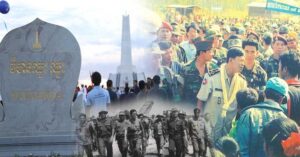
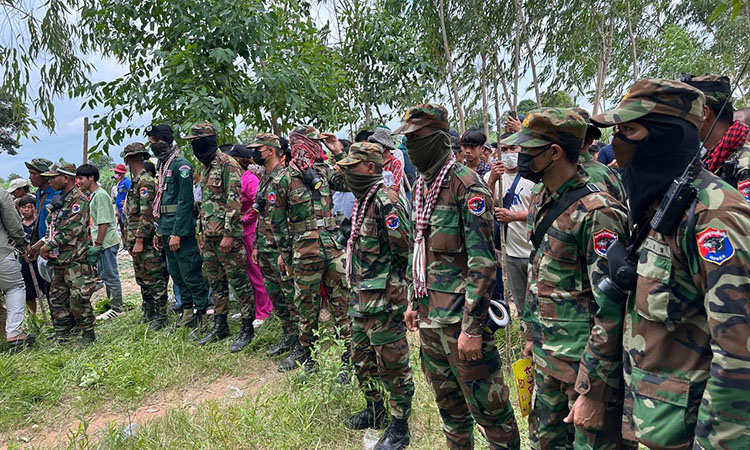
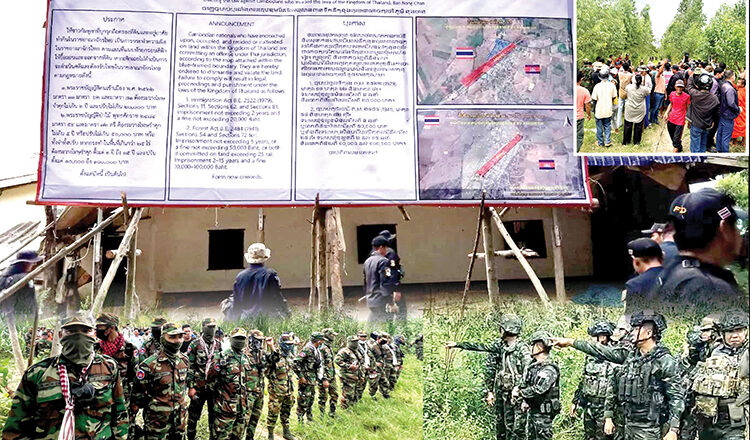 (Top L) A sign put up by the Thai army warning Cambodian villagers to vacate their land. (Top R) Cambodian villagers block Thai soldiers from entering their village.(Bottom L) Cambodian soldiers guard local villagers. (R) Thai soldiers attempt to evict Cambodian villagers from their homes. Photos: Royal Cambodian Army and Royal Thai Army
Synopsis: Cambodian villagers confront Thai troops over new barbed wire fences and eviction warnings, sparking a scuffle at the border. Phnom Penh has lodged another diplomatic protest, accusing Thailand of expanding conflict areas, unilateral demarcation, and threatening forced removal of hundreds of Cambodian families.
Cambodian villagers stood off against the Thai army yesterday after the latter attempted to lay more barbed wire along a Cambodian border village in Banteay Meanchey province, sparking a scuffle between the two sides. The incident prompted Phnom Penh to lodge yet another diplomatic protest against Thailand for expanding the conflict area.
Tensions rose in O’Beichoan commune, O’Chrov district when Thai authorities yesterday installed two banners warning 170 Cambodian families in two border villages to “dismantle and vacate the land” or face punishment under Thai law. The signs were written in Thai, Khmer, and English under the order of Thailand’s Sa Kaeo Governor Parinya Photisat. However, the Khmer text appeared as illegible scribbles, further angering villagers.
“Cambodian nationals who have encroached upon, occupied, and resided or cultivated on land within the Kingdom of Thailand are committing an offence under Thai jurisdiction, according to the map attached within the blue-framed boundary. They are hereby ordered to dismantle and vacate the land,” read a sign in English.
“Failure to comply will result in legal proceedings and punishment under the laws of the Kingdom of Thailand,” it added, warning of penalisation under Thailand’s Immigration Act and Forest Act.
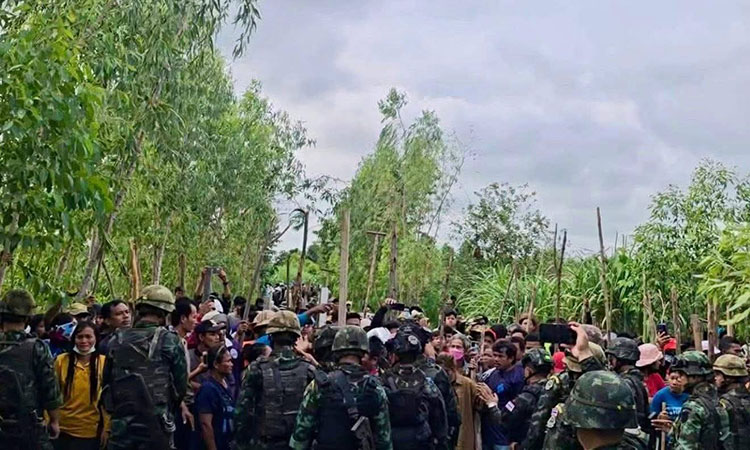
The move caused enraged local residents to gather yesterday morning at the border village of Chouk Chey. Thai military personnel, supported by police yesterday, were seen in a scuffle with the villagers, while Cambodian soldiers were present to protect citizens on Cambodian soil, eyewitnesses said.
Banteay Meanchey Provincial Governor Oum Reatrey yesterday urged Thai authorities to refrain from escalating tensions and to respect the border arrangements. He said the issue should be addressed through the General Border Committee (GBC) and the Joint Border Committee (JBC) under established mechanisms.
On Wednesday, the Thai Governor of Sa Kaeo province issued a statement urging cooperation to relocate the families said to be living in the villages of “Ban Nong Chan” and “Ban Nong Ya Kaeo” in Thailand.
In a formal reply dated September 2, Reatrey acknowledged receipt of Sa Kaeo’s request but said the matter directly concerns border management, demarcation, and placement of boundary markers. These, he noted, are under the purview of the GBC and JBC.
Reatrey cited the 1995 Agreement on Border Cooperation and the 2000 Memorandum of Understanding (MOU) on land boundary demarcation as the legal frameworks that govern such disputes.
He warned that any unilateral action affecting residents currently living and relying on the disputed area would constitute a violation of these agreements, the July 28 ceasefire deal between Cambodia and Thailand, and the spirit of recent bilateral border meetings.
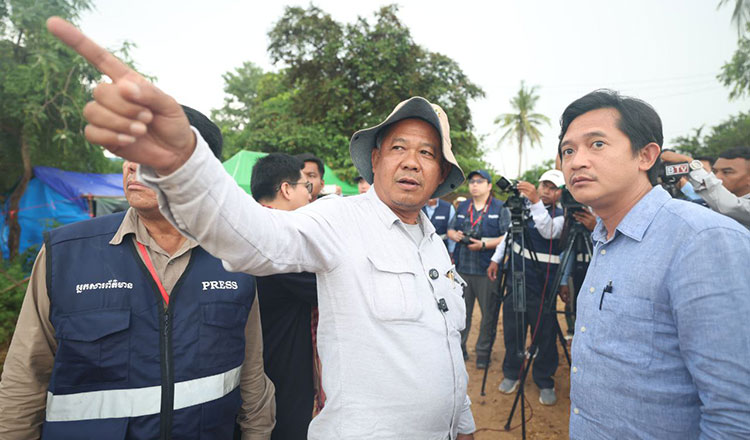
“Any unilateral action that impacts people residing in the area would breach the 2000 MOU and the ceasefire agreement of July 28, 2025, as well as the understanding reached during the GBC meeting on August 7 in Malaysia and the Regional Border Committee meeting on August 22,” Reatrey wrote.
The governor urged Thai authorities to maintain the current situation on the ground and allow the GBC and JBC to address the matter through established mechanisms. He expressed hope that the dispute would soon find a peaceful solution based on international law and mutual agreements.
“In full respect of the 2000 MOU, international law, and bilateral commitments on border affairs, I request that the current border and population situation be preserved, leaving this issue to the GBC and JBC, which are the competent mechanisms for resolution,” his letter stated.
In a statement yesterday, the Foreign Affairs and International Cooperation Ministry said it had communicated the Cambodian government’s protest “over the acts of expanding conflict area by Thai forces in the border regions” between the two nations, particularly in areas where Cambodian communities have lived for decades.
In its protest, the ministry highlighted concerns over Thai military activities along the border in Banteay Meanchey province. It said the installation of barbed wire, nets, barriers, and tyres in O’Beichoan commune last month has forced many Cambodian families from their homes and farmland. The ministry also cited an ultimatum issued by Thai authorities in late August, demanding that Cambodian villagers evacuate Chouk Chey within three to six months or face removal by force.
Thailand’s to issue land titles to its citizens in areas long inhabited by Cambodian families were described as an attempt to unilaterally redraw the border. Such actions, the ministry stressed, violate the mandate of the Joint Commission on Demarcation for Land Boundary (JBC) and run contrary to MOU 2000, the ceasefire, and agreements reached in recent General and Regional Border Committee meetings.
“The Royal Government of Cambodia remains firmly committed to seeking amicable resolution to boundary disputes with all its neighbours through peaceful means in accordance to international law while remaining resolute in upholding its principled position that borders must not be changed by force,” the Ministry said.
The statement added that Cambodia urges Thailand to maintain the status quo and to settle the current border situation through the GBC and JBC, as previously committed and mutually agreed by both sides.
In a statement yesterday, the Royal Government Spokesperson Unit said that under the leadership of Prime Minister Hun Manet, Cambodia is making the “utmost efforts to defend national sovereignty and territorial integrity by all possible means.”
The government noted that since August 12, Thai actions have affected Cambodian citizens “who have long been residing” and dependent on the area, prompting Phnom Penh to act through diplomatic and legal mechanisms.
The Ministry of Foreign Affairs and International Cooperation has issued three diplomatic protest notes to Thailand, while also raising the issue with the United Nations and other international organisations. Cambodian officials also organised visits to the affected areas with diplomats, UN representatives, and NGOs.
Additionally, an Extraordinary Meeting of the Cambodia-Thailand General Border Committee (GBC) and four Regional Border Committee (RBC) meetings were held, focusing on protecting Cambodia’s territorial integrity. The Border Affairs Secretariat issued three diplomatic protests under the Joint Border Commission framework, and provincial authorities in Banteay Meanchey submitted two protest notes to Sa Kaeo province in Thailand.
The Cambodian Human Rights Committee also sought urgent intervention from international human rights mechanisms, including the UN Special Rapporteur on adequate housing, the Office of the United Nations High Commissioner for Human Rights, the ASEAN Intergovernmental Commission on Human Rights, and other independent institutions.
The government said Mr Hun Manet has raised the matter in bilateral and multilateral meetings with major leaders. At the recent Shanghai Cooperation Organisation Plus Summit in Tianjin, he discussed the issue with Chinese President Xi Jinping, UN Secretary-General António Guterres, Malaysian Prime Minister Datuk Seri Anwar Ibrahim, and Wang Huning, Chairman of the National Committee of the Chinese People’s Political Consultative Conference.
The Prime Minister, according to the statement, requested intervention “to effectively and fully implement the ceasefire through the necessary presence of a third-party monitoring mechanism, to resolve border issues peacefully based on international law, and to halt the expansion of conflict zones, unlawful military occupation, and forced eviction of civilians.”
Meanwhile, Senate President Hun Sen has also raised the issue in meetings with foreign leaders, calling for peaceful solutions in line with international law.
“The protection of national sovereignty and territorial integrity has always been the top priority of the Royal Government of Cambodia, led by the Cambodian People’s Party, in the past, present, and future,” the statement said.
-Khmer Times-