Flags once again flying over Preah Vihear Temple
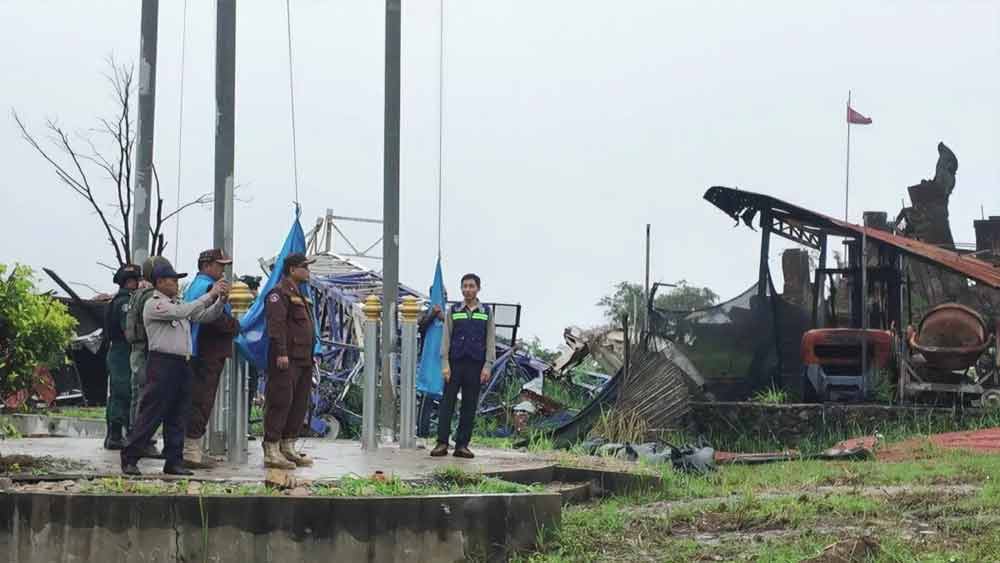
 The Cambodian national flag, along with those of UNESCO and World Heritage sites, are once again flying above Preah Vihear Temple. Hong Raksmey
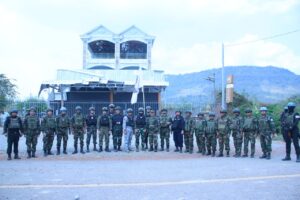
Cambodia’s national flag, the UNESCO flag and the World Heritage flag were raised again at Preah Vihear Temple on September 10, almost nine months after the site’s three flagpoles were damaged by Thai artillery strikes during last December’s armed clashes.
Local authorities described their restoration as a symbol of solidarity, Cambodia’s continued presence and the Kingdom’s commitment to protecting the World Heritage site.
A flag-raising ceremony took place at the temple, where the scars from last year’s armed conflict remain visible. It came a day after a joint World Heritage Centre-ICOMOS mission report on damage to the temple was officially published on the World Heritage Centre’s website.
Kong Puthikar, director-general of the National Authority for Preah Vihear (NAPV), said before the flag-raising that all three flagpoles had fallen during the fighting in December 2025 and were subsequently repaired.
“The white-painted marks you can see on these flagpoles are the places where they were repaired so they could stand again,” he explained.
Puthikar described how raising the flags again was more than a ceremonial act; it was intended to demonstrate unity in protecting the nation and its heritage.
“We are holding this ceremony to demonstrate our solidarity. We stand united for our nation and for our heritage,” he said.
“Raising the flags again means that our presence is here. Our flags continue to stand firm,” he added.
The raising of the flags comes as the condition of Preah Vihear Temple receives renewed international attention following the joint WHC-ICOMOS mission, which inspected the temple in March.
Their report assessed that the 2025 attacks, particularly those in December, caused extensive damage across the heritage site.
According to the report, Cambodian authorities identified 142 locations that were damaged during the July clashes and another 420 from the December fighting.
The mission noted that the scale of damage resulting from the latest conflict was incomparable with that caused by previous conflicts and had significantly affected the integrity, authenticity and Outstanding Universal Value of the property.
An assessment conducted by the NAPV following the December 7-27, 2025, fighting also recorded damage to almost all major structures of the temple, with the destruction in December significantly more extensive than that documented following the July clashes.
Cambodian authorities have accused the Thai military of causing damage to the temple through artillery fire and airstrikes.
Thailand, meanwhile, has maintained that its operations targeted military positions and has accused Cambodia of using the temple area for military purposes, an allegation Cambodia has denied.
As the conflict was unfolding on December 10, 2025, UNESCO expressed deep concern over escalating tensions between Cambodia and Thailand, particularly in the vicinity of Preah Vihear Temple, and called for the urgent protection of cultural heritage.
UNESCO also reminded all parties of their obligations under international law, including the 1954 Hague Convention for the Protection of Cultural Property in the Event of Armed Conflict and the 1972 World Heritage Convention.
Security conditions surrounding the temple remain an obstacle to conservation work. The WHC-ICOMOS report called for urgent measures to secure unstable structures, complete documentation of the damage and safeguard displaced architectural elements.
Clearance of unexploded ordnance is also considered a prerequisite for allowing conservation teams to work safely at the site.
UNESCO is implementing the $120,000 “Emergency Safeguarding and Documentation of the Temple of Preah Vihear” project for 2026-2027.
It focuses on ensuring the core area is cleared of unexploded ordnance, documenting the condition of the temple, collecting and securing displaced stone fragments and providing temporary structural support to ancient structures at risk of collapse.
On the morning of September 10, the ASEAN Observer Team in Cambodia (AOT-KH) inspected the temple.
Preah Vihear Temple was inscribed on UNESCO’s World Heritage List in 2008. The International Court of Justice ruled in 1962 that the temple was under Cambodian sovereignty.
In an 2013 interpretation of that judgment, the court further clarified Cambodia’s sovereignty over the promontory of Preah Vihear. With scars of the conflict still visible on the ancient structures, the NAPV viewed the renewed raising of the three flags as a demonstration that protection and conservation of the temple will continue, even as the prospects for full restoration remain dependent on security conditions.
-Phnom Penh Post-