Information minister: Ceasefire not a title deed granting Thais control of Cambodian territory
 Information minister: Ceasefire not a title deed granting Thais control of Cambodian territory
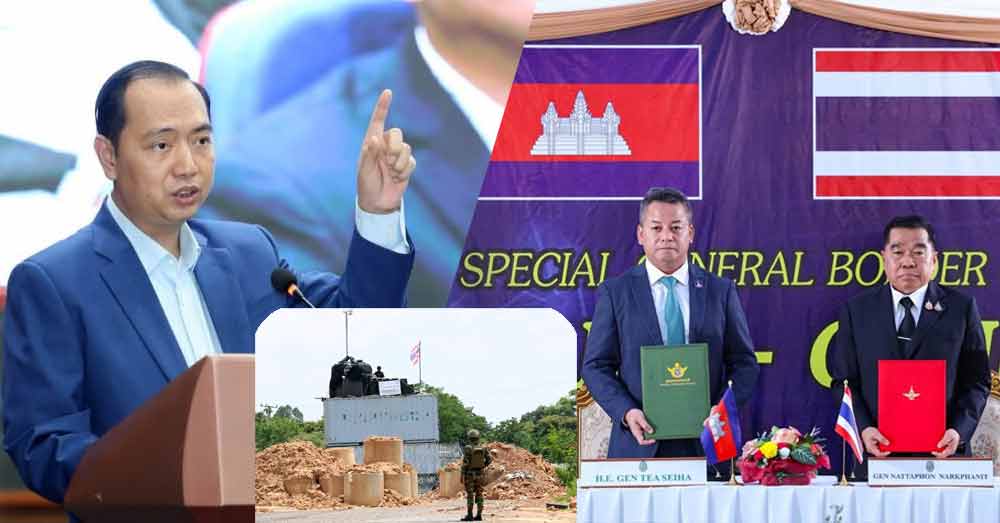
Minister of Information Neth Pheaktra has rejected any interpretation suggesting that maintaining troop positions under a ceasefire gives either party the right to continue controlling disputed territory, stressing that the arrangement is a temporary military measure, not a title deed or the basis for creating a new border.
In a post addressing the current Cambodia-Thailand border situation, Pheaktra said the essence of a ceasefire was clear: no advance, no creation of new facts on the ground and no establishment of new border lines.
He questioned whether a ceasefire could transform territory occupied through force into the lawful territory of the occupying party. His answer was unequivocal: “It cannot”.
Pheaktra said Cambodia’s refusal to recognise border lines altered through the use of force was consistent not only with fundamental principles of international law, but also with the December 27, 2025 Joint Statement signed by Cambodia and Thailand.
The ceasefire took effect at noon on December 27. According to Pheaktra, both parties were required from that moment to halt further advances and troop movements and refrain from expanding or reinforcing control beyond their respective sides.
They were also obliged not to prevent civilians from returning home or undertake activities that could establish new border lines, he added.
Despite the terms of the agreement, Pheaktra alleged that the Thai military had failed to comply with all provisions of the Joint Statement and was selectively invoking clauses that served its interests.
He said one Thai argument was that the Joint Statement required both parties to maintain their existing troop positions without further movement. Under this interpretation, Thailand regarded the continued presence of its forces in those locations as compliance with the ceasefire rather than territorial occupation.
Pheaktra rejected this interpretation, arguing that paragraph 2, concerning the maintenance of troop positions, could not be read separately from paragraphs 3, 4 and 6 of the Joint Statement.
“Freezing troop positions was a temporary military measure intended to stop the fighting. It does not amount to recognition of sovereignty over the territory where troops happen to be positioned,” he said.
According to Pheaktra, paragraph 3 clearly states that all arrangements under the Joint Statement are without prejudice to border demarcation and the international boundary between the two countries.
He stressed that freezing troop positions did not mean freezing sovereignty, as military positions were not international boundaries and factual control through force did not constitute legal title.

“A ceasefire is not a title deed to territory. Where troops happened to be standing at noon on December 27, 2025, cannot determine where the international boundary lies,” he said.
Pheaktra accused Thai forces of advancing into Cambodian territory and carrying out unauthorised construction after the ceasefire. He claimed that some of the activities had extended not only beyond the international boundary recognised by Cambodia, but also well beyond the unilateral boundary line previously asserted by Thailand.
He referred to the alleged installation of razor wire and shipping containers, the digging of trenches and the construction of roads, fortifications and other infrastructure in areas Cambodia considers its territory.
Pheaktra argued that construction and reinforcement activities conducted after the ceasefire could not be defended as merely maintaining existing troop positions. Instead, he said, they could represent an attempt to consolidate control and create “new facts on the ground” for use in future territorial claims.
He warned that creating a fait accompli – an established situation intended to compel the other party to accept it – could ultimately lead to an attempt to incorporate Cambodian territory into Thailand, which he described as a violation of Cambodia’s sovereignty and territorial integrity.
Beyond the military and legal dimensions, Pheaktra pointed to the right of displaced civilians to return home as a practical test of whether the ceasefire was being implemented.
He asked why approximately 20,000 displaced Cambodians remained unable to return to their homes if Thailand maintained that no unlawful occupation had taken place.
Paragraph 4 of the Joint Statement requires residents of affected areas to be permitted to return home and resume their normal livelihoods without obstruction, in safety and dignity.
According to Pheaktra, if Cambodian residents remained unable to reach their homes, farmland or villages because of troop deployments, roadblocks, barbed wire or shipping containers, the situation could not be concealed behind the phrase “maintaining current troop positions”.
He described the situation as an encroachment on Cambodian territory that seriously affected residents’ rights to their homes, land and communities.
The information minister also called on Thailand to explain what he described as a contradiction between its claim that it respected the December 27 Joint Statement and its continued control of areas that Cambodia claims as its territory, based on the phrase “current troop positions”.
Pheaktra said Thailand could not invoke paragraph 2 to produce a territorial outcome that paragraph 3 expressly excluded. Nor could it selectively apply provisions that served its interests while disregarding other obligations under the same agreement.
“The agreement must be read and implemented as a whole. One paragraph cannot be selected in order to negate the others,” he said.
Pheaktra concluded that if Thailand genuinely respected the Joint Statement, that commitment should be demonstrated by halting further advances and the creation of new facts on the ground, refraining from consolidating control through force, allowing Cambodian civilians to return home and not using temporary military positions as the basis for territorial claims.
“This is the core meaning of a ceasefire: no advance, no fait accompli and no new border lines,” he said.