Cambodia urged to build self-reliance amid shifting global order
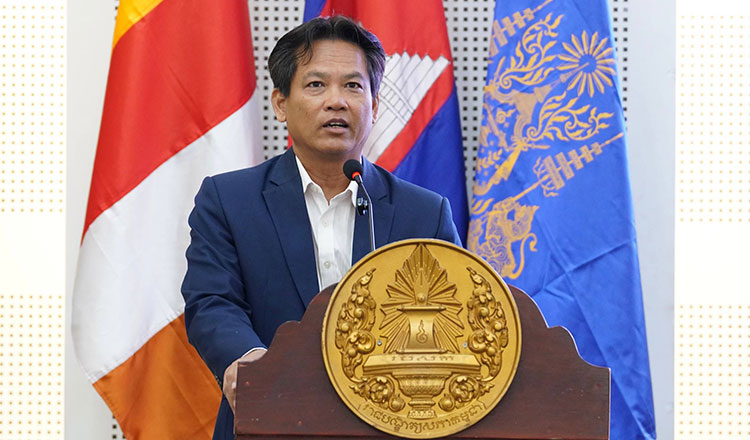 - Royal Academy of Cambodia President Sok Touch speaks in a roundtable on the shifting world order, in Phnom Penh on July 17. KT/Ben Sokhean
Synopsis: As global power dynamics shift and international institutions face declining influence, the Kingdom must strengthen the rule of law, invest in human capital and build greater self-sufficiency to safeguard its long-term development, speakers at a RAC roundtable say.
Cambodia must strengthen its rule of law, human capital and economic resilience to navigate an uncertain global environment, while investing in education and self-reliance as the international order undergoes change, speakers said during a roundtable discussion hosted by the Royal Academy of Cambodia (RAC) on July 15.
The discussion, “What scenarios are causing the world to lose its current order?”, brought together academics, policymakers, journalists and students to examine the impact of geopolitical tensions, shifting power dynamics and global economic uncertainty.
In his presentation, RAC President Sok Touch said Cambodia should focus on strengthening its internal capabilities rather than relying on external assistance.
“Before others can help us, we must first help ourselves. If we cannot help ourselves, no one else can help us,” he said.
Touch said global instability is driven by competition among major powers and urged countries to judge them by their actions rather than their rhetoric.
Responding to a question about attracting investment to Cambodia’s border areas, including the shared frontier with Thailand, he said tax incentives would not be enough to convince investors.
Instead, he outlined five priorities for strengthening Cambodia’s competitiveness: a strong legal framework, quality human resources, domestic capital development, competitive national brands and efficient transport infrastructure.
“Investors invest for 30 or 40 years. Governments change, but the law must continue protecting their investments,” he said.
Touch called on Cambodia to move beyond exporting raw materials by expanding value-added industries and developing recognised Cambodian brands, while improving transport networks – including waterways and railways – to reduce logistics costs.
Addressing Cambodia’s younger generation, he said education remains the country’s most important long-term investment.
“If the younger generation does not study hard, they should not later regret it or blame other countries for developing faster than Cambodia,” he said.
He pointed to neighbouring countries whose economic growth began with agricultural development before expanding into tourism, agro-industry and construction, urging Cambodian youth to strengthen their knowledge and skills to become high-quality human resources.
Referring to regional conflicts and changing global dynamics, Touch said Cambodia must build internal strength and rely on its own capabilities to ensure resilience and sustainable development.
Also speaking at the forum, Club of Cambodian Journalists President Puy Kea said the current international system has not collapsed despite growing geopolitical tensions, although the institutions that underpin it have become less influential.
“The world order has not been lost,” he said.
“As previous speakers have mentioned, it has not disappeared. We can clearly see that the United Nations, the International Monetary Fund, the World Bank, the International Criminal Court and the International Court of Justice still exist. They remain in place; it is simply that they are not as influential as they once were.”
Kea said the influence of international institutions weakened during Donald Trump’s presidency and noted that China has since assumed a prominent role in maintaining aspects of the global order.
He added that the international system is entering a new phase characterised by intensifying competition among major powers, the emergence of a multipolar world and rapid technological change.
The speakers agreed that as the global landscape becomes fragmented, Cambodia’s resilience will depend on strengthening governance, investing in human capital, expanding economic competitiveness and building national self-reliance.
-Khmer Times-