
Cambodian Delegation Committed to Dialogue and Praises Fuxian Consensus at Beijing Track II Forum
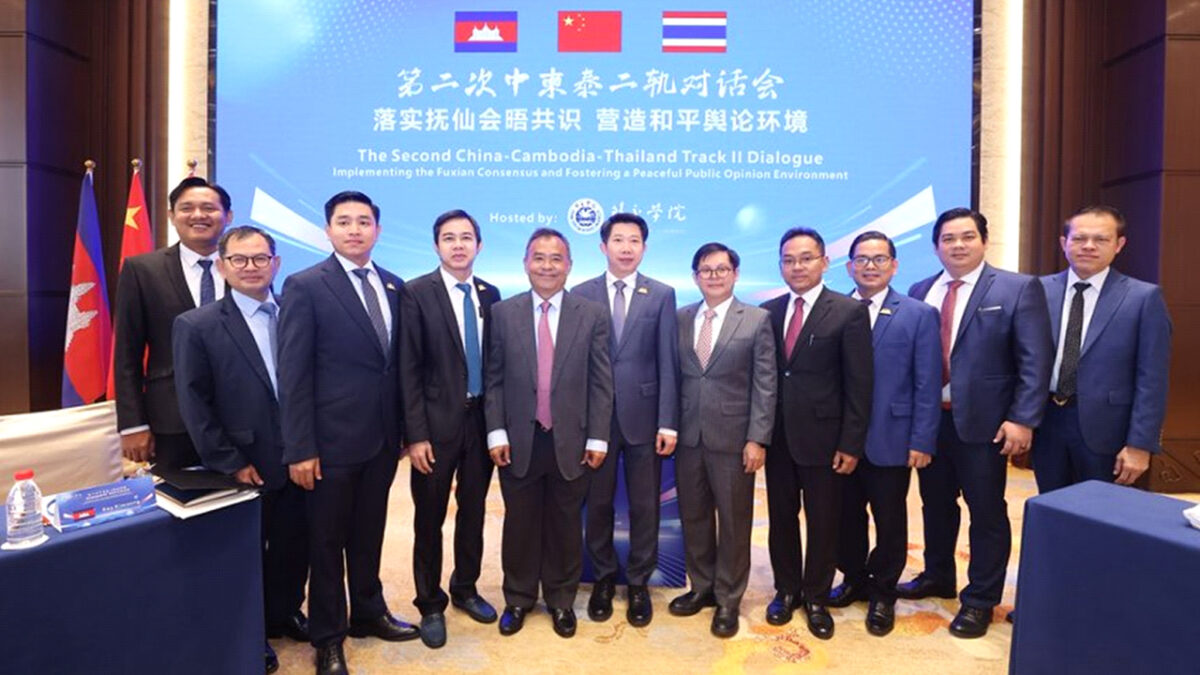 Several leading Cambodian scholars participated in the Second China-Cambodia-Thailand Dialogue in Beijing, China, on April 21. Supplied
#opinion
In a clear demonstration of its dedication to regional harmony, the Cambodian delegation strongly reaffirmed its full commitment to the path of dialogue, mutual respect and the peaceful resolution of any differences along the Cambodia-Thailand border. Participating in the Second China–Cambodia–Thailand Track II Dialogue held on April 20–21, hosted by the China Foreign Affairs University (CFAU) in Beijing, Cambodian scholars, civil society leaders and media professionals described the Track II platform as an indispensable complement to official (Track I) diplomacy.
By bringing together specialists from academia, non-governmental organisations and the media, the dialogue generated fresh, constructive ideas and helped cultivate a broader societal environment that supports reconciliation and the building of lasting friendship between the two neighbouring Kingdoms.
The delegation took the opportunity to express its heartfelt appreciation to CFAU for the outstanding organisation of the event and the warm, professional hospitality extended to all participants.
The smooth arrangements, inclusive atmosphere and high-level intellectual engagement created ideal conditions for open and productive discussions. Sincere thanks were also extended to fellow participants from China and Thailand for their positive, forward-looking contributions, which enriched the dialogue and reinforced a shared vision of peace. Cambodia remains ready to collaborate closely with all regional partners — and particularly with China — to advance enduring peace, stability and shared prosperity across Southeast Asia.
A central theme of the Cambodian intervention was the vital role of responsible communication in sustaining peace. The delegation stressed the critical importance of promoting accurate, balanced and peace-oriented information in the public domain.
In today’s fast-paced digital age, where news and opinions spread rapidly across borders, the dangers of disinformation, sensationalism and inflammatory narratives cannot be overstated. Such distortions risk undermining fragile trust and rekindling tensions that both sides have worked hard to calm.
Media professionals from the three countries were encouraged to uphold the highest standards of journalistic integrity, focusing on facts, context and solutions rather than division. Responsible reporting, the delegation noted, serves as a powerful tool to rebuild confidence, foster mutual understanding and prevent the escalation of misunderstandings into conflict.
At the heart of the discussions was strong praise for the landmark Fuxian Consensus, reached on December 29, 2025, at Fuxian Lake in Yunnan Province, China. This five-point diplomatic framework, concluded by senior officials including foreign ministers and military representatives from China, Cambodia and Thailand, stands as a historic achievement in regional conflict management.
Following the outbreak of border conflicts in 2025 that unfortunately led to loss of life, displacement of civilians and disruption of livelihoods, the Fuxian Consensus provided a timely and effective step-by-step roadmap.
Its key elements include consolidating the ceasefire, gradually resuming normal cross-border exchanges, rebuilding political mutual trust, improving overall bilateral relations and jointly safeguarding long-term regional peace and stability. The agreement is firmly grounded in the principles of the UN Charter and the spirit of ASEAN, emphasising sovereignty, non-interference and peaceful settlement of disputes.
Four months after its adoption, the Fuxian Consensus continues to demonstrate its value. It successfully paused active hostilities and created breathing space for de-escalation and recovery. Cambodian participants at the Beijing dialogue repeatedly lauded the Consensus as a model of constructive diplomacy that prioritises dialogue over confrontation and development over division.
By offering a practical, phased approach, it has laid a solid foundation upon which both Cambodia and Thailand can rebuild trust and cooperation at multiple levels — from high-level political engagement to grassroots people-to-people interactions.
The Cambodian delegation highlighted China’s exemplary and impartial role throughout this process. Since the initial outbreak of tensions in 2025, the Chinese government has consistently acted as a constructive facilitator, advocating for peaceful resolution, de-escalation and solutions oriented toward long-term development rather than zero-sum outcomes.
China’s approach — providing platforms for dialogue without imposing external agendas — has earned widespread appreciation across the region. By hosting both the original Fuxian Lake meeting and the subsequent Track II dialogues in Beijing, China has demonstrated its commitment to being a responsible major power and a genuine friend to its neighbours in Southeast Asia. This supportive role aligns with broader Chinese initiatives that emphasise win-win cooperation, mutual respect and shared prosperity.
The Track II format itself offers unique advantages. Unlike formal government negotiations, it allows scholars and civil society voices greater flexibility to explore sensitive issues, test creative ideas, and propose practical confidence-building measures.
Topics discussed in Beijing included enhancing media cooperation to counter disinformation, expanding humanitarian and public health coordination, gradually reopening safe cross-border trade routes, and promoting educational and cultural exchanges. Such people-centred initiatives are essential to ensure that peace delivers tangible benefits to communities living along the border, many of whom have endured economic hardship and uncertainty over recent months.
Looking forward, the Cambodian delegation expressed optimism that the ideas generated during the second Track II dialogue will provide valuable input to ongoing official processes.
Cambodia stands ready to work hand-in-hand with Thailand and China to implement the Fuxian Consensus. Challenges remain, but with sustained goodwill, patience and practical cooperation, the border region can transform from a zone of past tension into a corridor of friendship, trade and shared development.
In conclusion, the success of the Fuxian Consensus and the productive atmosphere of the Beijing Track II Dialogue reflect the maturing diplomatic culture in the region. Cambodia deeply values China’s steadfast support and the facilitative role played by the China Foreign Affairs University.
By continuing along this path of dialogue and mutual respect, Cambodia, Thailand and China can contribute meaningfully to a more peaceful, stable and prosperous Southeast Asia — a goal that benefits not only the three nations but the entire ASEAN community and beyond.
Dr. Seun Sam is a policy analysist at the Royal Academy of Cambodia, and participated in the Track II Dialogue between China-Cambodia-Thailand. The views and opinions expressed are his own.
-Phnom Penh Post-