Cambodia-Thailand border tensions spill onto the global stage at United Nations Human Rights Council
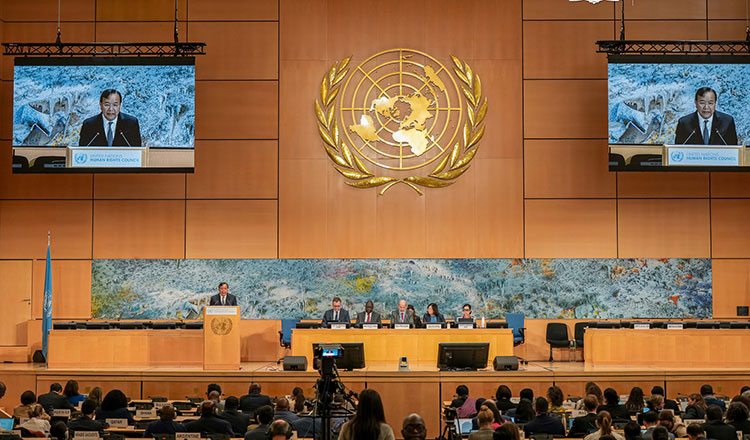 Foreign Affairs and International Cooperation Minister Prak Sokhonn addresses the High-Level Segment of the 61st Session of the UN Human Rights Council, in Geneva, on Tuesday. Ministry of Foreign Affairs
#National
Synopsis: Southeast Asian nations exchange accusations of territorial encroachment and human rights violations, underscoring the fragility of the ceasefire, before an assembly of world leaders in Geneva.
The Cambodian foreign minister exposed the human rights violations linked to Thailand’s military operations along its shared border with Cambodia, at the High-Level Segment of the 61st Session of the UN Human Rights Council in Geneva on Tuesday.
The accusation was countered by the Thai foreign minister, who tried to shift the topic to online scam networks in Cambodia, which Thailand has used to justify its attack on Cambodia.
The UN Human Rights Council’s 61st regular session, taking place from February 23 to March 31, features debates, interactive dialogues and panel discussions on issues such as disability rights, child rights, peace and sustainable development.
In his Tuesday remarks, delivered in French before dignitaries from more than 100 countries, Foreign Affairs and International Cooperation Minister Prak Sokhonn stressed that the international human rights system is going through a challenging period.
Armed conflicts, geopolitical fragmentation, and the rise of unilateral approaches, he added, are weakening mechanisms designed to protect populations. In many parts of the world, civilians continue to pay a heavy price for political and military rivalries.
Sokhonn said that Cambodia, once a struggling, war-torn country, has shown great progress in terms of human rights protection in the past 30 years.
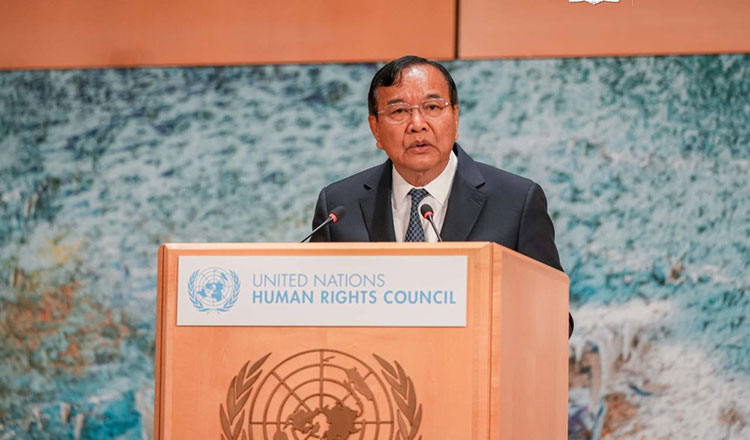
“Nearly three decades of stability have enabled Cambodia to make major progress in promoting and protecting human rights, fostering institutional reconstruction, economic recovery, and the gradual consolidation of rule-based governance,” he said.
“These achievements are tangible: a significant reduction in poverty; near-universal access to primary education; improvements in health and social protection systems; increased participation of women in national and international responsibilities, including in UN peacekeeping operations; and the strengthening of the legal framework to combat domestic violence and human trafficking and to protect workers.”
However, Cambodia’s progressive journey has been hindered by the conflict with Thailand, he said.
“While we consolidate our internal progress, since mid-2025, Thai military operations have expanded into several border areas, causing serious consequences for our civilian population—consequences that fall directly within the responsibility of this Council,” he said.
Sokhonn added that the second ceasefire reached at the end of last year, after 21 days of intense military clashes between the two neighbours, still holds but remains fragile.
“Since then, military positions have been established beyond the claimed lines, resulting in encroachments well inside Cambodian territory,” he said.
According to Sokhonn, in several occupied border villages, civilians have been expelled from their homes, houses destroyed, military infrastructure erected, and access blocked by barbed wire and shipping containers, preventing the safe and dignified return of civilians, contrary to the arrangements agreed upon by the two countries. At the height of hostilities, nearly 650,000 people were displaced. Currently, more than 80,000 people are still unable to return home.
“These actions affecting civilian populations raise serious concerns under international law and human rights law, including the rights to life, personal security, freedom of movement, adequate housing, and access to cultural and religious life,” he said.
Sokhonn said that throughout the conflict, Cambodia has exercised utmost restraint and responsibility, providing humanitarian assistance, ensuring continuity of essential services to displaced persons, and remaining firmly committed to an effective and lasting ceasefire and peaceful dialogue for normalisation.
“The protection of human rights is inseparable from peace. In this spirit, Cambodia calls for full respect for and faithful implementation of existing agreements, the withdrawal of Thai military forces from Cambodian territory—whose presence remains the main obstacle to the safe and dignified return of civilians—and the peaceful settlement of disputes, in accordance with the principles of non-use of force, international law, and international humanitarian law,” he said.
“Only through such adherence can our two peoples coexist in peace, stability, and mutual respect.”
When it was his turn to speak, Thai Foreign Minister Sihasak Phuangketkeow denied the accusation against his country, adding that he was “compelled” to respond to the “far-fetched remarks” of his Cambodian counterpart.
“Rather than contributing to peace as they vocally desire, it is regrettable that Cambodia has chosen, time and again, to demonise Thailand through false accusations and distorted narratives,” he said.
Sihasak claimed that the recent escalation of conflict followed “years of encroachment and repeated provocations seemingly intended to test Thailand’s restraint and resolve.” He also accused Cambodian leaders of attempting to interfere in Thailand’s internal politics.
“Throughout history, Thailand has had nothing but good intentions for our neighbour,” he added. “We provided refuge to those fleeing conflict. We supported humanitarian assistance and reconstruction following Cambodia’s civil war. Our intention has never been confrontation. Because we understand that our peace is inseparable from Cambodia’s peace.”
The Thai minister blamed Cambodia for internationalising the issue, which has undermined the prospects for peace.
“The allegations made by Cambodia are that we are seizing territory. But the truth is that both sides have negotiated a ceasefire and agreed that troops are to remain where they are at the time of the ceasefire, pending a final resolution through dialogue,” he said.
“What we need now is to de-escalate tensions and not stir up public sentiments. Instead, after the ceasefire, premeditated provocations continue to occur. Thai soldiers continue to encounter landmines, and shots are still fired across borders—even today.”
Sihasak said Thailand remains committed to dialogue while doing its duty to defend its territory and people.
He drew attention to the issue of online scam networks, which the Thai army had used to justify its attack on Cambodia.
“Millions of people worldwide fall victim to these crimes. Trafficked persons are trapped in scam compounds, subjected to coercion, violence and forced criminality. What we are witnessing are industrial-scale scam networks that have evolved into a global human rights crisis,” he said.
“These operations are allowed to fester because of the lack of the rule of law in the countries they operate in.”
He insisted that Thailand stands at the forefront of international efforts to address the scourge.
“We will continue advancing cooperation to dismantle these criminal networks,” he said.
Sokhonn had in his earlier remarks highlighted the success of the anti-cyber fraud campaign rolled out by the Cambodian government.
“Since the creation of a national task force led by our Prime Minister, authorities have dismantled numerous networks, rescued thousands of victims and arrested many criminals,” he said. “We are finalising a special law to combat online scams, underscoring our firm commitment to eradicating this crime. To meet such a challenge, Cambodia is engaged in collective efforts with relevant stakeholders at the national, bilateral and multilateral levels.”
This fight against online scam syndicates, Sokhonn stressed, requires cooperation, not foreign unilateral police or military actions that serve only to mask acts of aggression and occupation.
Although Thailand has disavowed human rights violations in Cambodia, evidence has proved otherwise, said Senior Minister Ly Thuch, First Vice-President of the Cambodian Mine Action and Victim Assistance Authority.
“Thai F-16 fighter jets bombed and destroyed the bridge, violating basic human rights and international humanitarian law,” Thuch said in a social media statement. “The destruction of the bridge has cut off people’s access to medical services and treatment at the only health centre located in Tmor Da Commune. It has also severely restricted the movement of residents, causing significant socio-economic hardship to the local community.”
Documentation Centre of Cambodia Director Youk Chhang said that as much as Thailand struggles to twist the narrative, it cannot hold itself as a peacemaker in the region while its army occupies the territory of its neighbour in violation of international law and a ceasefire agreement.
“Thai Foreign Minister Sihasak Phuangketkeow’s statements are enlightening with respect to Thailand’s concerns with Cambodia’s ‘internationalisation’ of the conflict,” he said. “Like school kids on a playground, when one country bullies another country, the bully does not want the intervention of outsiders.”
He noted that this is evident in Thailand’s demand to keep the United States and other countries out of the conflict. Thailand is repeating its actions in the early 20th century and at the end of World War II, when it sought to prevent France and the US from blocking its capture of Cambodian lands.
“The past may not repeat itself, but it is always a prologue,” Youk added.
In his opening remarks at the session, Volker Turk, United Nations High Commissioner for Human Rights, said the normalisation of the use of force to resolve disputes between and within countries has become a worrying trend.
“The laws of war were being brutally violated, with mass civilian suffering unfolding before our eyes,” he said.
“Developments around the world pointed to a deeply worrying trend: domination and supremacy were making a comeback. Behind the rhetoric of some leaders was a belief that they were above the law, and above the United Nations Charter.”
-Khmer Times-
—————-