The Politics of Lies and Lures: Thailand’s Diplomatic Theatre and the Hardening of the Border
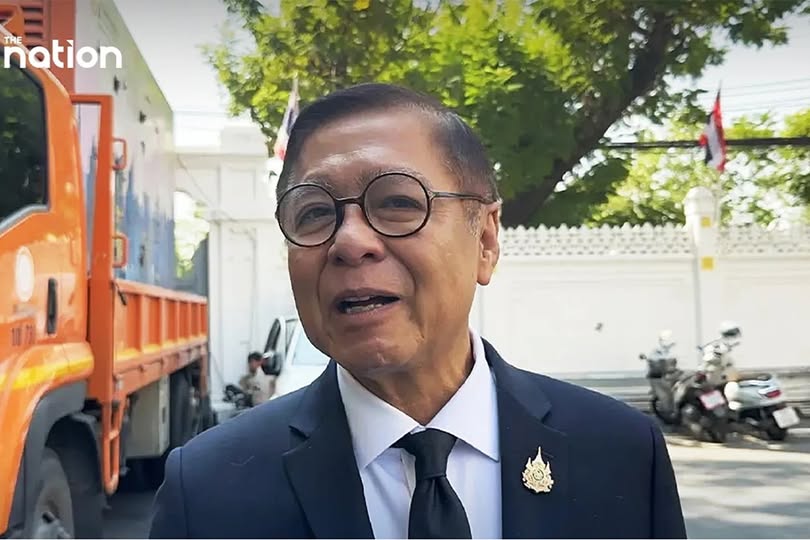 Thai foreign minister Sihasak Phuangketkeow recently appeared on European news outlet France24. ANN/The Nation
#Op-Ed
In February 2026, Thai Foreign Minister Sihasak Phuangketkeow embarked on a carefully staged diplomatic tour through Paris and Geneva. Cloaked in the polished vocabulary of restraint and responsibility, he portrayed Thailand as a stabilising force — a “responsible regional elder” committed to de-escalation and peaceful settlement.
The performance was smooth. The messaging disciplined. The optics reassuring. But diplomacy is not judged by how it sounds in European studios. It is judged by what unfolds on the ground.
And along the Thai-Cambodian frontier, the ground tells a different story.
While de-escalation was invoked abroad, fortified positions were reportedly reinforced in contested zones. Infrastructure expanded. Maritime detentions occurred in disputed waters. Civilian displacement mounted amid heightened military posture. Any single action may be defensible in isolation. Taken together, however, they reveal a pattern: incremental consolidation beneath a veneer of moderation.
This is not merely inconsistency. It is strategy. It is a politics of lies and lures — conciliatory rhetoric projected outward while strategic leverage advances quietly at home.
Diplomacy as Insulation
In international relations, actions calibrated just below the threshold of open conflict are often described as grey-zone coercion. They thrive on ambiguity. They advance incrementally. They avoid triggering unified backlash while quietly reshaping the negotiating baseline.
When a state calls for de-escalation while fortifying disputed ground, the word “de-escalation” becomes elastic. When dialogue is praised publicly while unilateral changes alter physical realities privately, negotiation ceases to be neutral.
The deception is rarely contained in a single provable falsehood. It resides in the widening gap between narrative and conduct. Under such conditions, diplomacy ceases to function as problem-solving. It becomes insulation — shielding tactical maneuverers from international scrutiny.
The Strain on ASEAN’s Legal Architecture
The ASEAN Charter demands respect for sovereignty, renunciation of force and peaceful settlement of disputes. The 2000 Memorandum of Understanding between Thailand and Cambodia explicitly prohibits unilateral development in contested areas.
If disputed land is physically transformed during stalled dialogue, the spirit — if not the letter — of those commitments is strained. Territory altered during delay becomes leverage. Leverage secured under the banner of restraint corrodes trust.
ASEAN’s cohesion depends not only on the absence of war, but on confidence that its members will not exploit ambiguity to entrench advantage.
If that confidence erodes, the consequences extend far beyond a single border.
A Politics That Lures Its Own People
This strategy is not directed only at foreign audiences. It speaks inward. Thai citizens are told their country acts with prudence and maturity. They are assured that posture is defensive, that escalation is exaggerated, that patience reflects responsible governance.
But citizens should ask — calmly and directly — what exactly is being done in their name.
If de-escalation is genuine, why do reported realities on the frontier suggest movement rather than pause?
If negotiations are prioritised, why do physical conditions appear to shift before talks resume?
If Thailand’s international reputation is invoked as proof of stability, why risk that reputation through actions that invite scrutiny?
Are citizens receiving the full strategic picture — or only the reassuring version?
When officials dismiss criticism as “nationalist rhetoric”, is that substantive rebuttal or rhetorical deflection?
When domestic political transition is cited to justify delay, does international law recognise such suspension — or does time simply become a strategic instrument favouring the party that continues to act?
And if this calculation misfires, who bears the cost?
It will not be the diplomat on television.
It will be Thai exporters confronting trade pressure. Thai workers facing economic strain. Thai families absorbing regional uncertainty. Thai taxpayers financing prolonged deployments.
A politics of lies and lures does not merely shape foreign perception. It risks asking its own public to accept narrative over evidence — performance over proof.
The Reputation Gamble
Thailand has long cultivated the image of a sophisticated regional balancer. That image is strategic capital. It grants Bangkok influence within ASEAN and credibility in Western capitals. But credibility operates like credit: it endures only so long as conduct sustains it.
The February diplomatic campaign appears to rest on a wager — that careful messaging abroad can offset incremental consolidation at home; that ASEAN’s reluctance to confront publicly will shield reputational damage; that moves kept below escalation thresholds will avoid serious consequence.
It is a perilous calculation.
Once the perception takes hold that diplomacy functions as cover for entrenchment, every reassurance weakens. Every declaration of restraint invites scrutiny. Every appeal to international norms sounds conditional.
Trust, once diluted, does not quickly replenish.
The Unavoidable Question
The contradiction is stark.
A state cannot credibly claim good-faith negotiation while materially altering the subject of negotiation. It cannot preach restraint while advancing position. It cannot invoke legality while bypassing mechanisms designed to uphold it.
If de-escalation is real, it must be visible. If diplomacy is sincere, unilateral alteration must cease. If leadership is responsible, rhetoric must align with reality.
Otherwise, what is being defended is not peace — but narrative control. And narrative control is not statesmanship. It is strategic misdirection.
Conclusion: Credibility Is the Real Border
History does not judge governments by the elegance of their interviews. It judges them by alignment between word and deed.
Short-term tactical advantage achieved through ambiguity may appear effective. Borders shift subtly. Negotiations stall quietly. International attention drifts.
But credibility erodes — gradually at first, then all at once. And once diminished, it is costly to restore.
This moment presents a choice.
Thailand can reaffirm its regional leadership by freezing unilateral actions, reactivating formal mechanisms without delay and demonstrating that de-escalation is more than a televised phrase.
Or it can continue down a path where performance substitutes for principle, where delay advantages one side and where diplomacy becomes the velvet glove for a harder instrument.
One path strengthens regional order. The other weakens it.
Power can redraw terrain. But only credibility sustains peace.
And in the end, it is credibility — not choreography — that defines true leadership.
Panhavuth Long is founder and attorney-at-law at Pan & Associates Lawfirm. The views and opinions expressed are his own.
-Phnom Penh Post-
———————