Thailand justifying airstrikes with cybercrime allegations
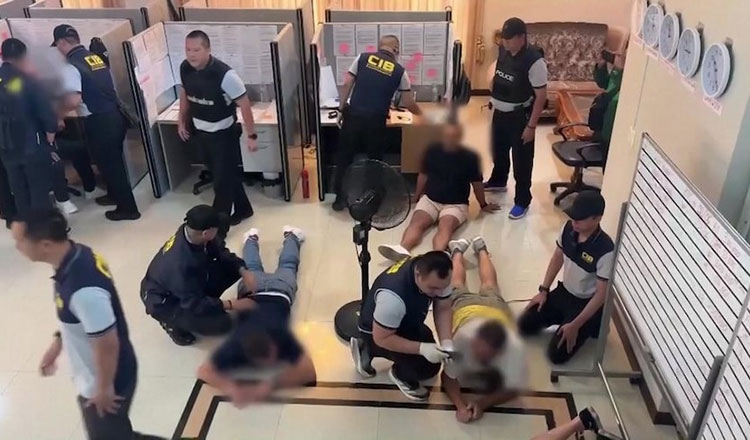 Royal Thai Police raid a multi-million-dollar scam operation targeting Australians, near Bangkok. abc.net.au
#opinion
Thailand is increasingly framing its military actions against Cambodia as part of a campaign against online scams. According to this narrative, alleged scam operations inside Cambodian territory justify cross-border strikes. Under international law, this claim is not only unfounded, it is dangerous.
Cyber-enabled fraud is a serious transnational crime. Southeast Asia has become a hub for online scams, human trafficking, and money laundering. But international law has never treated crime, however harmful, as a lawful basis for war. Turning criminal allegations into a justification for armed force erodes the most basic constraint of the international system: the prohibition on the use of force.
The legal starting point is clear. Article 2(4) of the United Nations Charter prohibits the threat or use of force against the territorial integrity or political independence of any state. The only relevant exception is self-defence under Article 51, which applies solely in response to an armed attack. Allegations of online scams do not meet that threshold.
Even under evolving debates on cyber operations, international law has not recognised cyber-enabled fraud or financial scams as “armed attacks.” These acts do not involve kinetic force, military violence, or the scale of destruction required to trigger a right of self-defense. States confronting such crimes are expected to respond through law enforcement and cooperation, not bombs.
Thailand’s “online scam” narrative also did not emerge in isolation. On Decmber 17–18, Thailand’s Ministry of Foreign Affairs and the United Nations Office on Drugs and Crime co-hosted an international summit in Bangkok, the Global Partnership Against Online Scams, bringing together representatives from more than 60 countries to discuss law enforcement cooperation and cross-border action against criminal syndicates. Cambodia did not attend the conference amid rising tensions. But international law is clear: participation in, or absence from, an international forum does not determine responsibility, and it cannot be transformed into a pretext for the use of force.
Yet Thailand has gone further. Under the banner of combatting scams, it has carried out strikes on Cambodian territory, including on buildings described as casinos, hotels, or commercial properties—structures that are, by their nature, civilian. These attacks are justified publicly by allegations that such buildings were linked to scam operations. But under international humanitarian law, allegation is not authorisation.
International humanitarian law draws a strict distinction between military objectives and civilian objects. Civilian buildings are protected unless and until they are proven to be used for military purposes and their destruction offers a definite military advantage. Even then, the principles of necessity and proportionality apply. No publicly available evidence has demonstrated that the targeted Cambodian buildings constituted lawful military objectives. No independent verification has been presented. Bombing civilian structures based on contested claims reverses the legal order: force first, proof later.
Thailand’s justification fails on another ground: selectivity. Online scams operate across Southeast Asia, including within Thailand itself. Thai authorities have publicly acknowledged the presence of scam networks, money-laundering channels, and trafficking operations inside Thai territory. Yet no one suggests that this reality gives foreign states a right to bomb buildings in Thailand.
International law does not permit double standards. What is unlawful at home does not become lawful abroad.
The correct legal framework already exists. Cyber-enabled fraud falls under transnational organised crime, governed by instruments such as the UN Convention against Transnational Organised Crime. That framework emphasises cooperation: joint investigations, mutual legal assistance, extradition, asset seizure, and financial intelligence sharing. What it does not permit is unilateral military action against alleged criminal infrastructure in another state.
The danger of Thailand’s argument lies in the precedent it sets. If allegations of cybercrime can justify bombing civilian buildings, then the prohibition on the use of force collapses. Any state could accuse a neighbour of hosting criminals and claim a right to strike. Civilian protection would become conditional on political narratives rather than legal proof.
International law is designed precisely to prevent this logic. It requires that claims be proven, responsibility established, and harm addressed through lawful means. Criminal accusations do not transform civilian objects into military targets. Cybercrime does not become a casus belli simply because it is serious or politically useful.
Cambodia’s position, that allegations must be subjected to independent verification and addressed through law, reflects this legal reality. Thailand’s reliance on force, by contrast, replaces evidence with escalation.
Cybercrime is a shared regional challenge. It demands cooperation, transparency, and accountability across borders. Using it to justify strikes on civilian buildings does not advance justice or security. It undermines the very rules meant to prevent conflict from becoming routine.
International law is unambiguous on this point: cybercrime is not a justification for war, and civilian buildings are not lawful targets.
Lex-Opinion is a flagship initiative of the Sala Traju Association, designed to provide clear, concise, and timely legal opinions on pressing national and international issues, making complex legal analysis accessible and relevant to public discourse and policy development. The Sala Traju Association is a professional legal organisation that brings together legal practitioners, academics, and students to promote legal awareness, scholarly engagement, and respect for the rule of law through research, dialogue, and public-oriented initiatives.
Footnotes
1.ABC News (Australia), Thailand’s bombing of Cambodian casinos could be putting trafficking victims at risk, 12 December 2025.
https://www.abc.net.au/news/2025-12-12/thailand-bombs-cambodian-casinos-and-scam-centres/106125824
2.The Wall Street Journal, Scam Compounds Become Targets in Thai-Cambodian Border War, 14 December 2025.
https://www.wsj.com/world/asia/scam-compounds-become-targets-in-thai-cambodian-border-war-7fbfe575
3. Reuters, Thailand seizes $318 million in assets, issues 42 arrest warrants in scams crackdown, 4 December 2025.
https://www.reuters.com/world/asia-pacific/thailand-seizes-318-million-assets-issues-42-arrest-warrants-scams-crackdown-2025-12-03/
4. Associated Press, Thailand hosts global partnership against online scams amid regional tensions, 19 December 2025.
https://apnews.com/article/thailand-online-scams-southeast-asia-tiktok-meta-aa0607152278f3d900c6abdc11595510
5. UNODC ROSEAP, Transnational Organized Crime in the Pacific: Expansion, Challenges and Impact (TOCTA Pacific 2024).
https://www.unodc.org/roseap/uploads/documents/2024/TOCTA_Pacific_2024.pdf
6.UNODC ROSEAP, Inflection Point: Global Implications of Scam Centres, Underground Banking and Illicit Online Marketplaces in Southeast Asia, April 2025.
https://www.unodc.org/roseap/uploads/documents/Publications/2025/Inflection_Point_2025.pdf
-Khmer Times-