Global powers urge Cambodia and Thailand to uphold peace accord
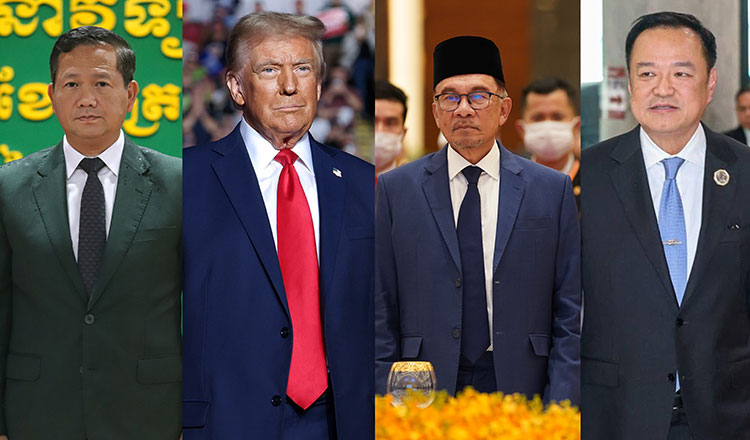 [Composite photo shows (L-R) Prime Minister Hun Manet, US President Donald Trump, Malaysian Prime Minister Datuk Seri Anwar Ibrahim and Thai Prime Minister Anutin Charnvirakul. KT/White House/Xinhua]
Synopsis: The US, Malaysia and China press the feuding neighbours to return to dialogue after deadly border incidents call into question the newly brokered Kuala Lumpur Joint Declaration for peace.
Amid renewed tensions between Cambodia and Thailand, the US and Malaysia, who brokered the Kuala Lumpur Peace Accord, as well as China, a close ally of both countries, have called on the two neighbours to embrace dialogue to realise the spirit of the peace agreement.
On November 10, several Thai soldiers were injured by a landmine while conducting a routine patrol near the border in Sisaket province. In response, Thailand accused Cambodia of recently planting the device and announced the suspension of all progress on the peace agreement until Cambodia could demonstrate non-hostility. Cambodia rejected the allegations, reaffirming its commitment to the accord, yet tensions along the border remain unresolved.
The issue was intensified last Wednesday when Thai forces opened fire on Cambodian civilians in Prey Chan village, Banteay Meanchey province, leaving one dead and three injured. In a strongly worded social media statement posted the same night, Prime Minister Hun Manet condemned what he described as “the unprovoked use of violence by the Thai side against innocent Cambodian civilians.”
As the peace accord hangs in the balance, the powers that had helped to broker it have renewed their calls to defuse tensions.
Malaysian Prime Minister Datuk Sri Anwar Ibrahim announced on Friday that he had spoken with both Mr Hun Manet and Thai Prime Minister Anutin Charnvirakul to discuss peace efforts following the recent eruption of violence along the Cambodia-Thailand border.
In a social media statement, Anwar said the two prime ministers had given “positive feedback” and reaffirmed their commitment to resolving the dispute peacefully, in accordance with the points set out in the October 26 Kuala Lumpur Joint Declaration.
“I reiterated Malaysia’s position that the friendship and ceasefire between both countries must be further strengthened in accordance with the agreement concluded in Kuala Lumpur,” Anwar said.
“Malaysia remains ready to continue playing our role as a facilitator in charting this path towards peace.”
He added that the Cambodian and Thai leaders expressed their appreciation for Malaysia’s stance and recognised the responsibility Malaysia bears “not only as ASEAN Chair, but also as a friend and close neighbour committed to regional peace.”
Anwar’s statement came amid heightened tensions following the November 12 deadly shooting incident. The situation has raised regional concern and prompted calls for restraint and renewed dialogue.
The Malaysian Prime Minister urged both nations to “demonstrate the resolve and courage needed to restore stability along the border,” stressing that lasting peace and the safety of their people must remain the ultimate goal.
US President Donald Trump, whom Cambodia had nominated for the Nobel Peace Prize earlier this year, also urged the Cambodian and Thai leaders to settle their differences.
Trump pledged during a phone call with Mr Hun Manet on Thursday night to continue to monitor the situation closely to help prevent renewed armed clashes.
According to Mr Hun Manet’s statement, President Trump delivered a clear and firm message during their conversation: he wants to see lasting peace between the two neighbouring countries and is prepared to stay engaged to support that goal.
Trump “emphasised his clear position that he wishes to see lasting peace between Cambodia and Thailand,” the statement said. He assured the Cambodian leader that the United States would continue to follow developments “with care” to ensure the ceasefire holds and that no new violence erupts along the border.
During the call, Mr Hun Manet thanked Trump for his role in helping secure the July ceasefire followed by the Kuala Lumpur Joint Declaration, which set out a framework for long-term peace between Cambodia and Thailand. He also reaffirmed Cambodia’s commitment to fully upholding the declaration and to working with Thailand through agreed principles and bilateral mechanisms.
But the centre of the discussion was Trump’s renewed pledge to remain actively involved in supporting stability.
Mr Hun Manet said Trump’s assurance reflects Washington’s continued interest in preserving regional peace and preventing further escalation following recent incidents along the border.
Cambodia, he added, will continue to seek peaceful solutions to all border issues in line with established agreements, as both countries work to maintain lasting peace.
The discussions between the US and Thailand, however, appeared to be more intense. The US Trade Representative has sent a letter to Thailand notifying it of the suspension of tariff negotiations until Thailand fully implements the peace agreement with Cambodia.
Nikorndej Balankura, spokesman for the Thai Foreign Affairs Ministry, said the letter indicated that negotiations could resume once Thailand reaffirmed its commitment to the peace declaration with Cambodia.
Just days earlier, Anutin had remarked that Thailand was not concerned about the US tariff rate, emphasising that his priority was to act in the best interests of the nation.
Meanwhile, China has called on Cambodia and Thailand to prevent further escalation along their shared border.
At a regular press briefing in Beijing on Thursday, Chinese Foreign Ministry spokesman Lin Jian said China had noted “issues” in the implementation of the recent Thai-Cambodian joint statement on border management. He urged both sides to recommit to dialogue.
“As a friend and close neighbour of both countries, China sincerely hopes that Thailand and Cambodia will exercise restraint, move toward each other, adhere to friendly consultations, give full play to the role of existing bilateral mechanisms and find a solution acceptable to both sides as soon as possible to prevent the situation from escalating,” he said.
Lin added that China would continue to play a “constructive role” in helping de-escalate the dispute.
Documentation Centre of Cambodia Youk Chhang said the continuation of conflict risks magnifying the competition between the US and China.
“There are several misconceptions of the recent conflict between Thailand and Cambodia that have implications at the local, regional and global levels.
“The conflict is not new, insignificant or localised. And, unless this conflict is resolved appropriately and soon, the impact of this conflict has the potential to reverberate across the region and the world,” Youk said.
In many ways, he added, this conflict represents the next iteration of a centuries-old Thai nationalist sentiment to reclaim territory lost to Cambodia and Western colonialism.
“This Thai nationalist sentiment is rooted in the history of the shifting borders between Cambodia and Thailand,” he added.
“Currently, Cambodia treads carefully between an economically robust friendship with China and an increasingly friendly relationship with the United States. Thailand, on the other hand, is navigating its historical relationship with the United States in the context of an increasing nationalism that demands bolder military action.”
-Khmer Times-