Labour minister urges returning migrant workers to call 1297, register for jobs
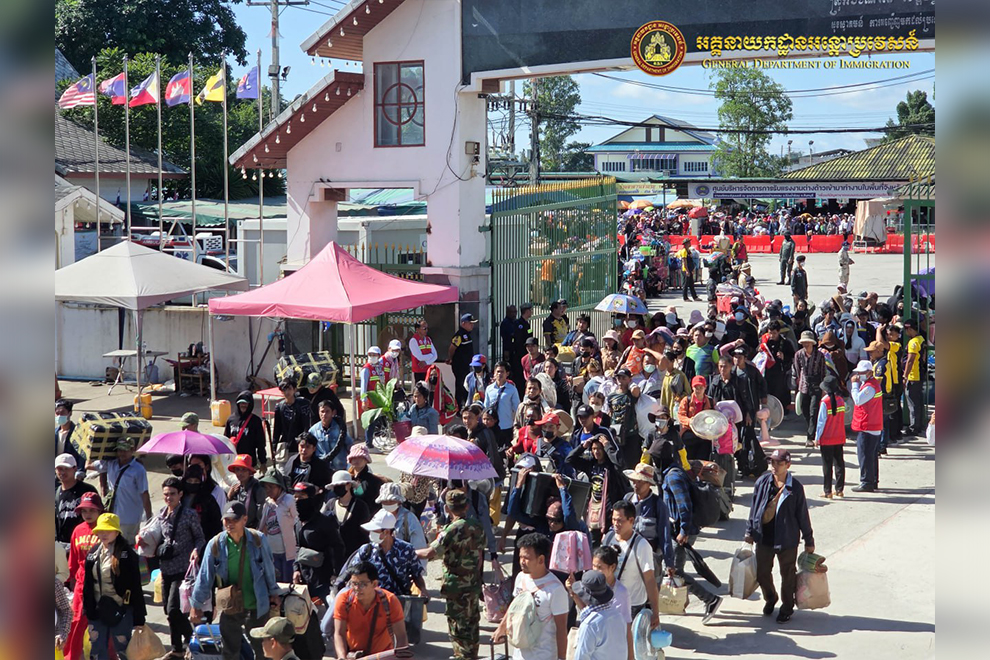 Cambodian workers return home through the international border gate at Dong in Battambang province. Immigration department
Cambodian workers returning from Thailand who want to find work in Cambodia need only call the 1297 hotline, said Minister of Labour and Vocational Training Heng Sour. He explained labour ministry staff will register them directly, saving them travel expenses and time.
The ministry is continuing to push a campaign to help returnees register for employment opportunities at companies and factories nationwide.
The hotline 1297 and the Telegram group “Job Search – MLVT” have been introduced as tools to make it easier for the returnees to quickly find jobs. They are also open to other Cambodians who wish to help friends or relatives in need of work.
The minister explained that many returnees live in their home villages, and travelling to register at job centres would require both time and money.
“To avoid long and costly trips, workers just call 1297. Our officials will ask their name, age, preferred province, sector and expected salary, then input the information into the system and complete registration for them,” he said.
He added that registration can also be done via Telegram. Those who prefer not to call 1297 can scan a QR code to complete registration.
“This technology helps our people returning from Thailand, and it also opens a way for all Cambodians to support them. It’s an open platform that lets everyone help each other in these difficult circumstances,” he noted.
Employers can also benefit from the QR code system, which allows them to request workers by simply stating the number of employees needed, gender and salary, without having to publish recruitment announcements.
The minister also noted that the government offers training courses for returnees who wish to acquire vocational skills to work independently. The National Social Protection Council is currently preparing a support package for this.
“Some who return want to start their own businesses. We’re planning training programmes that don’t require travel to Phnom Penh. If they want to process agricultural products, or learn motorcycle repair, mechanical work, electrical wiring or air-conditioning, we will provide courses for them along with intervention packages,” he said.
According to the ministry, more than 910,000 Cambodian workers have returned from Thailand since June 8, following border tensions and reports of discrimination, including some incidents of violence. While returns continue, the flow has eased compared to the peak of territorial clashes.
Economist Chan Sophal noted that if one million workers each earn about $250 per month, this would generate around $3 billion per year, potentially boosting Cambodia’s GDP by 6%.
He explained that unlike in Thailand — where Cambodian workers consume Thai rice, vegetables, fish, meat and drinks — their presence in Cambodia will increase domestic demand, create local markets, ease labour shortages for enterprises and support new investments.
“If jobs are lacking and workers cannot return to Thailand, it will be a heavy burden on the banking sector, which already faces high rates of non-performing loans. When they were in Thailand, migrant workers remitted over $1 billion annually. Without jobs, unemployment could also create social problems,” he warned.
He added that the current pressure is no less serious than during the Covid-19 crisis, when the government spent more than $1 billion in emergency measures.
“The government should study the situation and intervene, instead of waiting until the border dispute with Thailand ends. This is a major opportunity for Cambodia to expand its economy and strengthen its resilience against neighbouring countries at a time when international law is weakening,” he said.
“If corruption were cut by 50 per cent, the state would have enough resources to intervene across all sectors,” he noted.