Cambodia blasts Thailand’s plan to sue, arrest its top leaders
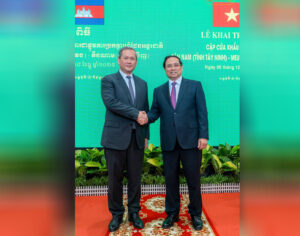
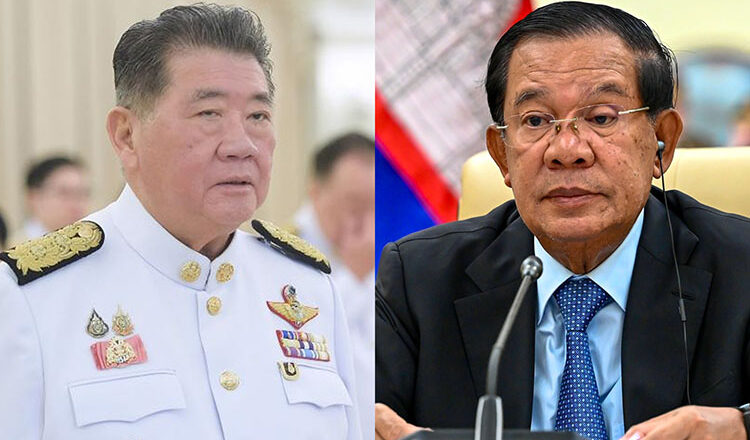 A composite photo of Senate President Hun Sen (R) and Thailand’s Acting Prime Minister Phumtham Wechayachai. Senate/Xinhua
Synopsis: Cambodia says the plan violates sovereignty that threatens the July ceasefire and bilateral relations.
Cambodia’s Ministry of Foreign Affairs and International Cooperation yesterday voiced deep concern over the recent statements of Thailand’s Acting Prime Minister Phumtham Wechayachai announcing plans to pursue domestic legal action against Cambodian leaders.
In an official statement, the ministry said, “Thailand taking legal action against Cambodian leaders not only violates the sovereignty and integrity of the Cambodia, the principles of sovereign equality and mutual respect enshrined in the Charter of the United Nations, but also severely damages Cambodia-Thailand relations.”
The statement added that Thailand’s move “seriously undermines all efforts exerted so far to achieve a lasting ceasefire and to restore peace and normalcy between the two countries.”
The ministry warned that the proposed legal action could derail confidence-building measures agreed under the July 28 ceasefire.
“The intended legal action would undermine all endeavours to restore trust and confidence that are much needed to effectively implement the ceasefire agreed by Cambodia and Thailand on 28 July 2025,” it said, referencing the subsequent Extraordinary Meeting of the Cambodia-Thailand General Border Committee on August 7, which outlined steps toward de-escalation, including the convening of Regional Border Committees.
Despite its condemnation, the ministry emphasised Cambodia’s commitment to dialogue and peace. “The Royal Government of Cambodia reaffirms its unwavering commitment to work with the Royal Thai Government to achieve peace and restore relations to normalcy in the nearest future,” it said.
The statement followed threats from Thailand on Monday to arrest Cambodian leaders, including former Prime Minister Hun Sen and current Prime Minister Hun Manet, if they entered Thai territory, a move widely criticised by Cambodian officials as provocative and legally untenable.
Mr Hun Sen lashed out at Thailand’s Acting Prime Minister on his Facebook page on Monday night. Phumtham, who is nearing the end of his term as acting premier, announced that Thailand’s National Security Council had resolved to pursue civil and criminal lawsuits against Cambodia’s top leaders in Thai courts over recent border incidents.
According to Thai media, Phumtham declared that Mr Hun Sen and Mr Hun Manet would be detained if they entered Thailand.
Mr Hun Sen accused Thailand of undermining international norms and questioned whether Bangkok’s stance was aimed at promoting peace or destabilising relations.
“Customary law has been violated by the aggressors. Is this an effort to build trust and move toward better relations, or an act of provocation that could reignite conflict following the ceasefire agreement?” he asked.
“If the newspaper publications accurately reflects the remarks of the acting prime minister, who is nearing the end of his term, it reveals that he is a reckless individual who lacks understanding of customary law and diplomatic protocol.”
Mr Hun Sen went further, warning that Cambodia could respond in kind if Thailand moved ahead with such an unprecedented step.
“If Thailand is in a position to arrest Cambodian leaders, then Cambodia could likewise arrest certain Thai leaders who have invaded and killed Cambodian citizens,” he wrote.
Quoted by these newspapers, Phumtham stressed that the lawsuits are a domestic measure since Thailand does not recognise the jurisdiction of the International Court of Justice. He said the move is intended to protect Thai citizens’ lives and property affected by recent border clashes.
“It’s a lawsuit that can be proceeded with. It’s a case for detention; if they enter the country, they will be arrested immediately,” Phumtham said.
“The Attorney-General will look into it and collect the cases to proceed according to the facts and the law.”
The news reported in Cambodia on Monday night drew the ire of not only Cambodians but also some Thais, including veteran journalist Pravit Rojanaphruk.
“I strongly disagree with the idea of issuing arrest warrants against Hun Sen and Hun Manet,” Pravit wrote on his Facebook page.
“While this might please some Thai ultra-nationalists, it will only make it harder for the two nations to find a peaceful resolution. Do you really want peace or another round of military conflict?”
Pravit said it is both impossible and internationally unacceptable for Thailand to arrest foreign leaders.
“It also won’t benefit Thailand in the long run. It’s counterproductive,” he added.
“Please calm down, come to your senses, and announce the cancellation of this idea before the people on both sides of the border suffer even more. We don’t need to be belligerent. It’s not people like you who will suffer from the consequences of such a myopic act but ordinary people along the border and rank-and-file soldiers.”
According to customary international law, sitting heads of state, heads of government, and foreign ministers enjoy absolute personal immunity (immunity ratione personae) from foreign criminal jurisdiction. This means they cannot be arrested, prosecuted, or sued in another country’s courts while in office, regardless of the alleged crime.
The UN Convention on Jurisdictional Immunities of States and Their Property (2004), though not yet in force, codifies the principle that state officials acting in an official capacity are immune from foreign courts for acts of state.
Belgium once issued an arrest warrant for a sitting foreign minister, Abdulaye Yerodia Ndombasi, but the International Court of Justice ruled that Belgium had violated the immunity of foreign officials.
Spain’s 1998 case against former Chilean dictator Augusto Pinochet case showed that former heads of state can sometimes be prosecuted abroad, but usually only for international crimes such as genocide and crimes against humanity, not for cross-border military clashes.
Neak Chandarith, Associate Professor and Director of the Institute for International Studies and Public Policy of the Royal University of Phnom Penh, commented that Thailand’s legal gambit is a direct affront to customary international law.
“The threat to arrest Hun Sen and Hun Manet if they enter Thai territory disregards diplomatic protocol and risks reciprocal measures, as articulated by Hun Sen’s warning that Cambodia could similarly target Thai leaders for alleged transgressions,” he said.
“This tit-for-tat dynamic, rooted in historical border tensions over areas like Preah Vihear, jeopardises the ceasefire brokered in Malaysia on July 28, 2025, following clashes that claimed 43 lives and displaced over 300,000.”
Chandarith said Thailand’s refusal to engage through international mechanisms like the ICJ, coupled with its reliance on domestic courts, undermines the legitimacy of its claims and sets a dangerous precedent for ASEAN’s non-interference principle.
“From a Cambodian perspective, Hun Sen’s condemnation of Thailand’s ‘reckless’ actions is both justified and strategically necessary. His invocation of customary law and warning of retaliatory measures underscore Cambodia’s resolve to defend its sovereignty while exposing Thailand’s provocative intent,” he said.
Thailand’s actions, Chandarith stressed, are less about legal accountability and more about domestic political exigencies and historical rivalries.
“The legal action serves as a populist tool to deflect criticism and appease factions critical of the Shinawatra family’s perceived deference to Cambodia. Furthermore, economic frictions suggest a broader strategic intent to assert dominance amid looming US tariffs affecting both nations,” he said.
According to the professor, Thailand’s decision to criminalise Cambodian leaders risks closing diplomatic channels and could provoke renewed military clashes along the disputed frontier.
“Regionally, this move could alienate ASEAN partners, particularly Malaysia, which mediated the ceasefire, and embolden external powers to deepen their influence, thus unsettling ASEAN’s geopolitical balance,” he said.
“The involvement of US and Chinese envoys in earlier talks underscores the dispute’s broader implications, necessitating urgent de-escalation to prevent a regional crisis.”
Documentation Centre to Cambodia Director Youk Chhang called Thailand’s threat of using legal action a “Thai twist”.
“The phrase ‘twisting things from right to wrong’ is a common idiom used to describe the act of manipulating information or situations to present a false or misleading narrative,” he said.
“It implies a deliberate effort to distort the truth, making something appear opposite to its actual nature. This can involve exaggerating facts, omitting crucial details, or outright fabricating information.” Khmer Times