Opinion: A Plea for Cambodia’s Sovereignty and Justice
 The author, Iphing Lim, hopes to work in diplomacy, where she can combine scholarly insight with real-world action to help develop her country and foster stronger international relationships. Supplied
Cambodia, a nation both small in size and profound in spirit, has endured a turbulent history marked by devastating wars, internal upheaval and the tragic Khmer Rouge genocide that claimed millions of lives. Only in recent decades has Cambodia begun the painstaking process of reconstruction, gradually reclaiming peace and nurturing hope for a brighter future. Yet, despite these hard-fought gains, the threat of conflict continues to cast a shadow over our homeland. How much longer must our nation endure the weight of hostility and insecurity? When will Cambodia finally know lasting peace and stability?
Our history is marked not only by internal struggles but also by repeated acts of aggression from neighbours we once called friends.
The current border conflict with Thailand is not a sudden dispute; its roots trace back to 1946, when Thailand lost a significant portion of Cambodian territory under US orders. This historical loss appears to have fuelled a persistent animosity, leading to repeated attempts to claim what is rightfully ours. From 2008 to 2011, Thailand sought to seize the Preah Vihear Temple, an ancient site under Cambodia’s sovereignty, resulting in deadly clashes along the border. The International Court of Justice reaffirmed its 1962 verdict in 2013 that the temple belongs to Cambodia and ordered Thailand to withdraw its forces, yet tensions have never truly subsided.
The eruption of hostilities on July 24 was the tragic culmination of escalating tensions, initiated by a deadly skirmish in May that claimed the life of a Cambodian soldier. The subsequent clashes witnessed the deployment of heavy artillery by Cambodia, including Russian-made BM-21 rocket launchers, and aerial bombardments by Thailand, utilising F-16 and Gripen fighter jets.
The human cost has been grievous: over 38 lives lost, predominantly innocent civilians caught in the crossfire, and the displacement of more than 300,000 people on both sides of the border. Entire communities have been uprooted, compelled to seek refuge in makeshift camps along roadsides and within forested areas, deprived of adequate shelter, sanitation and basic necessities.
This suffering is compounded by the struggles of the Cambodian soldiers who continue to endure captivity.
Thailand has held 18 Cambodian soldiers who were captured after the ceasefire prisoner, despite promises of their release. The return of only two, one physically wounded and the other mentally unstable, raises urgent concerns regarding the treatment of prisoners and potential violations of international humanitarian law. The muted response from the global community to these breaches is profoundly disappointing and underscores the urgency for heightened accountability and international attention.
Youk Chhang, director of the Documentation Center of Cambodia, has demanded an immediate, transparent investigation into allegations against Boonsin Padklang, a Thai military general accused of ordering the killing of unarmed Cambodian soldiers and the torture of prisoners of war, as well as of expressing ambitions to seize Cambodia’s capital.
Whether acting independently or under orders, such acts constitute grave violations of international law and demand justice. Thailand, as a member of the international community, must be held fully accountable for these transgressions.
You might wonder why Thailand, a larger country, would attempt to invade and annex Cambodian territory. The reasons stem primarily from greed, resentment and economic interests.
Before the border near Preah Vihear Temple was closed, Thai tourists frequently visited this mountain-top temple, enjoying its breathtaking views, looking down onto Thailand itself. This tourism brought economic benefits such as income from tuk-tuk rides, the sale of refreshments and other local services, which boosted the livelihoods of communities near the border.
However, after the border closures that followed the 2008-2011 conflict, these opportunities disappeared. Regaining access to these historical sites, including Ta Mone Thom Temple, would not only revive local economies but also help the ruling party in Thailand gain popular support by promoting economic development alongside military strength. If Thailand were to gain access to other historical temples along the border, it would further solidify public backing while increasing economic gains.
Beyond economics, this dispute also serves as a way for Thailand to demonstrate competence to its citizens and assert itself on the international stage. The historic conflict has been a source of embarrassment and loss of face for Thailand.
Deep-seated resentment lingers, especially since lands were returned to Cambodia in 1946 under US pressure. From the Thai perspective, living on land for centuries only to be forced to return it, feels unjust. Yet, what does not rightfully belong to you will never truly be yours. Thailand has initiated this conflict without a genuine intention of resolution, even while claiming to seek peace. Their size and media influence do not justify painting Cambodia as the aggressor.
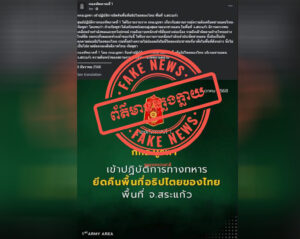
Thailand, a young nation with no real history, has heavily invested in media and education systems that propagate a fabricated version of history. This indoctrination aims to cultivate nationalist sentiments and sow distrust toward neighbouring countries in younger generations. Because Thailand was never colonised, it had the unique opportunity to develop into a large, economically powerful nation. However, this has also fuelled a nationalist agenda that comes at the cost of regional harmony and the well-being of its own citizens.
In the face of adversity, the Cambodian people have demonstrated remarkable resilience and unity. From urban centres to rural provinces, citizens of all ages have mobilised to support displaced families and frontline soldiers. Social media platforms have become vital channels for disseminating truthful information, countering disinformation and galvanising humanitarian aid. Contributions of food, clothing, and medical supplies have flowed in from citizens, non-governmental organizations, and international partners. Visits by international diplomats, such as Ülkü Kocaefe, ambassador of Türkiye, to affected regions has helped draw global awareness and solidarity with Cambodia’s plight.
Türkiye’s own experience with longstanding territorial disputes with Greece offers valuable insights for Southeast Asia. These conflicts, shaped by complex historical treaties and differing interpretations of sovereignty, require patient diplomacy, confidence-building and sustained dialogue to prevent escalation.
Türkiye’s role as an ASEAN Sectoral Dialogue Partner, combined with its cordial relations with both Cambodia and Thailand, positions it to contribute constructively to regional peace and cooperation. Strengthening Turkey–ASEAN ties through trade, investment and cultural exchange will further enhance ASEAN’s capacity to resolve its own challenges independently.
The ceasefire brokered by ASEAN chair Malaysia, under Prime Minister Anwar Ibrahim, represents a crucial but delicate pause in hostilities. Yet, Thailand’s ongoing provocations and failure to fully comply with ceasefire obligations, particularly regarding prisoner release, reveal that the fundamental causes of conflict remain unaddressed.
Cambodia must prepare to confront future challenges by modernising its military capabilities, enhancing training and acquiring advanced equipment to safeguard its borders and sovereignty effectively. While international intervention remains valuable, Cambodia’s long-term security will ultimately depend on its own resilience and unity.
The leadership of Prime Minister Hun Manet, supported by international partners including the US, has been instrumental in preventing further escalation. Malaysia’s mediation exemplifies ASEAN’s potential to resolve regional disputes autonomously, fostering greater unity and stability across Southeast Asia.
As a Political Science and International Relations student in Türkiye, I carry both the weight of academic insight and the grief of lived reality.
The theories I study are not distant concepts when every innocent life lost, every family torn apart and every soldier who has made the ultimate sacrifice defending our homeland is part of that reality.
Delving into the complexities of diplomacy, security and territorial integrity only deepens my connection to this border conflict, making it not just an academic subject, but a personal and heartfelt struggle.
Cambodia is a developing nation, still healing from the scars of past atrocities and striving toward progress. We do not seek conflict; we seek peace, dignity and justice. Yet let there be no doubt: no foreign power will diminish Cambodia’s sovereignty or erase its rightful place in the world. Our history stretches across millennia, and our spirit remains unbroken.
Cambodia will stand resolute, undaunted, united and unwavering, until peace and justice prevail.
Iphing Lim, 22, is currently pursuing a degree in Political Science and International Relations at Marmara University in Türkiye. The views and opinions expressed are her own.