Imagining peace and healing between eternal neighbors, Cambodia and Thailand
 Imagining peace and healing between eternal neighbors, Cambodia and Thailand
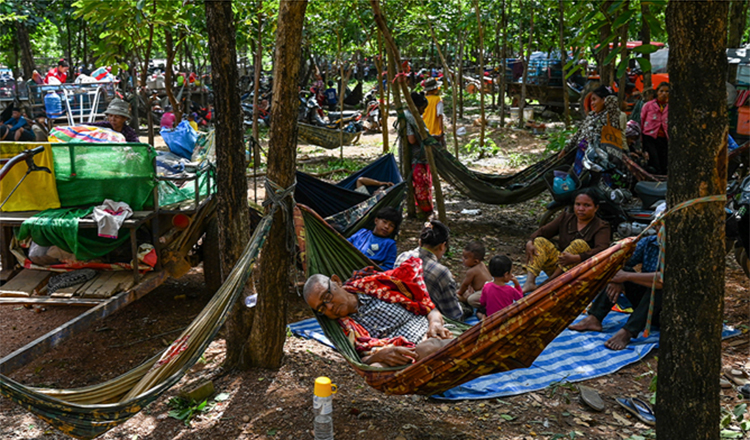
Every peace-loving Cambodian and Thai wake up to read news that could hurt our inner souls and blur our human compassion; news that continues to create hatred, anger, and resentment that eventually dominate our hearts and leave us with deep wounds, to the point that we wonder if our human hearts will ever heal anytime soon.
There are two key sets of questions related to peace and healing.
We constantly wonder when peace can reign and be assured between the two eternal neighbors? Will it be tomorrow? Next week, next month, or next year?
What remedies should heal the wounds of our hearts?
This is a mental exercise that peace-loving Cambodians and Thais practice unconsciously, trying to connect with their innermost souls.
Among many thoughts, here are four elements of thought that may cross their minds as they seek to guide their minds toward peace and healing.
1. Think about families
Cambodia has seven provinces bordering Thailand: Koh Kong, Pursat, Battambang, Pailin, Banteay Meanchey, Oddar Meanchey, and Preah Vihear, stretching over 800 kilometers.
With such a long border, it is inevitable that the two people share many things including “blood”. There are Khmers who are married to Thais and vice-versa. There are “mixed-blood” children who cannot separate or cut their flesh from purely Khmer or Thai.
These are silent groups who want nothing more than peace because if anything happens, they know they will have to kill some of their brothers and sisters, relatives or distant relatives who have mixed blood.
2. Think about friends
Almost every type of professions has the aspect of international cooperation, and cooperation with neighbors would naturally come first.
In any profession, you would have at least one Thai friend.
Think of your friends in Bangkok, Khon Kaen, Chiang Mai, etc. Think of those who attended the same schools in Thailand or abroad. Think of your Thai friends with whom you have formed friendship during your career and studies.
It hurts to see your friends on the other side speaking languages you would have preferred not to hear. And I think your Thai friends would have felt the same way.
3. Think about partners
In Khmer we say, “chounh chit chea cheang chounh ch-gnay” or trade near better than far because firstly it costs more to trade far, and since ancient time, there was a high risk of losing all businesses in case of shipwrecks, robberies or natural disasters in the long-distance businesses.
This remains true today, even though modern technologies have reduced distances, extended the shelf life of agricultural products, and improved connectivity in modern societies.
Nevertheless, trade with one’s neighbors cannot be avoided, especially when sharing a border of more than 800 kilometers.
Geography has made us natural partners for mutual prosperity and benefit.
Beyond trade, Cambodia and Thailand also share multidimensional cooperation. Cambodians and Thais would be hard-pressed to imagine areas or sectors where the two countries do not cooperate with one another before the war happened.
4. Think about humanity
Think about peoples’ lives. All lives matter, Khmer or Thai people’s lives worth the same, Khmer or Thai soldiers’ lives worth the same.
Any narratives that take light the lives of soldiers and peoples should be condemned by both societies.
I don’t have a conclusion to the above discussion but these are elements of thoughts that keep me awake at the intensity of mutual hatred and anger that continues to increase while mistrust deepens.
I still believe there are millions of peace-loving Cambodians and Thais struggling to deal with the anger and grudges that continue to breed a vicious cycle of violence, endless revenge, and bloodshed.
We should all strive to reflect more deeply, in our hearts and souls, on peace and healing amidst the tumult of war. Otherwise, as eternal neighbors, our two nations could not coexist peacefully. And the future of our next generations would be dominated by fears and insecurities.
Sim Vireak is a Cambodian writer and civil servant. He has written articles on various topics related to Cambodia’s political economy, development, and foreign affairs. The opinions expressed are his own.