Vietnam seeks favourable conditions to expand trade ties
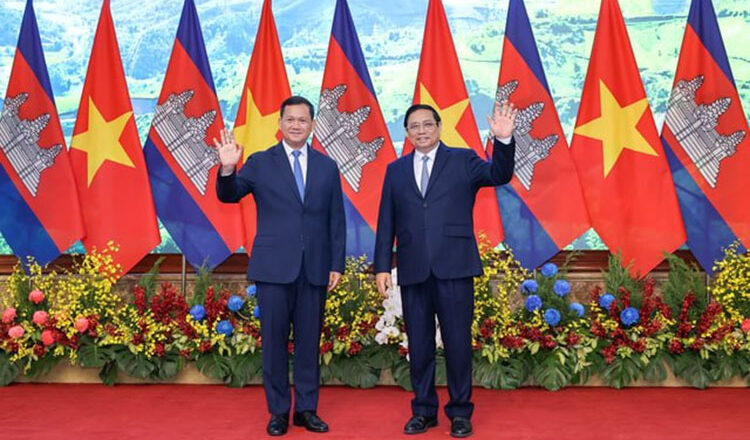 A file photo of Prime Minister Hun Manet (left) along with Prime Minister of Vietnam Pham Minh Chinh during the former’s two-day visit to Vietnam in 2023. Socialist Republic of VietNam
Synopsis: Both sides agree to improve the effectiveness of economic cooperation in the spirit of harmonising benefits for achieving the trade target of $20 billion.
Vietnamese Prime Minister Pham Minh Chinh Friday urged Prime Minister Hun Manet to continue supporting and creating favourable conditions for Vietnamese enterprises to operate stably and expand their investments in the country to quickly raise bilateral trade to the target of $20 billion.
The request was made during a phone call between Vietnamese Prime Minister Pham Minh Chinh and Mr Hun Manet, according to the Vietnam News Agency (VNA).
The two sides agreed to continue to improve the effectiveness of economic cooperation in the spirit of “harmonising benefits, sharing risks, soon achieving the bilateral trade target of $20 billion, promote local connectivity in a practical and effective manner, while developing border gate economy, facilitating cross-border trade and investment and continuing to negotiate and resolve remaining problems in border demarcation and marker planting.
PM Chinh was pleased to note that, after two years in office as head of the Royal Government, Prime Minister Hun Manet has promoted infrastructure development and economic growth, and the lives of the Cambodian people have been increasingly improved.
“PM Chinh requested the Cambodian side to continue to pay attention to and facilitate naturalisation for eligible Vietnamese people, as well as creating conditions for Vietnamese people to stabilise their lives, integrate and make positive contributions to Cambodian society; and for Vietnamese enterprises to operate stably and expand investment in Cambodia,” VNA added.
Speaking to Khmer Times, Chey Tech, a socio-economic researcher, said on Monday that relations between Cambodia and Vietnam have advanced significantly, particularly in 2025. He noted that to date, Vietnam has invested the most among all ASEAN members investing in Cambodia and Vietnam is also Cambodia’s fifth largest investor.
He added that, according to Hun Sen, President of Senate and also President of the Cambodian People’s Party (CPP) said during a meeting with Tô Lâm, General Secretary of the Communist Party of Vietnam (CPV) on Thursday, the trade volume between the two countries in the first seven months of 2025 exceeded $7 billion.
“Cambodia’s exports to Vietnam ranked third among its trading partners, reaching more than $3.8 billion, while imports from Vietnam amounted to around $3.2 billion. Therefore, for the balance of trade between Cambodia and Vietnam, Cambodia exports more to Vietnam than Vietnam imports to Cambodia,” said Tech.
Tech said, “The two countries plan to expand bilateral trade to $20 billion. We have maintained strong cooperation in trade exchanges, including about 28 Cambodian products that can enter Vietnam with zero tariffs. Similarly, some Vietnamese goods are also imported into Cambodia at zero tax rates.”
He further noted that Cambodia mainly exports raw agricultural products to Vietnam, such as cashew nuts, rubber, and rice, while imports from Vietnam consist largely of consumer goods, including steel and machinery.
“Going forward to strengthen the value chain between both countries, I think Cambodia must increase its capacity to export processed and semi-processed products instead of raw products, which generate lower added value. I also encourage Vietnam to invest more in processing industries in Cambodia, such as cashew nuts, rubber, and other agricultural products, as well as in the digital sector,” Tech emphasised.
It may be recalled that Mr Hun Sen and Tô Lâm, General Secretary of the Communist Party of Vietnam (CPV), discussed ways to spur bilateral trade via video conference on August 14.
During the meeting, Senate President Hun Sen emphasised that the robust Cambodia-Vietnam relationship reflects good neighbourliness, traditional friendship, comprehensive cooperation and long-term stability—foundations for promoting economic, trade and investment cooperation across multiple sectors.